
Why Choosing the Right White Label SEO Partner Matters for Your Agency
How to choose a white label seo agency comes down to seven key factors that separate successful partnerships from costly mistakes:
- Verify their expertise through case studies and client results
- Ensure transparent, ethical practices that follow Google guidelines
- Evaluate communication standards with dedicated account management
- Check scalability and flexibility for growing client needs
- Understand pricing structures and your profit potential
- Assess their technical capabilities and tool access
- Plan for seamless collaboration and brand integration
Growing agencies face a common challenge: clients want SEO services, but building an in-house team is expensive and time-consuming. The average SEO specialist costs $60,000 annually, plus benefits, tools, and training. Meanwhile, agencies that outsource SEO see a 20% increase in client retention and can reduce operational costs by up to 30%.
White label SEO offers a smarter path forward. You get expert services under your brand while focusing on what you do best – managing client relationships and growing your business.
The key is finding a true partner, not just a vendor. The wrong choice can damage your reputation and client relationships. The right partner becomes an extension of your team, helping you scale confidently while maintaining quality.
Understanding White Label SEO: Fundamentals for Agency Growth
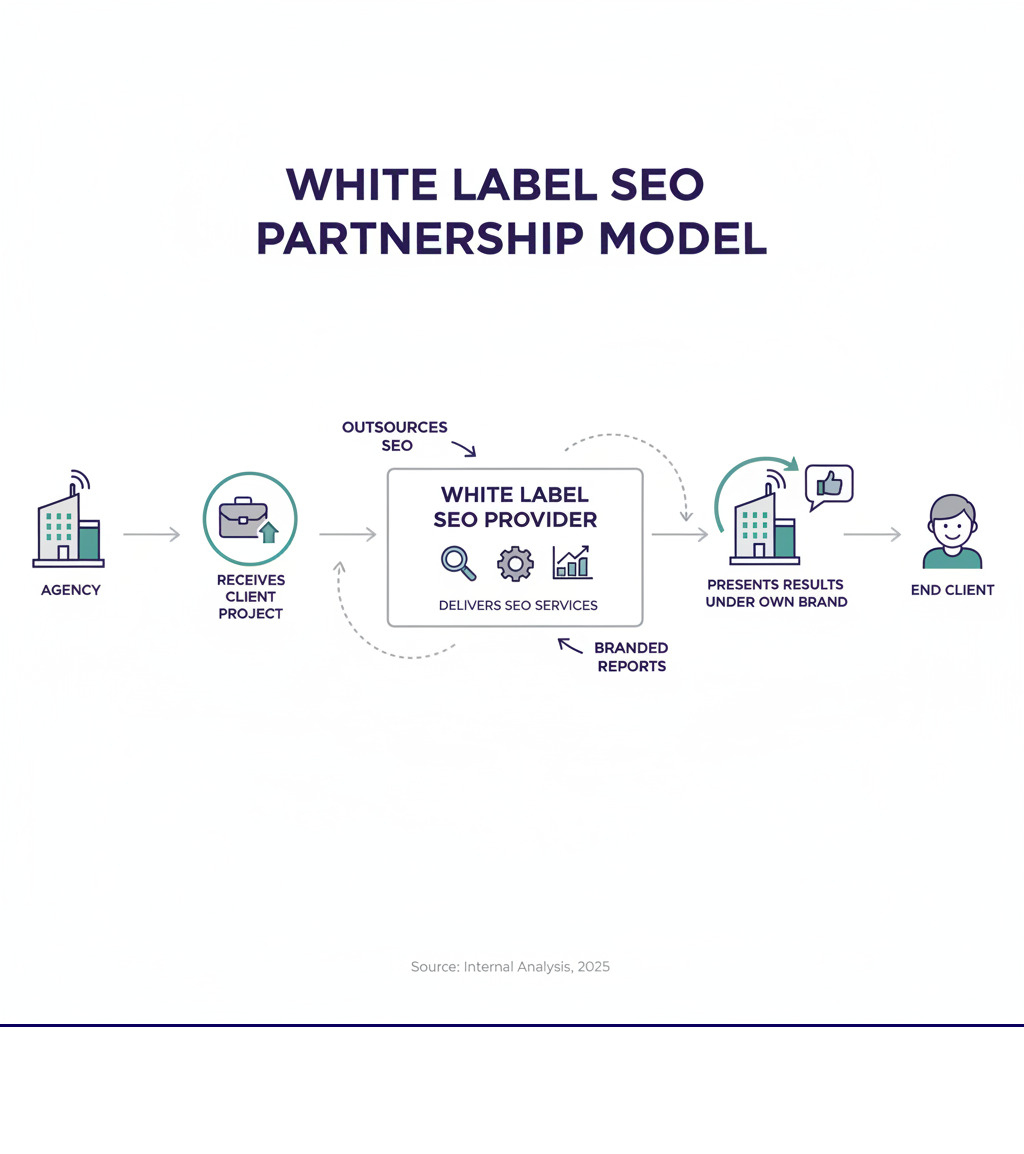
Think of white label SEO as your agency’s secret weapon for growth. It’s a partnership where an experienced SEO provider handles all the technical work behind the scenes, while you present those services under your own brand. Your clients get expert SEO results, and they think it’s all coming from your talented team.
Here’s how the magic happens: A white label SEO provider becomes your invisible partner. They do the heavy lifting – strategy, execution, and detailed reporting – while you focus on what you do best: managing client relationships and growing your business. Your clients receive top-notch SEO services that appear to come directly from your agency.
The process involves three key players working together seamlessly. The white label provider handles all the SEO tasks and creates branded reports. Your agency manages client communication and delivers those reports. The end-client enjoys professional SEO services without ever knowing about the partnership behind the scenes.
Understanding the difference between an SEO reseller and an SEO partner is crucial when you’re figuring out how to choose a white label SEO agency. A reseller simply passes along someone else’s services with minimal involvement. A true partner, however, works closely with your agency, sharing goals and collaborating on strategies. This partnership approach makes the white label provider feel like an extension of your own team.
The benefits of this partnership model are impressive for growing agencies. Building an in-house SEO team is expensive and challenging – good SEO talent is hard to find and harder to keep. White label partnerships offer a smarter alternative.
Agencies working with white label SEO providers typically see remarkable results: operational costs drop by up to 30%, client retention increases by 20%, and profit margins can grow by 25%. These aren’t just numbers – they represent real growth opportunities for your agency.
Beyond the financial wins, white label SEO gives you instant access to a team of specialists. You can scale your service offerings by up to 40% without hiring new employees. This means you can take on more clients and expand into new markets without the headaches of recruitment and training.
To understand how this approach can transform your operations, explore how Outsourced SEO Services to Streamline Your Efforts can benefit your agency.
White label SEO services cover everything your clients need for online success. SEO audits identify exactly what’s holding back a website’s performance, providing clear action steps rather than confusing data dumps. Keyword research – which takes up 36% of most SEO professionals’ time – gets handled by specialists who know how to find the golden opportunities.
On-page and technical SEO optimization ensures websites perform well for both users and search engines. This includes everything from crafting compelling meta descriptions to fixing technical issues that hurt rankings. Contextual link building leverages established relationships to secure high-quality backlinks that boost authority.
Content creation scales with your client demands, providing specialized writers for different industries. Local SEO services, including Google Local Citations and SEO and GMB optimization, help local businesses dominate their markets. Finally, white-labeled reporting delivers professional, branded reports that reinforce your agency’s expertise.
This comprehensive approach means you can offer enterprise-level SEO services without the enterprise-level overhead. Your clients get better results, you get better margins, and everyone wins.
How to Choose a White Label SEO Agency: A 7-Step Vetting Process

When you’re wondering how to choose a white label SEO agency, this decision will shape your agency’s future. The partner you select becomes an invisible extension of your team, directly affecting your reputation and client relationships. A poor choice can damage years of hard work, while the right partner helps you scale with confidence.
Think of this process like hiring a key employee – except this “employee” will handle multiple clients simultaneously. That’s why a thorough vetting process isn’t just smart business; it’s essential protection for everything you’ve built.
Step 1: Verify Their Expertise and Track Record
You wouldn’t hire someone without checking their resume, and the same principle applies here. Start by digging into their case studies – these should tell complete stories, not just showcase pretty numbers. Look for detailed examples that show specific challenges, the strategies used, and measurable results achieved.
Pay special attention to case studies that mirror your clients’ situations. If you work with local restaurants, a partner with e-commerce case studies might not be your best fit. Client testimonials are helpful, but don’t stop at their website. Check independent review platforms like Google Business Profiles and industry-specific sites for unfiltered feedback.
Here’s a reality check: if their own website doesn’t rank well for SEO terms, that’s a red flag. Proven results start with their ability to market themselves effectively. Look for partners with niche specialization in your industry – their deep understanding will translate into better results for your clients.
Step 2: Insist on Transparent and Ethical SEO Practices
This step could save your agency from disaster. Black-hat SEO techniques might promise quick results, but they’re like building a house on sand. When Google catches on (and they will), your clients’ websites could face severe penalties or complete removal from search results.
A trustworthy partner will eagerly explain their methods. They should follow Google’s Webmaster Guidelines religiously and be transparent about every strategy they use. If they’re vague about their link building quality standards or refuse to share their process, walk away.
White-hat practices take longer to show results, but they build lasting success. Your partner should focus on earning high-quality links from relevant, authoritative websites – not participating in link schemes that could backfire spectacularly.
Step 3: Analyze Communication and Reporting Standards
Poor communication kills partnerships faster than bad results. Agencies with dedicated account managers and strong communication see 20% better project outcomes. You need a single point of contact who understands your brand, your clients, and your expectations.
Discuss response times upfront. When a client has an urgent question, you can’t wait three days for an answer. Establish preferred communication channels – whether that’s email, phone calls, or project management tools.
Custom-branded reports should feel like they came directly from your team. But more importantly, these reports need to provide actionable insights, not just data dumps. Numbers without context don’t help anyone make better decisions.
Step 4: Evaluate Scalability and Flexibility
Your agency will grow, and your partner needs to grow with you. Companies leveraging white-label SEO can scale their service offerings by up to 40% without hiring additional staff. But this only works if your partner can handle increased demand without compromising quality.
Look for custom packages rather than rigid, one-size-fits-all solutions. Every client has unique needs, and your partner should adapt accordingly. Flexible contract terms are also important – some providers offer no-contract options that let you test the waters without long-term commitments.
The onboarding process reveals a lot about their organization. Smooth, systematic onboarding for new clients suggests they can handle growth professionally. Chaotic onboarding often predicts future problems.
Step 5: Understand Their Pricing and Value
Here’s the truth about SEO pricing: cheap usually means ineffective. Agencies typically mark up white-label services by 30-50%, with potential for 25% increases in profit margins. But focus on value, not just cost.
Ask about pricing models – whether they offer monthly retainers, project-based pricing, or custom arrangements. Watch out for hidden fees that can erode your margins. Quality providers often include expensive SEO tool costs in their service fees, which can save your agency thousands annually.
Calculate your potential profitability honestly. Factor in your time for client communication and project management. The goal is sustainable growth, not just immediate savings.
Step 6: Assess Their Technical and Tool Stack
SEO requires expensive, sophisticated tools. Premium platforms can cost thousands monthly, putting them out of reach for many agencies. Your white-label partner should provide access to premium SEO tools as part of their service.
Technical SEO capabilities are non-negotiable in today’s landscape. Website speed, mobile optimization, and proper site architecture directly impact rankings. Your partner needs deep technical expertise to handle these complex requirements.
The SEO world changes constantly. Partners who stay current with algorithm changes and adapt their strategies accordingly protect your clients from negative impacts and capitalize on new opportunities.
Step 7: Discuss Collaboration and Integration
The best partnerships feel seamless. Your brand guideline integration should be so thorough that clients never suspect the work comes from outside your agency. This requires detailed communication about your voice, visual identity, and client expectations.
Establish clear review and approval workflows from the start. You should see and approve all work before it reaches your clients. This protects your reputation and ensures quality consistency.
Constructive feedback loops help partnerships improve over time. Regular check-ins, honest discussions about what’s working and what isn’t, and willingness to adapt together build long-term partnerships that benefit everyone involved.
You’re not just buying a service – you’re choosing a partner who will represent your agency to your most important clients. Take the time to get it right.
White Label vs. In-House: A Cost and Control Comparison
When you’re deciding how to choose a white label SEO agency versus building your own team, you’re making a choice that will shape your agency’s future. It’s like choosing between buying a house or renting – both have their place, but the right decision depends on your specific situation and goals.
Let’s be honest: building an in-house SEO team sounds appealing. You get complete control, direct oversight, and the team sits right there in your office. But here’s the reality – over 70% of agencies find it challenging to maintain a dedicated in-house SEO team due to high costs and talent scarcity.
The numbers tell a compelling story. The average SEO specialist earns around $60,000 annually, and that’s before you factor in benefits, training, and the cost of hiring (which can range from $4,000 to $20,000 per new hire). Then there are the premium SEO tools – subscriptions that can easily cost thousands per month. Suddenly, that “controlled” approach starts looking pretty expensive.
White label partnerships offer a completely different equation. Instead of high fixed costs and slow scaling, you get immediate access to a team of specialists for a predictable, project-based investment. It’s like having a senior SEO team on speed dial, without the overhead headaches.
| Factor | In-House SEO | White Label Partner |
|---|---|---|
| Cost | High (salary, benefits, tools, training) | Lower (fixed cost per project/service, no overhead) |
| Control | High (direct management, full oversight) | Indirect (via partner, requires clear communication and trust) |
| Scalability | Slow to scale (hiring, training, infrastructure) | Highly scalable (on-demand expertise, quickly adapts to client volume) |
| Speed to Market | Slower implementation (recruitment, onboarding) | Fast implementation (immediate access to expertise and resources) |
| Expertise Access | Limited to employee’s knowledge and skill set | Access to a team of specialists with diverse, up-to-date knowledge and tools |
Here’s where it gets interesting: control doesn’t have to be an either-or proposition. Yes, an in-house team gives you direct management, but a well-chosen white label partner can offer remarkable control through transparent processes, dedicated account management, and detailed reporting. The key is finding a partner who truly acts as an extension of your team.
Think about scalability for a moment. When you land three new clients in one week (the good problem to have), an in-house team might struggle to keep up. You’d need to hire, train, and hope the new team members work out. With a white label partner, scaling up is as simple as a conversation about increased capacity.
Speed to market is another game-changer. While you’re spending months recruiting and onboarding new team members, your white label partner is already delivering results for your clients. In today’s fast-moving digital landscape, that time advantage can make or break client relationships.
The expertise factor might be the most compelling argument of all. Your in-house SEO specialist might be excellent, but they’re still one person with one perspective. A quality white label provider gives you access to specialists in technical SEO, content creation, link building, and local optimization – all working together on your clients’ projects.
The bottom line? Both approaches have their place, but white label partnerships offer a path to growth that’s both faster and more sustainable for most agencies. You maintain strategic oversight while benefiting from specialized execution, and you can focus your energy on what you do best – building client relationships and growing your business.
Frequently Asked Questions
What are the most important factors when you choose a white label SEO agency?
When you’re looking at how to choose a white label SEO agency, three factors should be at the top of your list. First, transparency is everything. Your partner should be completely open about their methods, willing to walk you through their processes, and never keep you guessing about what they’re doing for your clients.
Second, you need to see proven results through case studies and third-party reviews. Don’t just take their word for it – ask for detailed examples of how they’ve helped other agencies grow. Check independent review platforms to get the real story from other agency owners.
Third, clear communication with a dedicated account manager makes all the difference. You want someone who responds quickly, understands your goals, and provides actionable insights rather than just dumping data on you. A true partner acts as an extension of your team, sharing your vision for client success and helping you achieve it together.
What red flags should I watch out for when choosing a white label SEO agency?
There are several warning signs that should make you run in the opposite direction. Guaranteed #1 rankings are the biggest red flag of all. SEO doesn’t work that way, and anyone promising specific ranking positions is either lying or using dangerous tactics.
Vague or secretive strategies are another major concern. If they can’t clearly explain what they’re doing or seem evasive about their methods, something’s wrong. The same goes for providers who won’t share case studies or client references – what are they hiding?
Poor communication is a partnership killer. If they’re slow to respond during the sales process, imagine how frustrating it’ll be when you’re trying to manage client expectations.
Most importantly, stay far away from any agency using unethical black-hat techniques like keyword stuffing, hidden text, or manipulative link schemes. These tactics might seem tempting for quick results, but they can get your clients’ websites penalized or banned from Google entirely. That’s not just bad for your clients – it’s devastating for your agency’s reputation.
How much should I mark up white label SEO services?
The markup question keeps many agency owners up at night, but there’s actually some flexibility here. Most agencies mark up services by 30-50%, which covers your client management time, strategic oversight, and a healthy profit margin.
However, your markup should reflect the value you’re adding to the relationship. If you’re providing strategic guidance, managing complex client communications, or adding your own expertise on top of the white label services, you can justify higher markups.
Consider your target client’s budget and expectations too. Some agencies successfully charge premium rates because they position themselves as high-end strategic partners rather than just service providers. The key is ensuring your pricing remains competitive while reflecting the quality and results you deliver.
Cheaper isn’t always better in SEO. Your clients are investing in long-term growth, and quality work that drives real results is worth paying for.
Conclusion: Scale Your Agency the Smart Way

When it comes to how to choose a white label SEO agency, this isn’t just another vendor decision – it’s about finding a true partner who will help your agency thrive. The seven-step vetting process we’ve outlined gives you a solid framework to evaluate potential partners, but the real magic happens when you find that perfect match.
The key decision factors boil down to three pillars: transparency in their methods, proven expertise through real results, and clear, consistent communication. A partner who excels in these areas will become an extension of your team, helping you deliver exceptional results while you focus on what you do best – building client relationships and growing your business.
Think about it this way: the right white label SEO partner doesn’t just provide services; they provide peace of mind. You can confidently promise your clients improved rankings and increased organic traffic, knowing you have a skilled team backing you up. This confidence translates into better client relationships, higher retention rates, and ultimately, sustainable growth for your agency.
MDM Marketing understands these challenges because we’ve helped agencies steer them successfully. Our data-driven approach combines technical SEO expertise with compelling content that actually connects with your clients’ audiences. We don’t just deliver reports – we deliver results that make both you and your clients happy.
Every successful agency partnership starts with choosing wisely. Take the time to thoroughly vet your options, ask the tough questions, and trust your instincts. The investment you make in finding the right partner will pay dividends in reduced stress, improved client satisfaction, and accelerated growth.
Ready to see what a true partnership looks like? Explore our Outsourced SEO services and find how we can help you scale your agency the smart way. Your future self – and your clients – will thank you for making the right choice today.
About Jay McCullough
This author hasn't written a bio yet.