
Why Agencies Are Turning to White Label Content Creation
White label content creation is the practice of outsourcing content production to an external provider, then rebranding and selling that content to clients under your agency’s name. The provider remains invisible to your clients, who only see your agency’s branding on the final deliverables.
Quick Answer for White Label Content Creation:
- What it is: Outsourced content that you rebrand as your own work
- Who uses it: Marketing agencies, consultants, and freelancers
- Common types: Blog posts, website copy, social media content, email campaigns
- Key benefit: Scale your services without hiring full-time staff
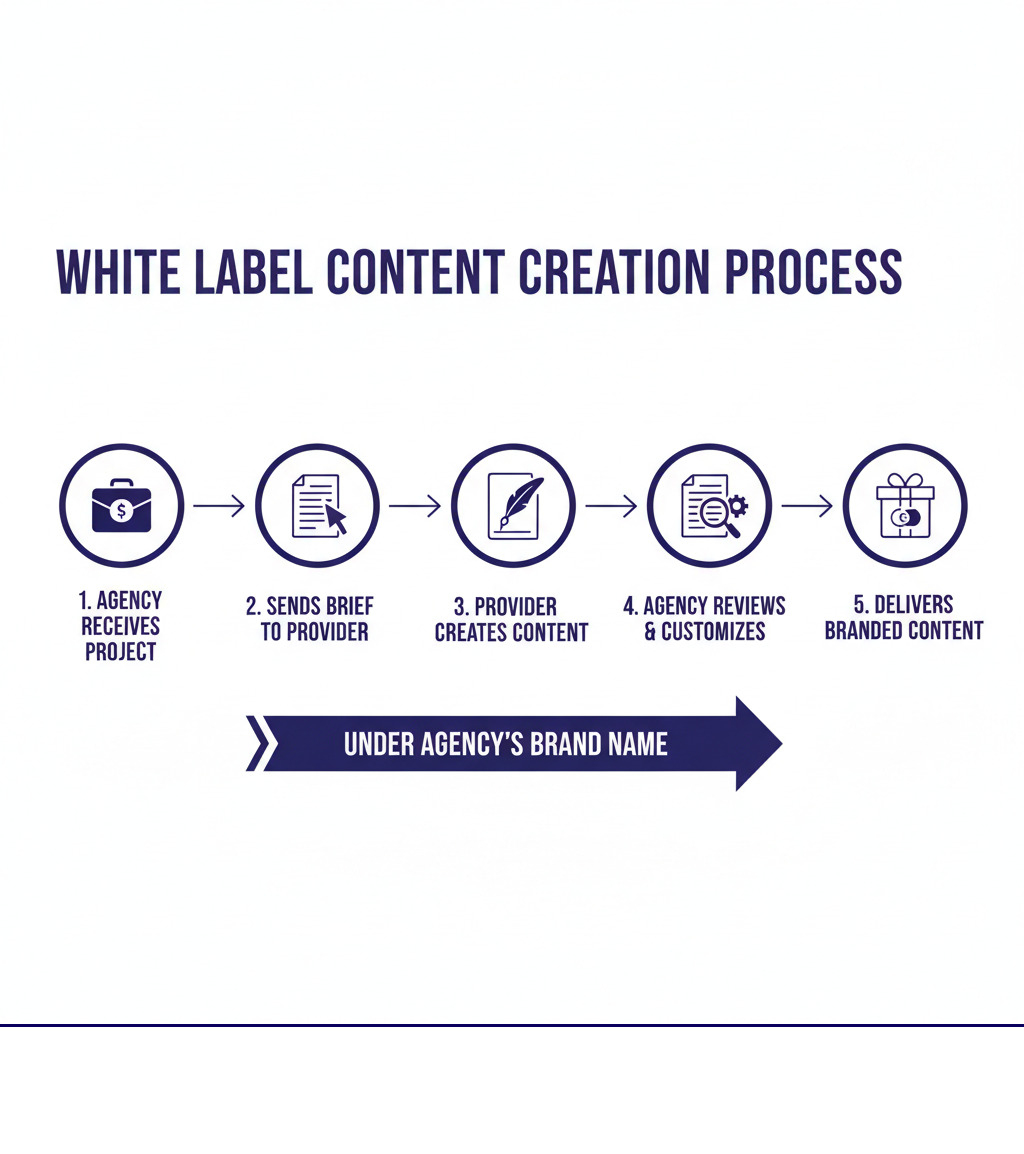
- Process: You brief the provider They create content You review and deliver to clients
- Cost savings: Agencies save 24-40 hours per month on average
As one agency owner put it: “Marketing agencies are usually started by entrepreneurs who are known for ‘doing everything themselves.’ That’s not scalable with a marketing agency. Delegation is crucial to growth and success.”
The white-label content market is projected to expand at over 15% annually. Agencies using these services report impressive results: a 287% average increase in organic traffic and a 246% boost in top 3 keyword rankings.
Many agency owners find their teams are maxed out, quality is slipping, or they’re turning down work due to a lack of capacity. White label content creation solves these problems by providing access to professional writers and strategists without the overhead of hiring full-time staff.
The model is simple: you maintain control over strategy and client relationships while your partner handles the heavy lifting of content production. Your clients get high-quality content, and you get healthier profit margins.
The Strategic Advantages of White Labeling for Agencies
When your agency lands new clients but your content team is already at capacity, white label content creation becomes your secret weapon for sustainable growth.
The biggest game-changer is scalability. Instead of a lengthy hiring process, you can expand your content capacity almost instantly. Your white label partner acts as an extension of your team, ready to handle increased demand without the usual growing pains.
As one agency owner puts it: “Marketing agencies are usually started by entrepreneurs who are known for ‘doing everything themselves.’ That’s not scalable with a marketing agency. Delegation is crucial to growth and success.” Trying to do everything in-house is a recipe for burnout.
Cost-effectiveness is another major win. Hiring a full-time writer involves salary, benefits, software licenses, and management overhead. White label services eliminate most of these fixed expenses, giving you access to a team of specialists on a variable-cost basis.
The time savings can transform your business. Agencies typically save 24-40 hours per month by outsourcing content. That’s time you can redirect toward strategy, client relationships, or business development. As one consultant emphasizes: “Proper resourcing fosters a culture of balance, collaboration, and well-being within our team, allowing us to sustain a healthy pace of work and achieve our goals effectively.”
This allows you to focus on your core competencies. If your team excels at technical SEO or PPC, let them do what they do best while your partner handles the content. For more insights, see how to Streamline Your SEO Efforts Using Outsourced Services.
With access to expertise across various niches, you’re not limited by your team’s current skill set. This leads to increased service offerings and better client retention. When you can confidently say “yes” to any content request, you become indispensable. The results speak for themselves: agencies using white label services report an average 287% increase in organic traffic and a 246% boost in top 3 keyword rankings.
When to Consider Outsourcing
Consider outsourcing when you see these warning signs:
- Team burnout: Your writers are consistently overworked, and quality is slipping.
- Maxed-out capacity: Your team has no room for new projects, limiting growth.
- Turning down work: You’re saying “no” to ideal clients due to a lack of bandwidth.
- Declining quality: The pressure to produce more content is hurting the final product.
- Excessive management: You spend too much time recruiting, training, and managing writers.
- Service expansion: You want to offer new content types without hiring full-time specialists.

White label providers are built to handle these scenarios, offering quick turnarounds and the flexibility to scale based on your needs.
The Financial Impact and Profitability
The financial case for white label content creation is compelling. An in-house team comes with fixed costs like salaries, benefits, and overhead. White label services operate on a variable cost structure, allowing you to scale expenses with revenue.
This model significantly improves profit margins. You purchase content at a wholesale rate and mark it up for your clients, turning content from a cost center into a profitable service. Common pricing models include monthly subscriptions, per-piece pricing, and retainers, offering flexibility to match your agency’s cash flow and client needs.
The Blueprint for Effective White Label Content Creation
A successful white label content creation system requires more than just finding a writer—it’s about building a seamless workflow. Your white label partner should function as an invisible extension of your agency, one your clients never see but always benefit from.
Success lies in the details. With a defined workflow, clear communication, and the right project management tools, content flows smoothly from concept to delivery. Your role becomes more strategic: you conduct the orchestra while your partner handles the technical execution.

Most agencies handle strategy internally—keyword research, audience analysis, and content goals. The white label partner then produces the content within that strategic framework. This collaboration is powered by project management tools that eliminate confusing email chains and provide a clear view of each project’s status.
Providing Effective Briefs and Feedback
The quality of your content brief determines the quality of the final product. A great brief is a clear roadmap for the writer. The best briefs include:
- Target Audience: Go beyond demographics to describe their pain points, motivations, and needs.
- Tone and Voice: Be crystal clear. Are you formal and corporate or playful and casual? Provide examples of your client’s desired voice.
- SEO Keywords: List primary and secondary keywords, but also explain the searcher’s intent behind them.
- Goals and Objectives: State the purpose of the piece. Is it to drive traffic, generate leads, or build thought leadership? This dictates the structure and call to action.
When you receive a draft, provide specific, constructive feedback. Point out what works and what needs adjustment. The more detailed your feedback is early on, the less revision you’ll need later. For more on this, explore Mastering Effective Web Marketing Strategies for Modern Needs.
Ensuring Quality and Customizing Content
Quality control is where your agency’s expertise shines. You aren’t just a middleman; you add layers of value that make the content exceptional.
Start with a solid internal review process. Your team should edit and proofread every piece, checking for brand alignment, factual accuracy, and overall quality. This ensures the content meets your high standards before it ever reaches the client.
The real magic is in customizing content with your agency’s unique insights. Take the well-written foundation from your partner and make it unmistakably your client’s by:
- Adding proprietary data from their analytics.
- Weaving in client-specific examples and case studies.
- Adjusting the messaging to perfectly match their brand voice.
- Applying your technical SEO knowledge to optimize meta descriptions and internal linking.
Your clients pay for your expertise, not just words on a page. By thoughtfully customizing white label content, you deliver a final product that no other agency can replicate. See how these strategies work in our Use Cases.
Choosing a Partner and Exploring Service Types
Finding the right white label content creation partner is crucial for your agency’s reputation and your clients’ success. The vetting process should be thorough. When evaluating potential partners, look for:
- Portfolio Quality: Examine the depth and versatility of their work across different industries and content formats.
- Industry Experience: A great partner can quickly grasp complex topics and translate them into engaging content, even in a new niche.
- Testimonials and References: See what other agencies say about their reliability, communication, and ability to drive results.
- Communication and Processes: A reliable partner will have clear workflows, respond promptly, and be transparent about their capabilities.
- Quality Control: Ask about their writer vetting process, editing standards, and how they ensure originality and factual accuracy.
The right partner should feel like a natural extension of your team, consistently delivering work you’re proud to put your name on. To see how we approach collaboration, explore our Why Us page.
Types of White Label Content Services
White label services offer immense versatility, allowing you to become a full-service content powerhouse. Common offerings include:
- Blog Posts and Articles: SEO-driven content to build authority and drive organic traffic.
- Website Copy: Compelling copy for homepages, service pages, and landing pages designed to convert visitors.
- Case Studies: In-depth success stories that build trust and showcase real-world results.
- White Papers and Ebooks: Long-form content to establish thought leadership and generate leads.
- Social Media Content: Platform-specific posts and captions to maintain an engaging online presence.
- Email Campaigns: Newsletters and automated sequences to nurture leads and drive conversions.
- Video Scripts: Professionally written scripts for explainer videos, promotional content, and educational series.
- Specialized Content: This can include e-commerce product descriptions, press releases, and data-driven infographics.
Partnering with a versatile provider allows you to scale your offerings as your clients’ needs evolve. To complement your content, you might also explore a Contextual Link Building Service.
Measuring Success: Tracking Performance and ROI
When investing in white label content creation, clients expect measurable results. Tracking the right metrics is key to demonstrating value and strengthening client relationships. Think of it as turning your content into a performance report card.
Organic traffic growth is often the first metric to grab attention. Agencies using white label services report an impressive 287% average increase in organic traffic—a number that speaks for itself.
Keyword rankings tell another compelling story. Showing a client’s website climb to the top of Google’s search results creates powerful “wow” moments. The data shows a 246% average increase in top 3 keyword rankings for agencies leveraging professional content services.
Beyond traffic, focus on metrics that show business impact, such as conversion rates, lead generation, and engagement metrics like time on page. As one digital marketing expert puts it: “Changing raw data into actionable insights is so critical, and by the time you get all of the work done, it can feel like you’re scrambling when it comes to reporting.” A solid tracking system is invaluable.
MDM Marketing’s data-driven approach aligns with this need for transparent tracking. When you show clients how their content investment is paying off, you become an essential partner. Learn more about making your efforts measurable with Strategic Marketing Services Visibility.
Key Metrics to Showcase Value
Focus on these key metrics to transform raw numbers into compelling success stories for your clients.

- Lead Generation: This is where content proves its worth in dollars and cents. Tying specific content pieces to new leads makes the ROI of white label content creation crystal clear.
- Customer Acquisition Cost (CAC) Reduction: Quality content attracts qualified prospects organically, reducing reliance on paid advertising and lowering the cost to acquire a customer.
- Return on Investment (ROI): The ultimate metric. Show clients that for every dollar spent on content, they are generating a significant return in revenue.
- Conversion Rate Improvements: Track increases in newsletter signups, demo requests, or purchases to prove your content is attracting the right visitors who take action.
Presenting these metrics on a dashboard helps clients see their success story unfold. When you consistently deliver measurable results, you transform from a service provider into a trusted growth partner.
Frequently Asked Questions about White Label Content
When agencies first explore white label content creation, a few common questions arise. Here are the answers to help you move forward with confidence.
What is the difference between white label content and ghostwriting?
While similar, they serve different functions. Ghostwriting creates content for a specific individual, mimicking their personal voice and style for their byline. It’s a one-to-one service.
White label content is designed for agencies to rebrand and resell to multiple clients. It’s built for scalability and adapting to various brand voices, not just a single author’s. It’s a one-to-many business solution.
Is using white label content legal and ethical?
Yes, it is a completely legal and ethical business practice common across many industries. From a legal standpoint, contracts transfer full ownership rights to your agency. You are free to rebrand the content as your own.
Ethically, you are purchasing a business service and delivering a finished product to your client. Your clients are paying for results and your strategic oversight, not for you to personally write every word. This is a standard B2B service model.
How do I maintain my agency’s unique voice with outsourced content?
Maintaining your client’s unique voice is entirely achievable with the right process. The key is to treat your white label provider as a partner, not just a content factory.
- Provide detailed brand guidelines and briefs: Give your writers a clear roadmap that defines the audience, tone, messaging, and goals for every piece of content.
- Choose an adaptable partner: Work with a provider that shows a genuine interest in learning your clients’ unique brand voices.
- Perform a final review: Your agency’s final touch is crucial. This is your opportunity to add proprietary data, client-specific examples, and unique strategic insights that only you possess.
By layering your expertise onto a professionally written foundation, you ensure every piece of content perfectly reflects your agency’s quality and your client’s brand.
Conclusion
White label content creation is more than a trend; it’s an essential strategy for modern marketing agencies seeking to grow without overwhelming their teams or budgets. It transforms common challenges—like capacity limits, budget constraints, and team burnout—into opportunities for scalable growth.
The statistics on traffic and ranking improvements show the model’s effectiveness, but the real value lies in the operational freedom it provides. This approach is powerful because it allows you to focus on your core strengths—be it technical SEO or strategy—while a trusted partner handles the execution.
This flexibility is key. You maintain complete control over client relationships and strategy, while your white label partner acts as an invisible extension of your team, scaling up or down on demand. It’s a content department without the overhead.
MDM Marketing understands this balance. Our data-driven approach to SEO and copywriting combines the technical expertise you need with content that connects with audiences and drives business results.
The future belongs to agencies that can adapt and scale efficiently. Those who accept smart outsourcing will leap over the capacity walls that limit in-house-only teams. The model’s success is proven; the only question is if you’re ready to leverage it for your agency’s growth.
Ready to transform how your agency handles content and open up new levels of growth? Explore our Outsourced SEO services to scale your agency and find how the right partnership can change everything.
About Jay McCullough
This author hasn't written a bio yet.