
Why AI Email Campaigns Are Changing Marketing Results
AI email campaigns use artificial intelligence to automate, personalize, and optimize email marketing based on real customer data and behavior—rather than static lists and guesswork.
Quick answer: AI email campaigns differ from traditional email marketing in three key ways:
| Traditional Email Marketing | AI Email Campaigns |
|---|---|
| Static subscriber lists | Dynamic, behavior-based segmentation |
| Manual A/B testing | Automated optimization and predictive analytics |
| Generic batch sends | 1:1 personalization at scale |
| Fixed send schedules | Predictive send-time optimization |
| Manual content creation | AI-assisted copywriting and subject lines |
If you’re a marketing leader tired of emails that get ignored, you’re not alone. Seven out of 10 marketers already use AI in some capacity—and email is one of the top channels where it’s making a difference.
Here’s what’s changed: AI doesn’t just help you write faster. It watches how your customers behave, predicts when they’re most likely to open an email, and suggests content that actually converts. HubSpot’s demand generation team achieved an 82% higher conversion rate, 30% better open rate, and 50% lift in click-throughs using AI for email nurturing.
But here’s the catch—AI can also make your emails sound robotic, generic, or downright creepy if you don’t use it right.
The difference between emails that convert and emails that get deleted often comes down to how you balance automation with human oversight. AI handles the repetitive tasks—segmentation, timing, list cleanup—so you can focus on strategy and brand voice.
In this guide, we’ll show you exactly how to set up AI email campaigns that feel personal, avoid common pitfalls like over-automation, and measure real ROI through CRM-connected analytics.
Understanding AI Email Campaigns and How They Differ from Traditional Marketing
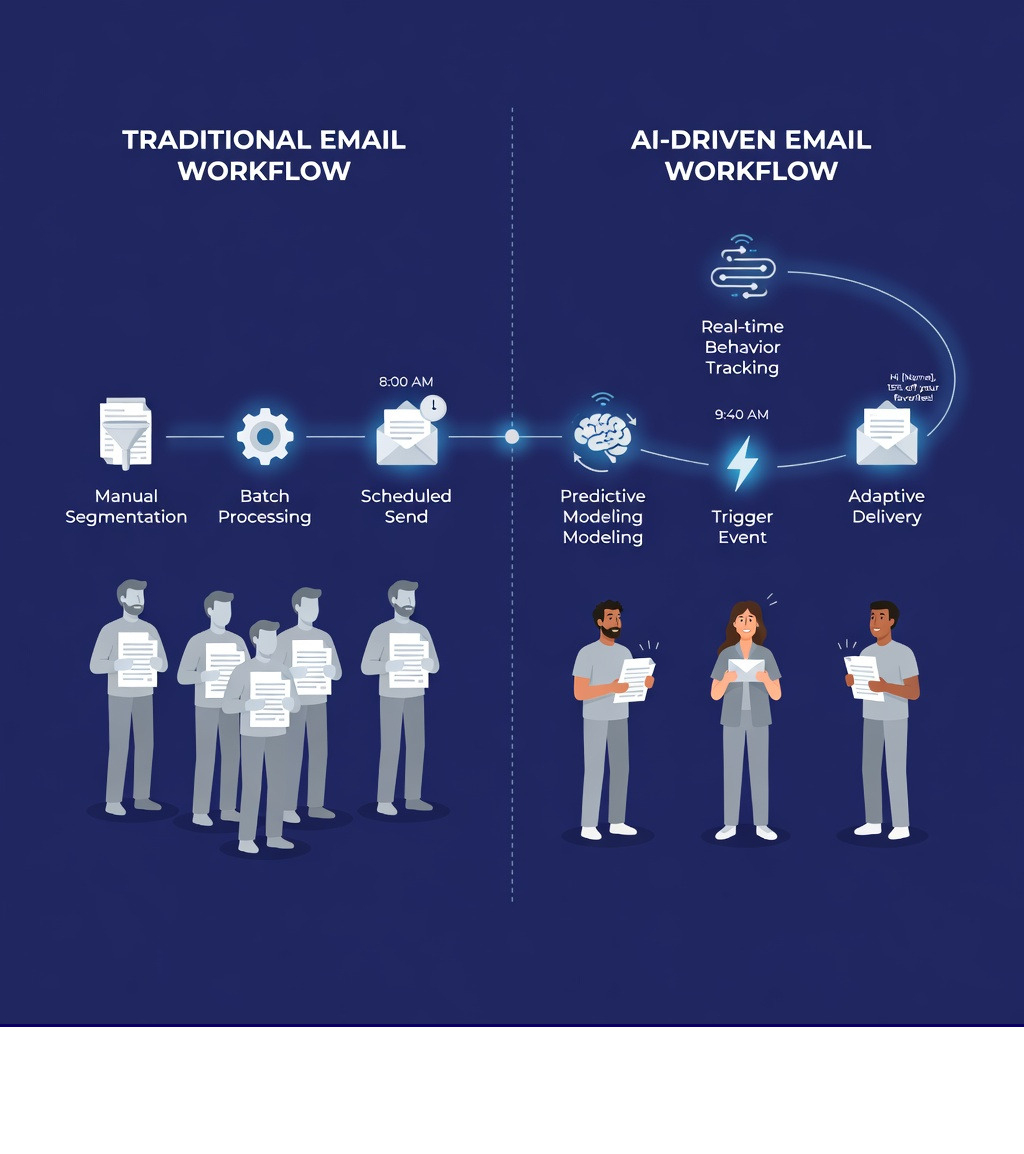
To understand AI email campaigns, one must first look at what they are replacing. Traditional email marketing relies heavily on “batch and blast” methods. A marketer creates one email, selects a static list of subscribers, and hits send. While this reaches many people, it often lacks relevance.
AI shifts the focus from the sender’s schedule to the recipient’s behavior. According to Statista AI Marketing Data, the majority of marketers are moving away from third-party data exchanges toward first-party data assets. This shift is powered by AI, which can analyze massive amounts of customer information—such as website visits, past purchases, and email engagement—to trigger messages at the exact moment they are most useful.
For a business in Canton, OH, this might mean the difference between sending a generic monthly newsletter and sending a perfectly timed follow-up to a local lead who just viewed a specific service page. This level of precision is why many brands are turning to Professional Email Marketing Services to bridge the gap between basic automation and true intelligence.
Why AI Email Campaigns Outperform Static Lists
The primary reason AI email campaigns outperform static lists is adaptability. A static list is a snapshot in time; it doesn’t account for a customer’s changing interests or life stages. AI-driven campaigns, however, use “adaptive” logic.
If a subscriber stops opening emails, the AI detects the drop in engagement and might automatically trigger a re-engagement sequence or reduce the frequency of sends to protect the sender’s reputation. Conversely, if a lead shows high intent—like clicking a pricing link multiple times—the AI can move them into a “sales acceleration” workflow instantly. This real-time optimization ensures that the marketing remains a “supportive friend” rather than an uninvited guest in the inbox.
The Role of CRM Integration in AI Email Campaigns
AI is only as smart as the data it can access. This is where CRM integration becomes the backbone of successful AI email campaigns. When your email tool is connected to your CRM (Customer Relationship Management) system, the AI can see the full story of a customer:
- What deal stage are they in?
- Have they spoken to a sales representative recently?
- What specific files or resources have they downloaded?
Tools like HubSpot emphasize that this integration creates a feedback loop. Every email sent, opened, or ignored becomes a new data point that helps the AI refine its next move. Furthermore, maintaining HubSpot AI Trust and Privacy standards ensures that this data usage remains compliant and secure, which is vital for building long-term customer trust.
The Core Benefits of Personalization, Automation, and Optimization
The ultimate goal of using AI in email is to achieve “hyper-personalization” at scale. In the past, personalizing an email for 10,000 people meant using a “First Name” tag and hoping for the best. Today, AI allows for 1:1 customization that spans content, timing, and offers.
| Feature | Traditional Automation | AI-Driven Optimization |
|---|---|---|
| Segmentation | Manual rules (e.g., “All leads in Ohio”) | Smart clustering based on behavior and intent |
| Timing | Fixed (e.g., “Tuesday at 10 AM”) | Predictive send-time for each individual |
| Content | One-size-fits-all templates | Dynamic blocks custom to recipient interests |
| List Health | Manual cleanup every 6 months | Real-time invalid email detection and removal |
By leveraging these capabilities, businesses can ensure their Data-driven SEO Strategies and email efforts work in tandem to capture and nurture high-quality traffic.
Smart Segmentation and List Hygiene
One of the most tedious tasks in marketing is managing list health. AI excels here by performing “list cleanup” automatically. It can check email addresses against server lists to identify invalid or low-quality accounts before you even hit send. This prevents high bounce rates that could land your emails in the spam folder.
Beyond hygiene, “smart segmentation” uses math and data analytics to group users by what they actually do. Instead of just knowing a contact is a “Manufacturer,” the AI might segment them as a “High-intent Manufacturer who prefers video content over whitepapers.” This allows for much more effective targeting.
Predictive Analytics and Send-Time Optimization
Have you ever wondered if your emails are getting buried because you sent them at the wrong time? Predictive send-time optimization solves this by learning the individual habits of every person on your list.
Some people check their work email at 7:00 AM over coffee, while others catch up on personal mail at 9:00 PM. AI tracks these patterns and “holds” the email until the recipient’s peak open time. This single feature often results in an immediate lift in open rates without changing a single word of the copy. As noted in the Salesforce Guide to AI in Email, this predictive approach shifts marketing from being reactive to being proactive.
How AI Improves Content Creation and Performance
Perhaps the most visible impact of AI is in the writing process. Generative AI tools can now assist in everything from brainstorming subject lines to drafting entire newsletters. However, the secret to “not sounding like a bot” lies in how you guide the AI.
When AI is used correctly, it acts as a force multiplier for your creative team. It can take a core message and spin it into five different variations for A/B testing, or translate a campaign into 25+ languages while maintaining the general intent. This efficiency is a core component of modern content marketing services.
Generating High-Converting Subject Lines
The subject line is the most important part of your email—if it isn’t opened, the rest doesn’t matter. AI can analyze years of engagement data to suggest subject lines that trigger emotional resonance or a sense of urgency.
Instead of guessing which words work, you can use AI to:
- Optimize character counts for mobile devices (keeping them under 40 characters for the best results).
- Test different tones, from professional to humorous.
- Avoid “spammy” language that triggers filters.
AI-Assisted Copywriting and Dynamic Content
Modern AI tools allow for “modular content.” This means you can build a library of pre-approved intros, product blurbs, and calls-to-action (CTAs). The AI then assembles these pieces into a unique email for each recipient based on their lifecycle stage.
For example, a new subscriber might see a “Welcome” intro, while a long-time customer receives a “Loyalty Reward” blurb in the same campaign. This ensures the content is always relevant. Platforms providing HubSpot AI Content Suggestions allow marketers to generate these variations instantly, ensuring that the brand voice remains consistent across thousands of unique messages.
Best Practices for Setting Up AI-Powered Workflows and Prompts
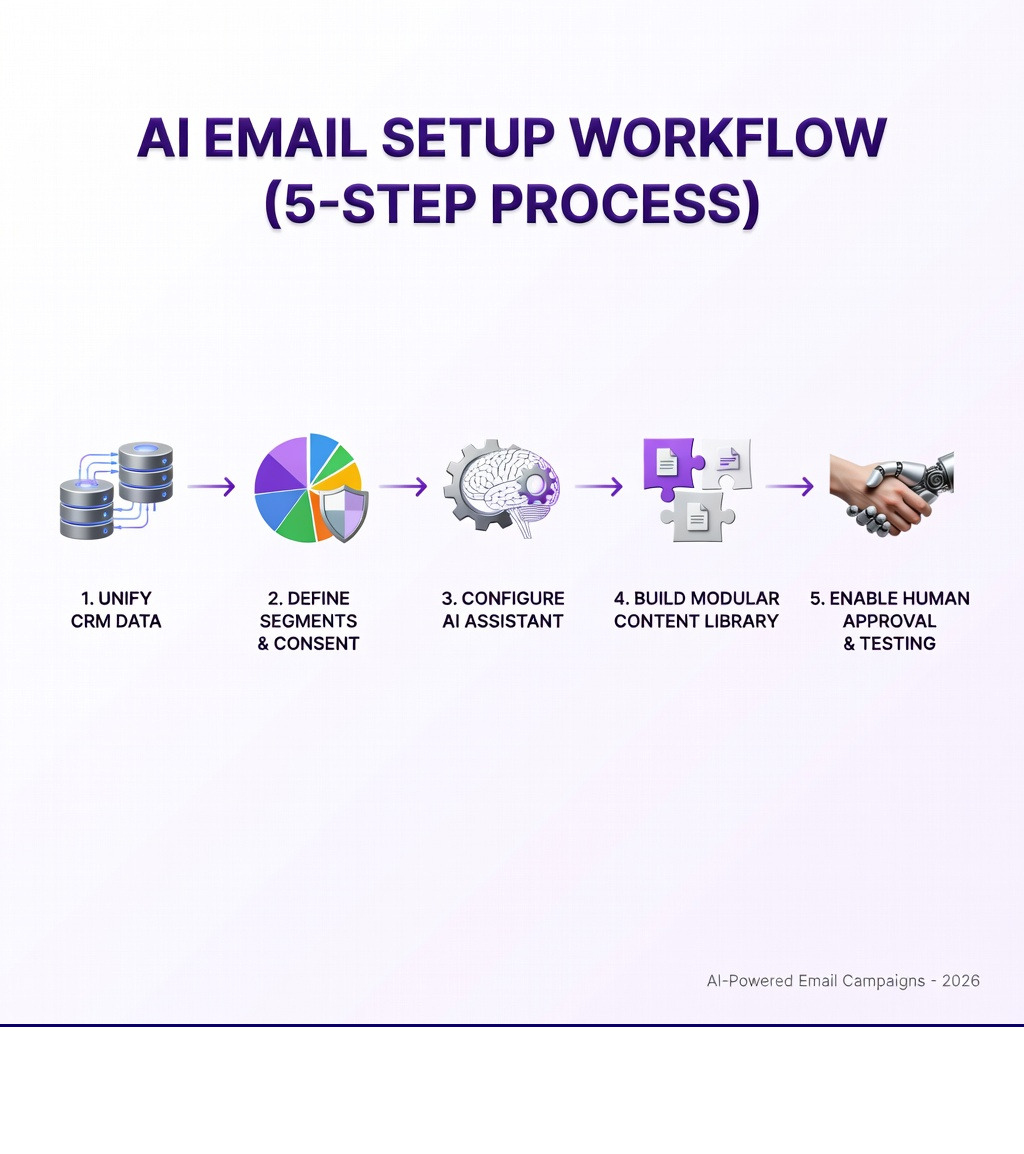
Setting up AI email campaigns requires a shift in how you think about “campaign building.” You are no longer just a writer; you are an orchestrator. Success depends on the quality of the instructions (prompts) you give the AI and the data you feed it.
If you are unsure where to start, you can always Contact MDM Marketing for a strategy session on how to integrate these workflows into your existing business model.
Crafting Effective AI Prompts
To get the best output, your prompts should follow a structured framework. A generic prompt like “Write a sales email” will yield a generic, robotic result. Instead, use a framework that includes:
- Goal: What is the specific action you want them to take? (e.g., “Book a demo”).
- Segment: Who is the audience? (e.g., “Small business owners in Canton, OH”).
- Context: What do they already know about us? (e.g., “They downloaded our SEO checklist last week”).
- Constraints: What should the AI avoid? (e.g., “Do not use overly aggressive sales language or mentions of limited-time offers”).
- Voice: What is the brand personality? (e.g., “Helpful, expert, and warm”).
Human-in-the-Loop Governance
The most successful AI email campaigns always include a “human-in-the-loop.” This means that while AI generates the drafts and suggests the timing, a human marketer performs the final quality assurance (QA).
Editorial standards are essential. You must verify that the AI hasn’t “hallucinated” (made up) facts or statistics. You should also check for brand drift—ensuring that the AI hasn’t become too formal or too casual over time. A simple QA checklist can prevent embarrassing mistakes and keep your communications feeling human.
Limitations, Guardrails, and Measuring ROI
Despite its power, AI is not a “set it and forget it” solution. There are real pitfalls that can damage your brand if ignored. One major concern is over-personalization. Just because you know a customer was browsing your site at 2:00 AM doesn’t mean you should mention it in an email. That’s not helpful; it’s creepy.

Marketers must also stay strictly compliant with regulations like the CAN-SPAM Act. This includes providing clear opt-out instructions and ensuring that your AI isn’t sending emails at an intrusive frequency.
Common Pitfalls and How to Avoid Them
- Data Silos: If your AI only sees email data but not purchase data, its recommendations will be shallow. Ensure your CRM is the “single source of truth.”
- Generic Output: If you don’t provide a brand voice brief, the AI will default to the “average” of all internet writing, which sounds boring and robotic.
- Lack of Oversight: Never let an AI send a high-stakes email (like a contract or a sensitive customer service response) without a human review.
Measuring Performance and Revenue Impact
The real beauty of AI email campaigns is their measurability. Because they are often connected directly to a CRM, you can track more than just “opens” and “clicks.” You can track revenue.
By using attribution modeling, you can see exactly how much pipeline was generated by a specific AI-driven nurture sequence. You can measure the “click-through lift” provided by AI subject lines and iterate quickly. If a certain type of content isn’t performing, the AI can suggest alternatives based on what is working for other segments.
The Future of AI in Email Marketing (2-5 Year Outlook)
Looking ahead, the next few years will see AI move from being a “writing assistant” to an “autonomous agent.” We are entering an era of true 1:1 hyper-personalization at scale.
One significant change on the horizon is the impact of mobile AI updates. For instance, Apple’s iOS 18 introduces AI-powered inbox summarization and categorization. This means your emails might be summarized by an AI before a human ever reads them. Marketers will need to optimize their copy not just for humans, but for the “AI readers” that act as gatekeepers.
Furthermore, the industry is moving toward a world where AI agents can handle the entire campaign process—from lead generation to final messaging—based on high-level business goals. To stay ahead, businesses should explore AI integration services now to build the necessary data foundations.
Frequently Asked Questions about AI Email Marketing
What is the difference between AI and traditional email automation?
Traditional automation follows “If/Then” rules set by a human (e.g., “If they sign up, send Email A”). AI uses machine learning to make its own decisions based on data (e.g., “This person usually buys on Fridays, so I will send the discount code on Friday morning”).
How do I keep AI-generated emails from sounding robotic?
The key is a strong “Brand Voice” guide and specific prompts. Tell the AI to use short sentences, avoid jargon, and include a conversational tone. Most importantly, always have a human editor review the copy for “heart” and empathy.
Is AI email marketing compliant with privacy regulations like GDPR?
Yes, as long as you are using consented, first-party data. AI actually helps with compliance by automating the removal of inactive users and ensuring that you are only messaging people who have shown a genuine interest in your brand.
Conclusion
AI email campaigns represent the biggest shift in digital communication since the invention of the smartphone. By moving away from static lists and toward dynamic, data-driven interactions, businesses can finally deliver the relevance that consumers crave.
At MDM Marketing, we specialize in helping businesses in Canton, OH, and beyond steer this new landscape. Our methodology combines deep discovery with precise AI implementation to ensure your marketing drives measurable, sustainable growth. Whether you are looking to scale your paid acquisition or transform your online presence through smarter email, we are here to help.
Ready to see how intelligent automation can increase your ROI? Transform your online presence today with a partner who understands the data behind the click.
About Jay McCullough
This author hasn't written a bio yet.