
What is Automated Keyword Research and Why Does It Matter?
Automated keyword research is the process of using AI-powered tools and platforms to find, analyze, and organize keywords at scale—without the manual grunt work of spreadsheets and endless Google searches. Instead of spending hours pulling data and guessing search intent, automation handles research, metrics analysis, competitor tracking, and keyword clustering in minutes, freeing you to focus on strategy and content creation.
Key benefits of automated keyword research:
- Speed: Generate thousands of keyword suggestions in seconds instead of hours
- Accuracy: Access real-time search volume, difficulty scores, and CPC data from reliable sources
- Scale: Analyze competitor keywords and content gaps across entire domains automatically
- Intelligence: AI identifies search intent, semantic relationships, and content opportunities you’d miss manually
- Efficiency: Reduce keyword research time by 60-70% while uncovering more opportunities
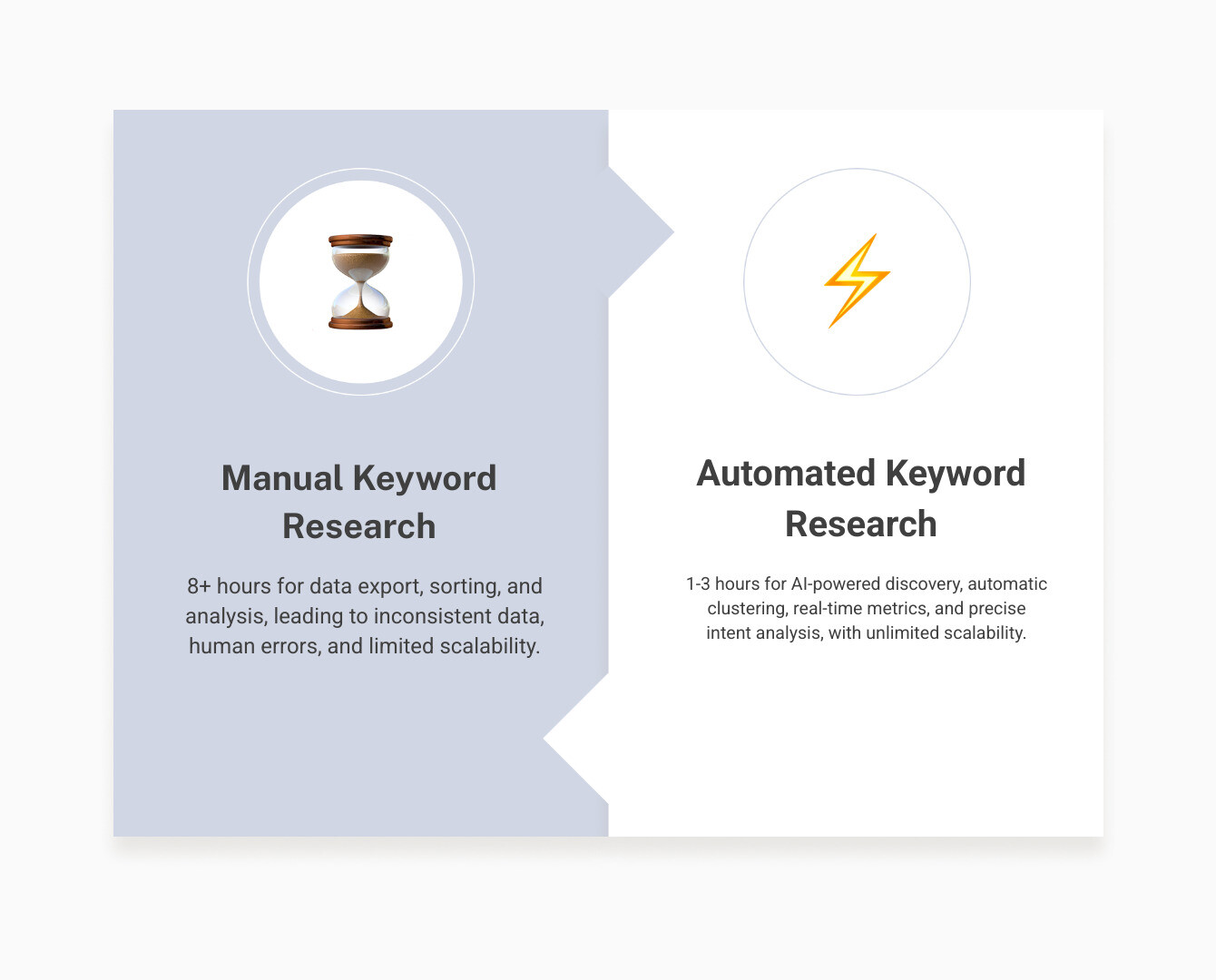
I turned a blind eye to AI and automation at first. But after testing these tools, I went from spending 8 hours on keyword research and content creation to just 3 hours for the same workflow. That’s not a minor improvement—it’s a complete change of how SEO gets done.
The Problem with Manual Keyword Research
Manual keyword research creates major productivity drains for marketers. Thorough keyword research and integration can consume hours or days.
You export data from multiple tools. You sort through messy spreadsheets. You try to color-code keywords by intent. You manually check search volumes one by one. You guess at keyword difficulty based on gut feeling.
The hidden costs are real:
- Time consumption: Hours spent on repetitive data collection tasks
- Inconsistent data: Different tools provide conflicting metrics
- Human error: Missed opportunities, typos, and incorrect categorizations
- Scaling problems: Manual processes break down when targeting hundreds or thousands of keywords
- Algorithm changes: Struggling to adapt quickly enough to search engine updates
When studying competitor keyword strategies, humans can only process so much information. For companies producing lots of content, maintaining consistent keyword usage across all materials becomes nearly impossible manually.
The Automated Solution: A Paradigm Shift
Automated keyword research isn’t just faster—it’s smarter.
AI agents transform the workflow by:
- Scanning massive amounts of online content like websites, competitor pages, and forums in minutes
- Clustering keywords into practical categories (primary, secondary, long-tail, question-based)
- Analyzing language context to understand true search intent at scale
- Continuously tracking search trends and updating strategies based on current data
- Generating content outlines with keywords already optimally placed
This dynamic approach helps you stay ahead of changing search patterns. Modern search engines use sophisticated AI like BERT and RankBrain to understand pages. Your keyword research needs to match that sophistication.
The shift moves you from rigid keyword strings to fluid concepts, topics, and intent. It’s not about stuffing exact-match phrases anymore—it’s about building topical authority and answering real user questions.
Learn more about our strategic SEO services that leverage automated research for sustainable growth.
How Keyword Automation Works: The Tech Behind the Magic
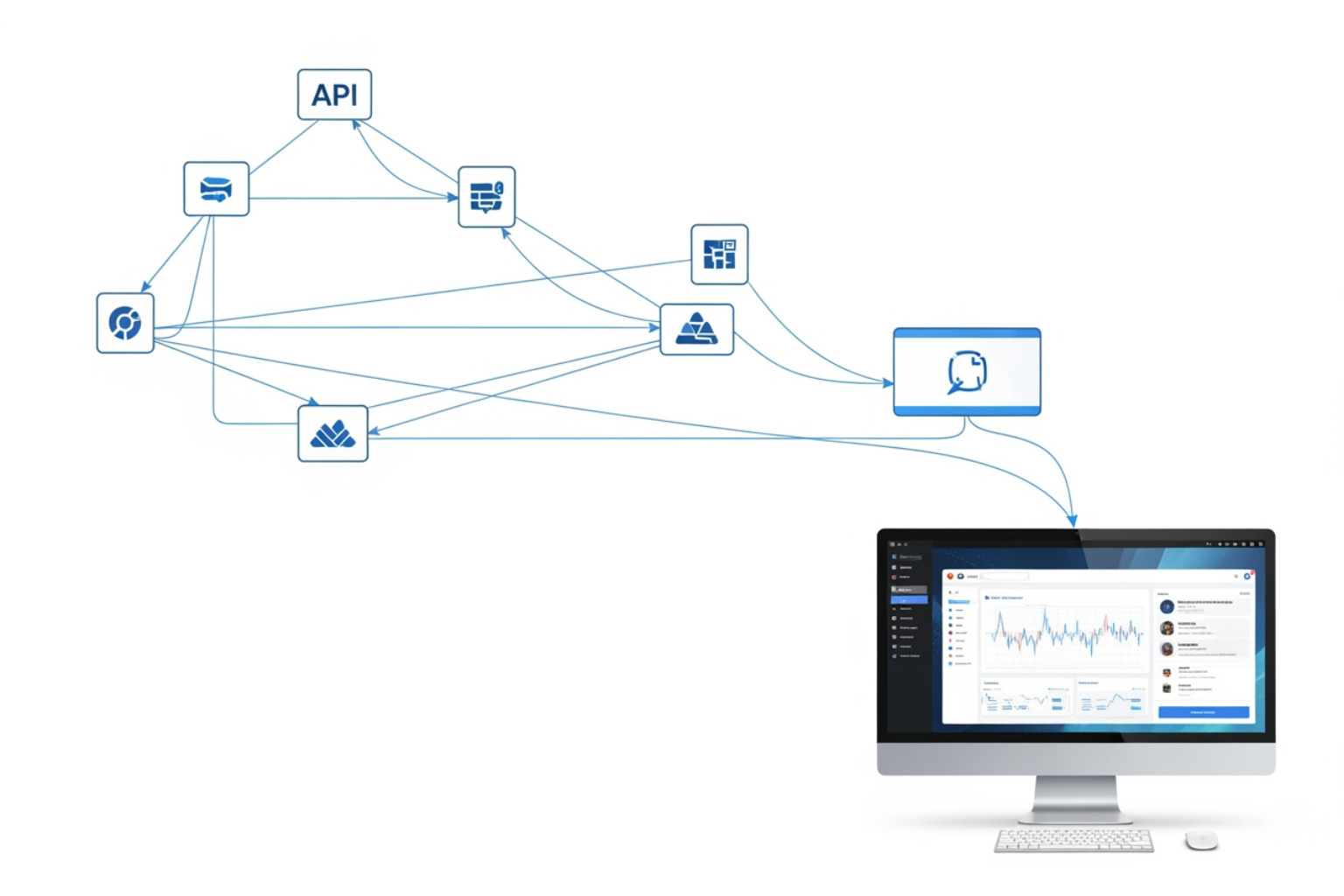
Automated keyword research isn’t magic, but the technology behind it sure feels that way. At its heart, automation uses artificial intelligence and data analytics to do what humans simply can’t—process massive amounts of information instantly and spot patterns we’d never see on our own.
Think of it as having a team of research assistants who never sleep, never make typos, and can analyze thousands of search queries in the time it takes you to finish your coffee.
The foundation starts with data APIs—the digital pipelines that connect your tools to search engines, analytics platforms, and competitor websites. These APIs pull real-time information like search volumes, cost-per-click data, and ranking positions. Instead of manually checking this data one keyword at a time, automation grabs it all at once.
Then artificial intelligence and machine learning models take over. These systems have been trained on billions of search queries and web pages. They recognize patterns in how people search, predict which keywords are gaining traction, and understand the subtle differences between similar terms. This is where automation moves from “faster” to “smarter.”
Natural Language Processing (NLP) is the breakthrough that makes modern keyword research so powerful. NLP allows machines to understand language the way humans do—including context, meaning, and intent. It’s why automated tools can tell the difference between someone searching “apple” for the fruit versus the tech company, or understand that “best running shoes” and “top sneakers for jogging” are really asking the same question.
Finally, data analytics platforms turn all this raw information into something you can actually use. They create dashboards that show you which keywords matter most, organize them into logical groups, and highlight opportunities you should jump on first.
The Role of AI Agents and LLMs
The newest generation of keyword automation uses AI agents and Large Language Models (LLMs)—the same technology powering many popular AI tools. This is where things get really interesting.
AI agents act like digital assistants that can handle complex, multi-step tasks without constant supervision. Tell them to research a topic, and they’ll generate hundreds of keyword variations, analyze competitor content, identify content gaps, and organize everything into a logical structure—all while you’re working on something else.
LLMs bring a level of understanding that older tools couldn’t match. They excel at contextual analysis, meaning they don’t just look at keywords in isolation. They understand how search queries relate to real user needs and how keywords should fit naturally into content. This solves the old problem of awkward, forced keyword placement that made content sound robotic.
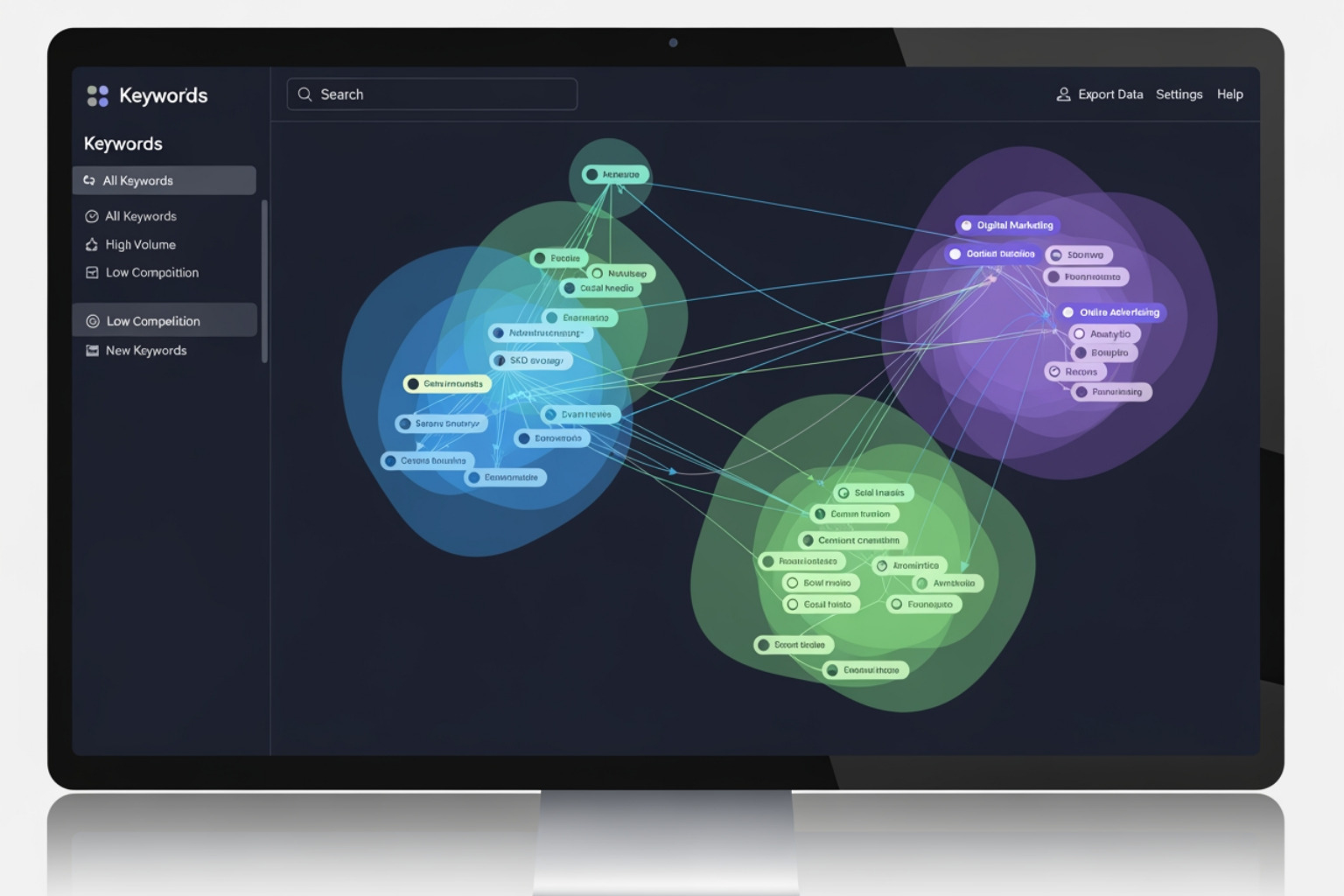
These models also map semantic relationships between terms. They know that “content marketing strategy” connects to “blog post ideas,” “editorial calendar,” and “audience engagement”—even though those exact words don’t appear in the original phrase. This helps you build topic clusters that establish your expertise across an entire subject area, not just individual keywords.
Want to write about email marketing? An AI agent can instantly generate related questions your audience is asking, identify subtopics worth covering, and suggest long-tail variations you’d never think of manually. Then it can create a content brief with keywords already mapped to the right sections.
The best part? These AI agents track trends continuously. When search patterns shift or new questions start trending, your keyword strategy updates automatically. Since Google uses AI in its own search algorithms, using AI in your research isn’t just helpful—it’s becoming essential to stay competitive. For an overview of how Google applies AI in Search, see How Google uses AI in Search.
Key Metrics and Data Points Uncovered
Automated tools don’t just find keywords. They reveal the full story behind each one, giving you the data you need to make smart decisions.
Search volume shows how many people are actually looking for a term each month. A keyword with 10,000 monthly searches obviously has more traffic potential than one with 100. But volume alone doesn’t tell the whole story.
Keyword difficulty scores estimate how hard it’ll be to rank on the first page. These scores analyze the authority and backlink profiles of pages already ranking. A high-volume keyword with sky-high difficulty might not be worth chasing if you’re just starting out.
Cost-per-click (CPC) data comes from paid advertising, but it’s valuable even if you’re focused on organic search. High CPC usually signals strong commercial intent—people searching these terms are ready to buy. Low CPC might mean informational searches where users aren’t ready to make a decision yet.
Speaking of intent, search intent analysis is probably the most important metric automation uncovers. Modern tools use NLP to classify whether someone is looking for information, trying to find a specific website, researching products, or ready to make a purchase. Match your content to the wrong intent, and you’ll get traffic that bounces immediately.
Trend data shows how keyword popularity changes over time. Some terms surge seasonally. Others are gradually declining. Some are brand new and growing fast. Spotting these patterns helps you create content at exactly the right moment.
Finally, automated tools identify SERP features—those special elements like featured snippets, “People Also Ask” boxes, and image carousels that appear in search results. Knowing which features show up for your target keywords opens up additional ways to capture visibility beyond standard blue links.
When you combine all these metrics, you get a complete picture of not just what people are searching for, but why they’re searching and how you can best meet their needs.
A Practical Guide to Automated Keyword Research
You know the theory. Now let’s talk about actually doing it.
Integrating automated keyword research into your daily workflow isn’t complicated, but it does require some thoughtful planning. The payoff? You’ll make smarter, faster decisions backed by real data instead of hunches. No more wondering if you’re targeting the right keywords or missing golden opportunities hiding in plain sight.
When you use automation to pull keywords, topic clusters, and semantic relationships from the content already winning in your industry, everything changes. Your content strategy becomes sharper. Your SEO gets more effective. And honestly, the whole process becomes less stressful. If you’ve been thinking about ways to streamline your SEO efforts using outsourced services, automation is a foundational piece of that puzzle.
Step 1: Choosing Your Automated Toolkit
The tool landscape can feel overwhelming. There are dozens of options, each promising to revolutionize your keyword research. But here’s the truth: the best tool is the one that fits your workflow, integrates with your existing systems, and delivers accurate data you can actually use.
You’ll encounter three main categories of tools. All-in-one SEO suites bring everything under one roof—keyword research, rank tracking, site audits, and competitor analysis. They’re convenient and comprehensive, perfect if you want a single platform for your entire SEO operation. The downside? They can be pricey and sometimes offer more features than you actually need.
Then there are AI agent builders and no-code platforms. These are the new kids on the block, letting you create custom workflows without writing a single line of code. They often integrate with Large Language Models for sophisticated semantic analysis and can be custom to your exact process. They’re incredibly flexible but might require some learning upfront.
Finally, data APIs are for those who want to build their own solutions or integrate keyword data directly into existing systems. They provide raw access to search volume, keyword suggestions, and SERP data. You get maximum control and customization, but you’ll need some technical know-how to make them sing.
When you’re evaluating options, focus on a few key factors. Data accuracy matters more than anything else—bad data leads to bad decisions. Check if the tool offers LLM integration for advanced semantic analysis and intent detection. Look for no-code interfaces if you want your team to use it without constant technical support. And think about tool integration—can it talk to your content management system, analytics platform, or project management tools?
Step 2: Finding Content Gaps and Competitor Insights
Here’s where automation really flexes its muscles. While you could manually analyze competitor websites and try to spot gaps in your content, it would take weeks. Automated tools do it in minutes.
Competitor analysis through automation means feeding the tool your competitor’s domain and watching it extract every keyword they rank for, every piece of content they’ve published, and every topic they’re covering. You get a complete picture of their strategy without spending hours clicking through their site.
SERP analysis takes this further by examining the actual search results for your target keywords. The tools identify patterns in what’s ranking—content length, structure, topics covered, and even the sentiment of the language used. This gives you a blueprint for what search engines reward.
The real gold is in content gap identification. Automation compares your content against competitors and shows you exactly what topics and keywords they’re ranking for that you’re not. These aren’t just random keywords—they’re proven opportunities where your competitors are already winning traffic that could be yours.
Keyword gap analysis drills even deeper, revealing specific search terms where competitors dominate while you’re nowhere to be found. It’s like having a map showing exactly where your weaknesses are and what to fix first. This strategic insight is invaluable, especially when combined with other growth tactics like building quality backlinks for SEO growth.
Step 3: Integrating Automation into Your Content Workflow
The real magic happens when automated keyword research becomes part of your everyday content process, not a separate task you do once in a while.
Start with content planning. Instead of brainstorming topics in a vacuum, use automated tools to generate data-backed topic ideas based on actual search demand and content gaps. Your editorial calendar suddenly becomes a strategic weapon instead of a guessing game.
Topic ideation gets boostd when AI agents can expand a single seed keyword into hundreds of related questions, subtopics, and long-tail variations. You’ll never run out of content ideas again, and every idea comes with built-in search volume data.
For content optimization, automation can analyze your draft content and suggest where to naturally integrate keywords, which related terms to include, and whether you’re matching search intent. No more awkward keyword stuffing or wondering if you’ve covered a topic thoroughly enough.
Performance tracking becomes proactive instead of reactive. Automated systems monitor your rankings continuously and alert you when something drops. Content decay detection identifies older pieces that are losing traffic, giving you a chance to refresh and reclaim those rankings before they disappear completely.
This integrated approach works beautifully alongside comprehensive content marketing services that understand how keyword research, content creation, and distribution all fit together.
About Jay McCullough
This author hasn't written a bio yet.