
Why Bad Customer Experience Examples Cost You More Than You Think
Bad customer experience examples are more common than most businesses realize — and the damage they cause is very real.
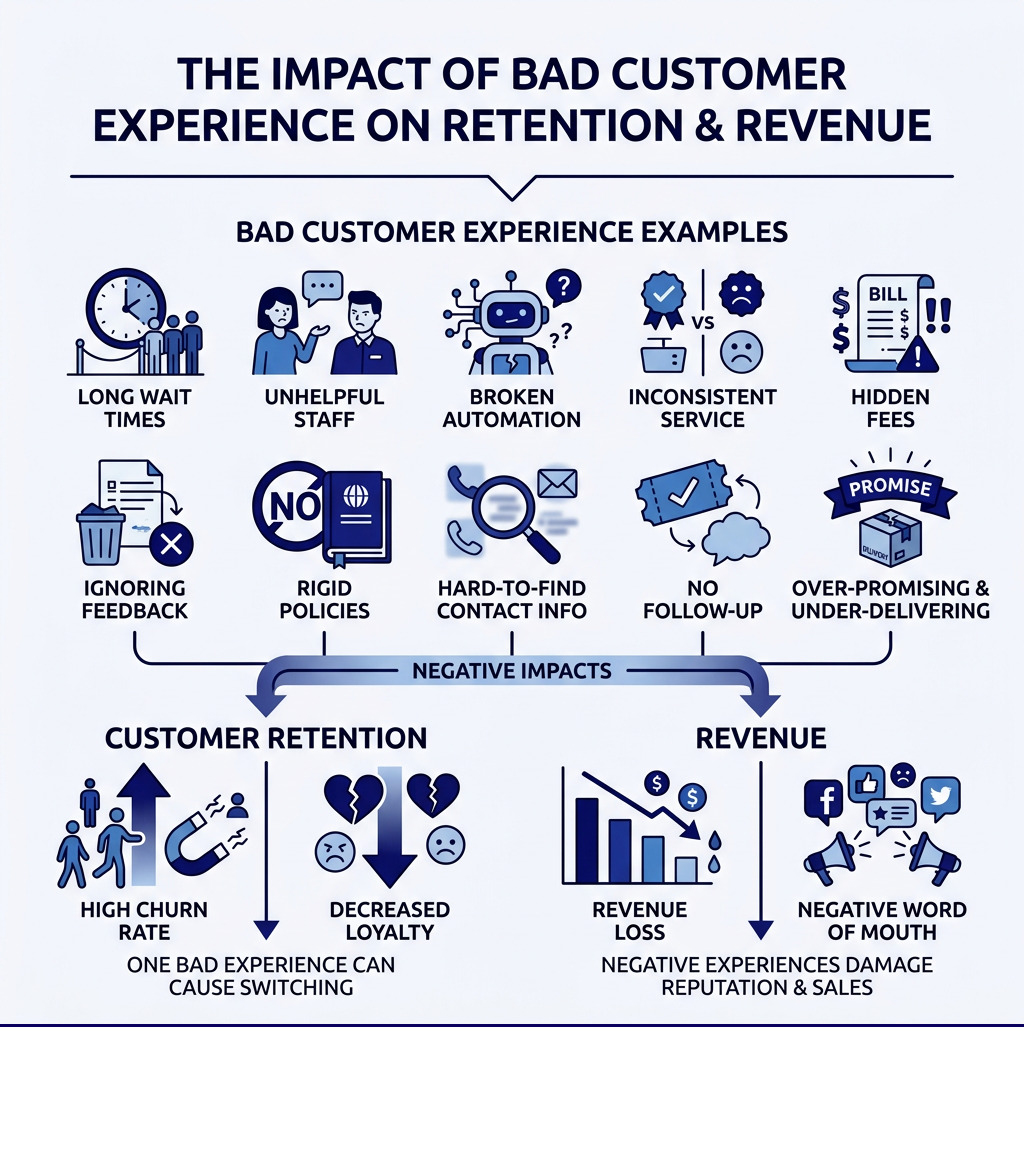
Here are the most common ones to watch for:
- Long wait times — customers hate being left on hold or in a queue with no updates
- Unhelpful or rude staff — agents who show no empathy or dismiss complaints
- Broken automation — chatbots that loop endlessly without solving anything
- Inconsistent service — different quality depending on the channel or agent
- Hidden fees — surprise charges that erode trust instantly
- Ignoring feedback — collecting reviews but never acting on them
- Rigid policies — no exceptions, even when the situation clearly calls for one
- Hard-to-find contact info — making customers hunt just to reach support
- No follow-up — resolving an issue and then going completely silent
- Over-promising and under-delivering — setting expectations you can’t meet
Any of these sound familiar? They should. Most businesses are guilty of at least a few.
The stakes are high. Roughly half of all customers say they’ll switch to a competitor after just one bad experience. That’s not a typo. One bad interaction can undo months of brand-building.
And it’s not just about losing a single customer. Negative experiences spread fast — through reviews, social media, and word of mouth. The ripple effect on your reputation and revenue can be significant.
The good news? Every one of these problems is fixable. This article walks you through the most common bad customer experience examples, what causes them, and exactly how to turn things around.
The High Price of Poor Service
When a business fails to meet expectations, the financial fallout is rarely a slap on the wrist. It’s more like a sledgehammer to the bottom line. Research shows that 58% of customers will pay more for better customer service. If you aren’t providing that top-tier care, you aren’t just losing customers; you’re leaving money on the table.
The reality of customer churn is even more sobering. According to industry data, 73% of customers will switch to a competitor after multiple bad experiences. When acquiring a new customer costs 5 to 25 times more than keeping an existing one, churn is a silent profit killer.
Think about it this way: if it costs you $200 in marketing to bring in one new client, losing ten clients a month because of poor service means you’re flushing $24,000 a year down the drain just to stay in the same place.
Bad service also creates a toxic cycle inside your company. When customers are frustrated, your front-line employees take the heat. This leads to high stress, employee burnout, and eventually, a “loss of top talent.” When your best people leave because they’re tired of apologizing for broken systems, your service quality drops even further.
| Metric | Good Customer Experience | Bad Customer Experience |
|---|---|---|
| Revenue Growth | 5.7x higher than competitors | Stagnant or declining |
| Customer Retention | 10x more profitable | High churn (50% leave after 1 fail) |
| Marketing Costs | Lower (word-of-mouth) | Higher (replacing lost leads) |
| Employee Engagement | 20% increase | High turnover and burnout |
15 Bad Customer Experience Examples to Avoid

To fix the problem, you have to know what it looks like. Here are 15 of the most frequent bad customer experience examples that drive people straight into the arms of your competitors.
1. Long Wait Times
This is the heavyweight champion of bad service. About 51% of consumers cite long waiting times as the primary cause of a negative experience. Whether it’s a 40-minute hold on the phone or a three-day wait for an email reply, silence tells the customer their time isn’t valuable.
2. Unhelpful or Rude Staff
Nothing kills a brand faster than an agent who treats a customer like an interruption. Negative tones, poor attitudes, or dismissive body language in person can turn a loyal fan into a vocal critic in seconds.
3. Lack of Empathy
Customers don’t just want a fix; they want to be heard. When a representative sticks strictly to a script and fails to acknowledge the customer’s frustration, it creates a cold, robotic interaction. Two-thirds of consumers now expect brands to act with empathy.
4. Rigid and Inflexible Policies
“I’m sorry, that’s just our policy.” Those eight words can end a relationship. While rules are necessary, failing to make exceptions for obvious errors or unique situations makes a company look like it values its handbook more than its human customers.
5. Poor Product Knowledge
There is nothing more frustrating than knowing more about a product than the person selling it. Roughly 83% of shoppers believe they have more expertise than store associates. When staff can’t answer basic questions, trust evaporates.
6. Hidden Fees and Unexpected Charges
Transparency is the bedrock of trust. When a customer gets to the final checkout screen and sees “processing fees” or “service charges” that weren’t mentioned earlier, they feel tricked. This is a leading cause of cart abandonment.
7. Broken or Looping Automation
We’ve all been trapped in “chatbot jail.” This happens when an automated system can’t understand a complex request and keeps repeating the same menu options. Technology should assist humans, not act as a “medieval barrier” to reaching them.
8. Inconsistent Branding and Service
If your social media is fun and helpful, but your phone support is cold and clinical, customers get “vertigo.” They don’t know which version of your brand to trust. Consistency across all channels is vital for online reputation building.
9. Difficult Cancellation Processes
Some companies make it incredibly easy to sign up but require a Herculean effort to leave. Forcing customers to call a specific “retention” line and wait on hold for an hour to cancel a subscription is a “dark pattern” that leaves a permanent bad taste in their mouth.
10. Ignoring Feedback
If you send out surveys but never change your behavior based on the results, customers notice. Ignoring negative reviews or suggestions signals that you don’t actually care about the user experience—you just want the data.
11. Privacy Breaches and Sensitivity Fails
Loudly announcing a customer’s declined card in a crowded store or mishandling sensitive data is a major breach of trust. Privacy should always be handled with the utmost discretion.
12. Poor Communication Skills
Using industry jargon that the average person doesn’t understand or providing vague, confusing explanations for delays makes customers feel alienated. Clear, simple language is always better.
13. Lack of Follow-Up
A problem isn’t “solved” just because the ticket is closed. Failing to check back in and ensure the customer is satisfied with the resolution is a missed opportunity to turn a negative into a positive.
14. Impersonal and Generic Interactions
“Dear Customer” is a red flag. In an age where 81% of people prefer a personalized experience, using one-size-fits-all scripts makes people feel like just another number in your database.
15. Hard-to-Find Contact Information
If a customer has to click through five pages of “FAQs” just to find a phone number or email address, they already feel like you’re hiding from them. Transparency starts with being reachable.
Learning from the Giants

Even the world’s biggest companies stumble. When they do, the world watches. These bad customer experience examples from well-known brands offer a masterclass in what not to do.
Lessons from Famous Bad Customer Experience Examples
One of the most famous examples involved a major telecommunications company and a viral recording of a cancellation call. A customer tried to end his service, but the representative spent nearly 20 minutes refusing to take “no” for an answer, demanding reasons for the cancellation. The recording was shared millions of times, cementing the brand’s reputation for being difficult to work with.
Another example comes from the automotive world. When a high-tech vehicle experienced a safety issue in an international market, the company blamed a vague “battery module issue” without providing specifics. This lack of transparency destroyed trust during a critical safety crisis.
In the airline industry, lost luggage is a common headache, but it becomes a “nightmare” when communication fails. One traveler spent two months chasing a bag across multiple handling agents because the airline’s internal systems didn’t talk to each other. By the time the bag was found, the customer had already decided never to fly with that airline again.
Finally, we see failures in fulfillment. A tech giant once sent a high-end desktop to a customer, but it was damaged in transit. Instead of notifying the customer and sending a replacement, the company initiated a return without consent and refused to honor the original sale price for a reorder. This “process over people” approach is a surefire way to lose high-value clients.
Social Media Fails as Bad Customer Experience Examples
Social media is a double-edged sword. It allows for instant connection, but it also amplifies mistakes. For instance, a major tech brand once posted a promotional tweet that was auto-tagged as being sent “via iPhone”—the product of their biggest competitor. It made the brand look hypocritical and disconnected.
Then there are “tone-deaf” posts. A sports team once used a civil rights quote to celebrate a game victory, which the public saw as incredibly insensitive. Similarly, a marine park tried to use a Q&A hashtag to improve their image, but the campaign was “hijacked” by activists who flooded the feed with criticism about animal welfare.
If you’re worried about your online presence, it might be time to look into social media services that can help you navigate these digital minefields.
How to Fix Common Service Pitfalls

Turning a bad experience around isn’t magic—it’s strategy. Here is how businesses can move from “terrible” to “top-tier.”
- Empower Your Employees: The best service happens when front-line staff have the power to solve problems on the spot without asking three managers for permission.
- Invest in Training: Emotional intelligence and active listening should be at the core of your onboarding. Staff who sell with product knowledge move 87% more than those who don’t.
- Use “Smart” Technology: AI chatbots are great for simple questions, but they must have an “escape hatch” to a human agent for complex issues.
- Adopt Omnichannel Support: Ensure that if a customer starts a conversation on chat, your phone agent can see that history. This prevents the “repeat your story” frustration.
- Personalize Everything: Use your data to remember names, purchase history, and preferences. It makes the customer feel like a partner, not a transaction.
- Close the Feedback Loop: When someone leaves a negative review, reach out. A sincere apology and a rapid resolution can turn a critic into a “superfan.”
For businesses looking to build authority and reach, specialized SEO services can ensure that when people search for your brand, they find positive, helpful content rather than a list of complaints. Part of that strategy often involves link building, which helps boost the visibility of your best customer-facing pages.
Frequently Asked Questions about CX
What defines a bad customer experience?
A bad customer experience is any interaction that fails to meet a client’s expectations. It usually manifests as a feeling of being neglected, undervalued, or irritated. Whether it’s a rude comment, a long wait, or a broken product, the core issue is a “gap” between what the brand promised and what it actually delivered.
How does poor service impact business revenue?
Poor service hits the wallet in three ways:
- Churn: Customers leave for competitors.
- Acquisition: You have to spend more on ads to replace the people you lost.
- Reputation: Negative word-of-mouth prevents new customers from ever trying you in the first place. Brands with outstanding CX generate 5.7 times more revenue than those that ignore it.
What are the quickest ways to fix a negative customer interaction?
The “Triple-A” approach works best:
- Acknowledge: Listen to the complaint without interrupting.
- Apologize: Give a sincere, human apology (not a scripted one).
- Act: Fix the problem immediately or provide a clear timeline for the resolution. Following up a few days later to make sure the fix held up is the “secret sauce” for long-term loyalty.
Conclusion
At MDM Marketing, we know that growth isn’t just about getting new clicks—it’s about keeping the people you already have. Our data-driven strategies are designed to help you build a sustainable, customer-centric culture that turns every interaction into an opportunity for growth.
Whether you are in Canton, OH, or serving a global audience, your reputation is your most valuable asset. Don’t let a few bad customer experience examples define your brand. From local SEO to high-level content marketing, we have the tools to help you scale your business and keep your customers smiling.
Ready to transform your online presence? Contact us for a custom strategy today and let’s start turning those frowns upside down.
About Jay McCullough
This author hasn't written a bio yet.