
What is On-Page SEO and Why It’s Your Foundation for Visibility
On page seo for website is the practice of optimizing individual web pages to rank higher in search engines and earn more relevant traffic. It covers everything you control directly on your site, from the content to the underlying HTML code.
Quick Answer: Essential On-Page SEO Elements
- Content Quality: Create unique, valuable content that matches search intent.
- Title Tags & Meta Descriptions: Write compelling snippets (50-60 and ~155 characters) to drive clicks.
- Heading Structure: Use H1-H6 tags to organize content logically.
- Keyword Placement: Include keywords naturally in titles, headings, and intros.
- Mobile-Friendliness: Ensure your site works perfectly on all devices.
- Page Speed: Optimize loading times and Core Web Vitals.
- Internal Links: Connect related pages to guide users and search engines.
- Image Optimization: Compress files and add descriptive alt text.
- URL Structure: Keep URLs short, descriptive, and keyword-rich.
- HTTPS Security: Secure your site with an SSL certificate.
On-page SEO is the foundation of your visibility. Without it, even a great backlink profile won’t be enough to rank well if your page loads slowly, is poorly structured, or fails to meet searcher needs.
Unlike off-page SEO, on-page optimization is entirely within your control. You decide what content to create and how to present it to users and search engines.
Modern on-page SEO has evolved beyond keywords. Google’s AI now prioritizes topical relevance, content quality, and user experience. Your goal is to create pages that are technically sound, hyper-relevant, and genuinely helpful.
This guide covers everything from foundational elements like title tags to advanced techniques like schema markup. These strategies will help you turn your website into a powerful acquisition channel.
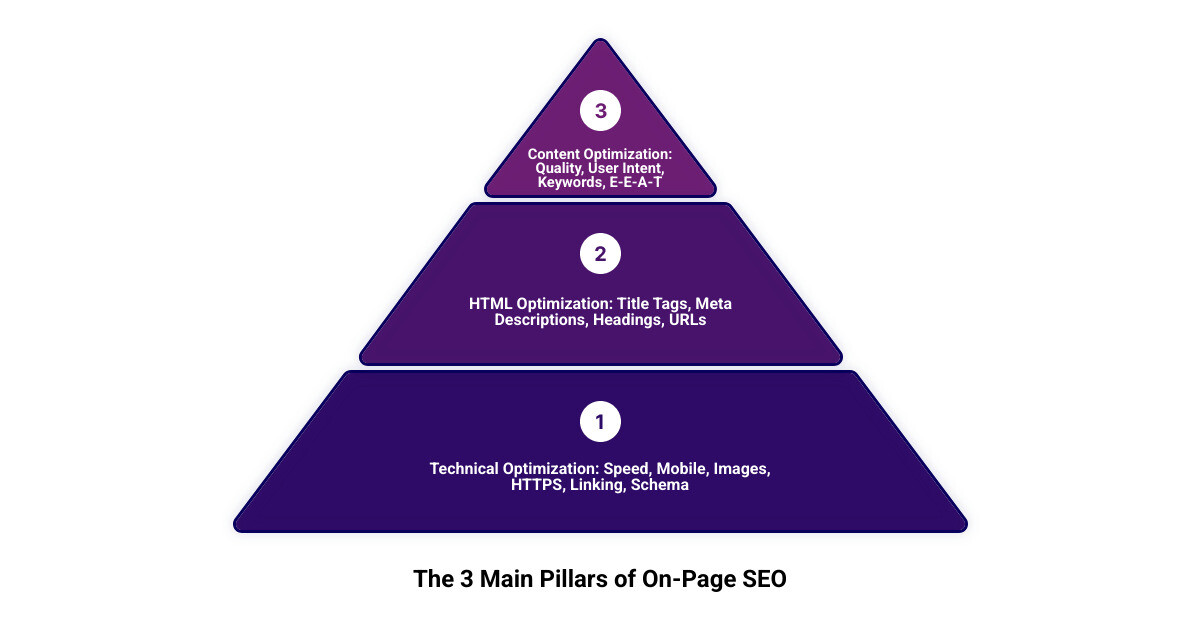
The Core Four: Content, Keywords, User Intent, and E-E-A-T
At the heart of effective on page seo for website lies a deep understanding of what users want and how search engines interpret content. This section dives into the fundamental pillars that drive your pages to the top.
Crafting High-Quality, Relevant Content
Content is king in SEO. High-quality content provides genuine value and meets user expectations. Google recommends focusing on “people-first content,” meaning it’s created for people, not just search engines.

What makes content high-quality?
- Uniqueness: Offer a fresh perspective and avoid duplicating content across pages. Each page should target a specific keyword to prevent cannibalization.
- Comprehensiveness: Cover your topic thoroughly so users don’t need to go elsewhere for answers.
- Readability: Use short sentences, paragraphs, and lists to make content easy to digest. Use readability tools to help.
- Accuracy and Freshness: Ensure your information is correct and up-to-date. Outdated facts erode trust.
- Avoiding Thin Content: Focus on depth and value. While there’s no magic word count, top-ranking pages are often comprehensive (over 1,000 words).
Understanding and Matching User Intent
User intent is the “why” behind a search. If your content doesn’t align with what a user is looking for, it won’t rank.
Main types of user intent:
- Informational: Looking for answers (e.g., “what is on-page SEO”).
- Navigational: Trying to find a specific site (e.g., “MDM Marketing blog”).
- Transactional: Ready to buy or act (e.g., “buy SEO services Canton OH”).
- Commercial Investigation: Researching before a purchase (e.g., “best SEO tools”).
To match intent, search your target keyword and analyze the top results. Note their format (blog post, product page), tone, and depth. If your content doesn’t match, it may not meet user expectations.
Strategic Keyword Placement (Without Stuffing)
Keywords connect what people search for with your content. Strategic placement helps search engines understand your page’s topic, but avoid “keyword stuffing”—excessively repeating keywords harms user experience and rankings.
Where to place your primary keyword:
- Page Title (Title Tag): Near the beginning.
- H1 Heading: The main headline.
- First Paragraph: Within the introduction.
- URL: Keep it short and descriptive.
- Subheadings (H2, H3): To introduce related topics.
- Image Alt Text: For accessibility and image search.
- Meta Description: To encourage clicks.
Incorporate long-tail keywords (e.g., “best on page seo for website techniques for small business”) to attract highly qualified traffic.
Demonstrating E-E-A-T for Trust and Authority
E-E-A-T stands for Experience, Expertise, Authoritativeness, and Trustworthiness. While not a direct ranking factor, it’s a framework Google uses to identify high-quality content, especially for “Your Money Your Life” (YMYL) topics.
How E-E-A-T influences on-page SEO:
- Experience: Show first-hand knowledge, like a review from someone who used the product.
- Expertise: Highlight the author’s credentials and knowledge.
- Authoritativeness: Cite trustworthy sources and back up claims with data.
- Trustworthiness: Ensure your site is secure (HTTPS) and your content is honest and accurate.
To demonstrate E-E-A-T, use author bylines, link to author profiles, and cite reputable sources. MDM Marketing showcases its expertise through case studies and client testimonials, highlighting measurable outcomes.
Optimizing Key HTML Elements for SERP Dominance
HTML elements are the backbone of your web pages. Optimizing them gives search engines a clear roadmap to your content and makes your site more appealing in search results.
Writing Click-Worthy Title Tags and Meta Descriptions
Your title tag and meta description are your storefront in search results. A well-optimized snippet can significantly boost your click-through rate (CTR).
How to optimize title tags:
- Length: Keep titles between 50-60 characters (or 600 pixels) to avoid truncation.
- Keyword Placement: Place your primary keyword near the beginning.
- Uniqueness: Every page needs a unique title tag.
- Modifiers: Use words like “best,” “guide,” or “review” to target long-tail searches.
- Branding: Consider adding your brand name at the end (e.g., | MDM Marketing).
How to optimize meta descriptions:
- Length: Aim for around 155 characters, putting the most important info first for mobile (~120 characters).
- Compelling Copy: Write a brief, benefit-driven summary to entice clicks.
- Keywords: Include your target keyword naturally. Google often bolds matching terms.
- Call to Action (CTA): A soft CTA like “Learn More” can be effective.
- Active Voice: Use active voice for clarity.
While meta descriptions don’t directly affect rankings, a strong description improves CTR, signaling to Google that your page is relevant.
Structuring Content with SEO-Friendly Headings (H1-H6)
Headings (H1, H2, etc.) create a logical structure for users and search engines. They break up text, improve readability, and define the content hierarchy.
How headings help structure content:
- H1 Tag: The main title of your page. Use only one H1 per page, and include your primary keyword.
- H2 and H3 Tags: Subheadings that break content into logical sections. Google’s John Mueller has confirmed that headings help search engines understand a page’s content.
- User Scannability: Headings allow users to quickly scan for information, improving user experience.
- Accessibility: Proper heading structure is crucial for users with screen readers.
Creating User-Friendly and Optimized URLs
Your URL provides important clues about your page’s content to both users and search engines.
Best practices for SEO-friendly URLs:
- Short and Descriptive: Keep URLs concise. Google advises using simple URLs in its official SEO starter guide.
- Keywords: Include your target keyword (e.g.,
https://mdmmarketing.io/on-page-seo-guide). - Hyphens for Separation: Use hyphens (-) to separate words, not underscores (_).
- Avoid Unnecessary Dates/Numbers: This helps keep content evergreen.
- Logical Structure: Organize URLs into clear directories (e.g.,
https://mdmmarketing.io/blog/topic-name).
An optimal URL is typically 50-60 characters and helps everyone quickly grasp the page’s topic.
Technical On-Page SEO for a Flawless Website Experience
Beyond the words and visible HTML, the technical foundation of your website plays a massive role in its SEO performance. A fast, secure, and mobile-friendly site is a non-negotiable for search engines.
Mastering Page Speed and Core Web Vitals
Page load speed is a confirmed Google ranking factor. A slow website can frustrate users, increase bounce rates, and negatively impact your search rankings.

What are Core Web Vitals?
Core Web Vitals are a set of metrics that measure real-world user experience for loading performance, interactivity, and visual stability of a page. They are crucial for your website’s “page experience” signal:
- Largest Contentful Paint (LCP): Measures loading performance. Aim for under 2.5 seconds.
- Interaction to Next Paint (INP): Measures interactivity. Aim for under 200 milliseconds. (Replaced FID in March 2024).
- Cumulative Layout Shift (CLS): Measures the visual stability of a page. A good CLS score is under 0.1.
How to optimize page speed and Core Web Vitals:
- Image Compression: Compress images using image compression tools and use modern formats like WebP. Keep files under 100kB if possible.
- Caching: Enable browser and server-side caching to speed up load times for repeat visitors.
- Reduce JavaScript and CSS: Minimize and defer non-critical JavaScript and CSS to speed up rendering.
- Content Delivery Network (CDN): Use a CDN to serve content from servers geographically closer to your users, reducing latency.
- Reliable Hosting: Choose a web hosting provider known for speed and uptime.
Tools like PageSpeed Insights from Google can help you test your page speed and provide actionable recommendations.
Ensuring Mobile-Friendliness in a Mobile-First World
With mobile traffic accounting for 62 percent of all internet traffic in Q4 2024, mobile-friendliness is no longer optional; it’s absolutely crucial for on page seo for website. Google’s mobile-first indexing means Google primarily uses the mobile version of your site for crawling, indexing, and ranking.
Best practices for mobile-friendliness:
- Responsive Design: This is the recommended approach, where your website adapts its layout to fit any screen size.
- Fast Mobile Speeds: Pay particular attention to page speed on mobile phones.
- Easy Navigation: Simplify menus and make buttons easily tappable.
- Readable Text: Use font sizes that are easy to read without zooming.
- Eliminate Aggressive Pop-ups: Intrusive pop-ups can severely hinder mobile user experience.
You can test your site’s mobile-friendliness using reputable mobile-friendly testing tools or the URL Inspection Tool in Google Search Console.
The Importance of Image Optimization and Alt Text
Images improve content, improve readability, and can even drive traffic through Google Images. However, unoptimized images can slow down your site and harm accessibility.
How can optimizing images and alt text improve SEO and accessibility?
- Descriptive File Names: Use clear, keyword-rich filenames (e.g.,
on-page-seo-guide.jpginstead ofIMG_001.jpg). Google notes in its documentation that image filenames give clues about the subject matter. - Alt Text (Alternative Text): This text describes the image for visually impaired users and search engine crawlers. It’s crucial for accessibility and helps search engines understand the image’s context. Include keywords naturally, keeping it descriptive and concise (125 characters or fewer).
- File Size and Format: Compress images to reduce file size without sacrificing quality. Use modern formats like WebP where possible.
- Lazy Loading: Implement lazy loading for images that are below the fold (not immediately visible) to improve initial page load speed.
Securing Your Site with HTTPS
Website security isn’t just about protecting user data; it’s also a factor in your on page seo for website. Google announced in 2014 that HTTPS (Hypertext Transfer Protocol Secure) has become a lightweight ranking signal.
Why HTTPS is significant for on-page SEO:
- Trust and Credibility: Users are more likely to trust and interact with a secure website.
- Data Integrity: HTTPS encrypts data transferred between the user’s browser and your server.
- Ranking Boost: While a “lightweight” signal, it can give you an edge over competitors.
Obtaining an SSL certificate (which enables HTTPS) is easier and often free these days. Many hosting providers integrate SSL certificates automatically.
Advanced On-Page SEO for Website Improvement
Once you’ve mastered the fundamentals, these advanced techniques can help you push your on page seo for website even further, enhancing visibility and providing richer experiences for users.
Leveraging Internal and External Links Strategically
Links are the highways of the internet, guiding both users and search engine crawlers through your content and across the web.

Internal Links:
Internal links connect pages within your own website. They are vital for:
- Crawlability: They help search engine crawlers find and navigate new pages on your site.
- Link Equity (PageRank): They pass authority between pages, boosting the ranking potential of important content.
- User Experience: They help users move through your site, find related content, and stay longer.
- Anchor Text: Use descriptive anchor text that accurately reflects the content of the linked page. Avoid generic phrases like “click here.”
Consider organizing your content using a hub-and-spoke structure, where comprehensive pillar pages (hubs) link to more detailed subpages (spokes), and vice-versa. This strengthens topical authority.
External Links:
External links (or outbound links) point from your site to other websites. Linking to reputable, authoritative sources can be beneficial.
- Credibility and Trust: Adding links to authoritative external sources can provide value. It shows you’ve done your research and support your claims, enhancing your trustworthiness.
- Ranking Signal: Some industry studies suggest that outgoing links may be used as a ranking signal by Google.
Enhancing Visibility with Schema Markup
Schema markup (also known as structured data) is code that you add to your website to help search engines better understand your content. It doesn’t directly influence rankings, but it can significantly improve your visibility in search results by enabling “rich snippets.”
What is schema markup and how does it improve visibility?
- Context: Schema provides context about your content (e.g., this is a recipe, this is a product, this is an event).
- Rich Snippets: When properly implemented, schema markup can lead to rich snippets in the search results, displaying extra information like star ratings or prices. These visually appealing results can significantly boost click-through rate (CTR).
- Implementation: The most common way to implement schema is using JSON-LD. There are many types of schema, defined by Schema.org, including Article, Product, LocalBusiness, and FAQPage.
You can test your schema implementation using Google’s own rich results testing tools.
Optimizing for Featured Snippets and AI Overviews
Featured snippets, often called “position zero,” and AI Overviews appear at the very top of search results and provide a direct answer to a user’s query.
How to optimize for snippets and AI:
- Direct Answers: Provide clear, concise answers to common questions directly within your content, ideally near the top of the page.
- Natural Language: Write in natural, conversational language that AI models can easily process.
- Break Down Complex Topics: Use clear headings and subheadings to break down complex topics into digestible chunks.
- Formatting: Use Q&A formats, bulleted or numbered lists, and tables when appropriate.
- Structured Data: Leverage schema markup to give AI models more context about your content.
Modern search engines use AI to provide answers directly on the search result page. By structuring your content to be easily scannable and answer-focused, you increase your chances of appearing in these coveted spots.
Common Mistakes, Maintenance, and Getting Expert Help
Even the most seasoned SEOs can make missteps. Understanding common pitfalls and maintaining your optimization efforts are crucial for long-term success.
Common On-Page SEO Mistakes to Avoid
Avoiding these common errors is just as important as implementing best practices for your on page seo for website:
- Keyword Stuffing: Overloading your content with keywords is an outdated and harmful practice.
- Duplicate Content: Having the same or very similar content on multiple URLs confuses search engines. Use canonical tags to consolidate.
- Thin Content: Pages with minimal value or originality will struggle to rank. Focus on providing comprehensive, helpful information.
- Broken Links: Both internal and external broken links create a poor user experience. Regularly audit and fix them.
- Poor Mobile Experience: A non-responsive or slow mobile site is a major red flag for Google.
- Ignoring Title Tags and Meta Descriptions: Failing to optimize these means missing out on potential clicks.
- Bad URL Structure: Cryptic or long URLs are difficult for users and provide little context to search engines.
The Role of Content Refreshes in on page seo for website
The digital landscape is constantly evolving, and so should your content. Regularly updating and refreshing existing content is a powerful on page seo for website strategy.
How often should on-page content be updated or refreshed for SEO purposes?
High-impact pages should ideally be reviewed and updated every 6 to 12 months. Updating combats “content decay,” signals freshness to Google, and can lead to significant ranking boosts. Improving existing content is often more effective than creating something new.
When to Outsource Your on page seo for website
For many businesses, especially those in Canton, OH, managing a comprehensive on page seo for website strategy in-house can be a significant challenge. This is where partnering with experts like MDM Marketing becomes invaluable.
Why outsource your on page seo for website?
- SEO Expertise: An agency possesses deep knowledge of the latest algorithms, best practices, and tools.
- Saving Time and Resources: Outsourcing frees up your internal team to focus on core business operations.
- Achieving Measurable Results: Professional agencies are data-driven, focusing on strategies that deliver tangible ROI, such as increased organic traffic and higher conversion rates.
For businesses looking to streamline their efforts and achieve sustainable growth, exploring “Streamline Your SEO Efforts Using Outsourced Services” on the MDM Marketing website can be a strategic move. MDM Marketing’s dedicated account management and transparent reporting ensure you’re always informed of progress.
Frequently Asked Questions about On-Page SEO
How long does it take to see results from on-page SEO?
The impact of on page seo for website changes can vary widely. Minor adjustments, like optimizing a title tag, might show results in a few days or weeks. More extensive changes could take several months to fully manifest in search rankings. It’s generally recommended to wait a few weeks to assess the impact of your work before making further drastic changes.
Does content length matter for on-page SEO?
Google states that the length of content alone doesn’t matter for ranking purposes. What truly matters is content quality, comprehensiveness, and how well it matches user intent. Longer content often ranks well because it tends to be more comprehensive, not because of its length. Focus on depth and usefulness, not word count.
Should every page on my website target a unique keyword?
Yes, ideally, every important page on your website should target a unique primary keyword. This helps prevent “keyword cannibalization,” where multiple pages on your site compete for the same keyword, confusing search engines. This ensures each page has a clear purpose and a distinct path to ranking.
Conclusion: Integrate On-Page SEO into Your Digital Strategy
Optimizing your on page seo for website is not a one-time task but an ongoing, iterative process. It’s about continuously refining your content, technical elements, and user experience to align with both search engine algorithms and, most importantly, the needs of your audience. From crafting compelling title tags to ensuring lightning-fast page speeds, every detail contributes to your overall visibility.
A well-executed on-page SEO strategy is the bedrock upon which all other digital marketing efforts are built. By prioritizing people-first content, understanding user intent, and adhering to technical best practices, you set your website up for sustainable growth in search results.
For businesses in Canton, OH, and beyond, looking to implement these advanced techniques and achieve measurable growth, the expert team at MDM Marketing provides comprehensive Outsourced SEO Services custom to your goals. Partner with professionals to transform your online presence and open up your website’s full potential.
About Jay McCullough
This author hasn't written a bio yet.