
Your Digital First Impression is Everything
Online reputation building is the strategic process of shaping how your business appears across search engines, review sites, and social media.
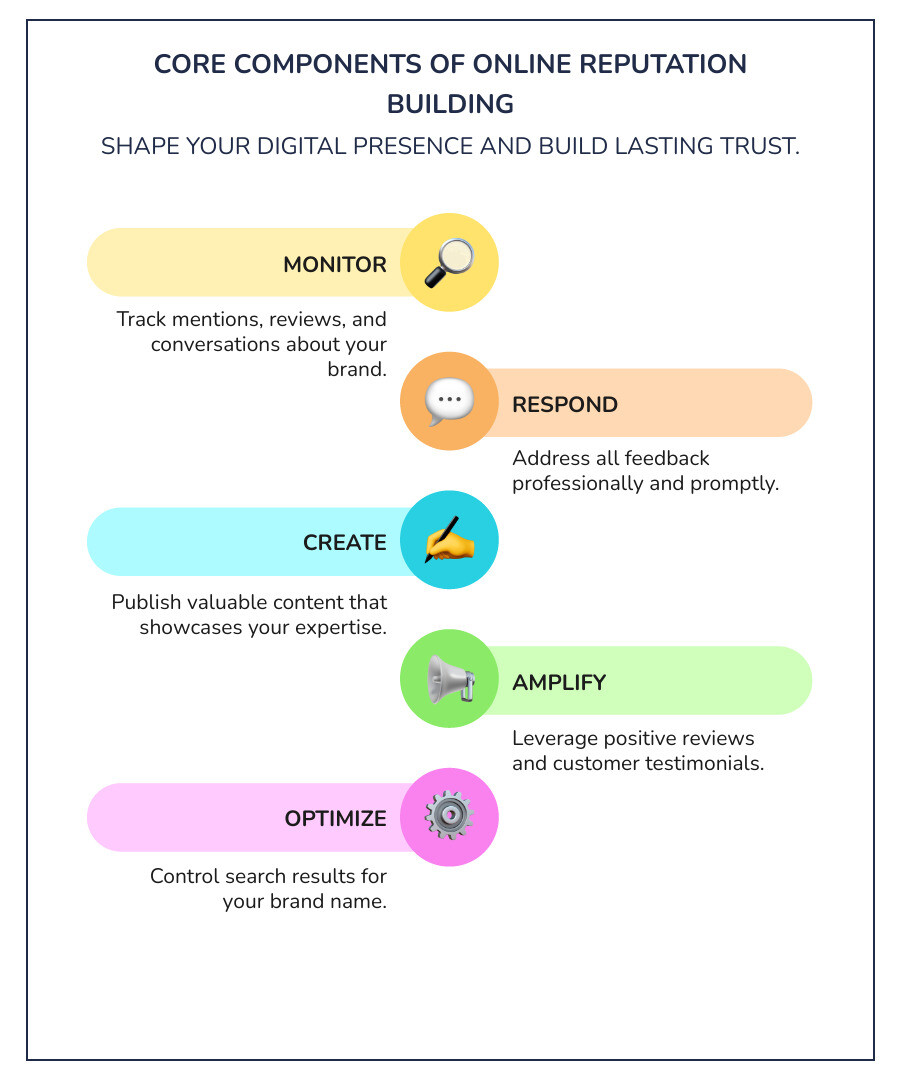
Core Components of Online Reputation Building:
- Monitor – Track mentions, reviews, and conversations about your brand
- Respond – Address feedback professionally and promptly
- Create – Publish valuable content that showcases expertise
- Amplify – Leverage positive reviews and customer testimonials
- Optimize – Control search results for your brand name
Your online reputation isn’t just about managing what people say anymore. It’s about building something strong before problems arise.
78% of consumers search online for local businesses more than once a week and make purchasing decisions based on what they find. Negative articles in search results can cost you up to 22% of potential customers. That is real revenue walking away because of what shows up on page one of Google.
Think of your online reputation as digital word-of-mouth on steroids. Every review, comment, and search result shapes whether someone trusts you enough to click, call, or buy.
The good news? You have more control than you think.
You can respond to reviews, create content that ranks, and build a foundation of positive information before negative content appears. 63% of consumers check Google reviews before visiting a business, which means your review strategy directly impacts foot traffic and sales.
This guide will show you how to build, protect, and leverage your online reputation as a growth engine for your business.
The Foundation: Auditing and Monitoring Your Digital Footprint
Before you can build, you must understand your current standing. Online reputation building starts with a thorough audit and continuous monitoring of your digital footprint.
Brand monitoring means systematically tracking mentions of your business across online channels. Social listening goes deeper into the sentiment and context behind those mentions. It is not just what is being said, but how it is being said and why.
A crucial part of this process is Search Engine Results Page (SERP) analysis: what appears when someone searches for your brand? Are your official channels ranking high, or are there negative results? A review site audit on platforms like Google Business Profile and Yelp helps gauge customer satisfaction. Analyzing competitors can also reveal opportunities or threats.
Understanding your target audience is paramount. Who are you trying to reach? What platforms do they frequent? Tailoring your monitoring efforts to where your audience spends their time keeps your online reputation building efforts focused. Setting up alerts, like a Google Alert, ensures you are notified in real time about new mentions. For a broader visibility plan, consider Strategic Marketing Services for Visibility.
Identifying Your Current Reputation
The first step in any effective online reputation building strategy is to honestly assess your current standing.
Start by “Googling” your brand in an incognito browser to get unbiased results. What shows on the first page? Ideally, it is your official website, social media profiles, and positive news. You might also see unfavorable reviews or critiques.
Next, dive into review sites. Check your Google Business Profile, Yelp, and relevant industry-specific platforms. Look beyond the star rating and read the actual comments. What themes emerge? Are there recurring praises or complaints?
Social media sentiment is another key indicator. Are people talking about your brand on platforms like Facebook, Instagram, or X (formerly Twitter)? What is the general tone? Are there specific hashtags or discussions related to your business?
Do not overlook forums and discussion boards like Reddit, which Google’s “discussions and forums” SERP feature increasingly highlights for diverse personal experiences. These platforms often contain raw, unfiltered opinions.
As you gather this information, identify recurring themes and common misconceptions that need clarifying. These insights are crucial for shaping an effective online reputation building strategy.
Leveraging Social Listening and Brand Monitoring
Once you know your current reputation, put a system in place for continuous vigilance.
Tools like Google Alerts are a basic starting point, notifying you when new content featuring your brand is published. More advanced platforms allow for tracking keywords related to your brand, products, services, and even key personnel. Many include sentiment analysis to reveal whether conversations are positive, negative, or neutral.
By actively monitoring, you can identify brand advocates who are already praising you online and spot issues before they escalate. Catching a negative comment early allows you to address it before it turns into a full-blown crisis.
Understanding customer conversations through these monitoring efforts provides direct feedback that can inform product development and customer service improvements. Some businesses even use conversation intelligence platforms to analyze call center interactions, spotting issues and preventing negative reviews before they happen. This continuous feedback loop is essential for building and maintaining a strong online presence.
The Core Pillars of a Proactive Online Reputation Building Strategy

Think of your online reputation as a valuable asset that needs constant care and protection. A proactive approach to online reputation building is like constructing a digital shield around your brand.
The foundation of this digital shield rests on three principles: authenticity, transparency, and consistency. Customers today are savvy; they can spot a fake quickly. Being genuine in your interactions, transparent about your business practices, and consistent in your messaging across all platforms builds trust.
A successful online reputation management (ORM) strategy is built on four core pillars:
- Proactive Monitoring & Listening: Staying vigilant about what is being said online.
- Strategic Response & Engagement: Interacting thoughtfully and effectively with your audience.
- Positive Content Amplification (SEO & Content Marketing): Creating and promoting content that showcases your expertise and values.
- Crisis Preparedness & Mitigation: Having a plan in place for when things go wrong.
Essential Steps for Proactive Online Reputation Building
Building a stellar online reputation is the result of deliberate, consistent effort.
One of the first steps is claiming and optimizing your business profiles on key platforms. This includes your Google Business Profile. A well-optimized profile ensures accurate information, boosts local search visibility, and provides a direct channel for customer reviews. MDM Marketing also offers specialized GMB Optimization Services to help businesses maximize their local presence.
Encouraging positive reviews is another cornerstone of online reputation building. A consumer is 21% more likely to leave a review after a negative experience than a positive one. This means you must be proactive in soliciting feedback from happy customers.
Simple methods include:
- Email campaigns: Follow up with satisfied customers with a polite request to leave a review, providing direct links to relevant platforms.
- In-person requests: Train your staff to politely ask happy customers for reviews at the point of service.
- Website prompts: Feature a “Leave a Review” section on your website.
The goal is to make it easy and appealing for customers to share their positive experiences, creating a buffer of goodwill that can soften the impact of any occasional negative feedback.
The Role of Valuable Content in Showcasing Expertise
In online reputation building, content is your brand’s voice. If you do not tell your story, share your expertise, and communicate your values, your audience may rely on incomplete information.
Blogging regularly on relevant topics is an excellent way to showcase your expertise. These articles can answer common customer questions, offer insights, and demonstrate your understanding.
Beyond blogs, consider creating:
- Case studies: Accounts of how your products or services helped clients achieve success.
- Whitepapers and e-books: In-depth resources that position your brand as a thought leader.
- Video content: Tutorials, behind-the-scenes looks, or interviews that humanize your brand and make complex information accessible.
Content can also highlight brand values, such as commitment to quality or sustainability. Valuable content naturally attracts backlinks, which are crucial for SEO and boosting your online authority. Learn more by exploring Insights on How to Build Quality Backlinks for SEO Growth.
Leveraging Social Media for Credibility and Community
Social media is a dynamic arena for online reputation building. It offers opportunities for brand storytelling, allowing you to share your brand’s personality, values, and mission.
Audience engagement is critical. Respond to comments, answer questions, and participate in conversations. 76% of reviewers expect a response to social media comments within a day. Prompt, thoughtful replies can turn a casual follower into a loyal advocate and help mitigate negative sentiment.
Encourage User-Generated Content (UGC) by inviting customers to share photos, videos, or stories using your products or services. Reposting UGC (with permission and credit) provides authentic social proof and makes your customers feel valued.
Strategic influencer collaborations can further extend your reach when partners genuinely align with your brand values and audience. For a deeper dive into digital tactics, review Mastering Effective Web Marketing Strategies for Modern Needs.
The Defense: Managing Negative Feedback and Crisis Communication

Even with the most proactive online reputation building efforts, negative feedback is inevitable. The true test of your brand’s character lies in how you respond. The goal is not to silence criticism, but to manage it with grace, turning potential detractors into advocates. 53.3% of customers expect a response to their online review within 7 days, highlighting the urgency of addressing feedback.
When faced with negativity, respond with empathy. Acknowledge the customer’s experience and validate their feelings. Even if you disagree with their assessment, their perception is their reality. Apologizing for their dissatisfaction, even if you do not feel entirely at fault, can de-escalate the situation.
Then, focus on offering solutions. What can you do to make it right? Sometimes, a public response is just the first step. For sensitive or complex issues, it is often best to take conversations offline. Provide a direct contact method (phone number or email) and invite them to discuss the matter further in private.
A robust crisis communication plan is also essential. The way you handle negative feedback and crises can either damage your brand further or strengthen your reputation over time.
Strategies for Mitigating Negative Feedback
When negative feedback surfaces, your immediate reaction might be defensive or to hit the delete button. Resist that urge.
Attempting to censor criticism often backfires and can make the problem worse. Deleting comments or reviews can make you look like you have something to hide.
Instead, follow a strategy built on professionalism and transparency:
- Respond promptly: Speed matters. A quick response shows you are attentive and care about customer concerns.
- Apologize and empathize: A sincere apology for their negative experience and empathy for their frustration goes a long way.
- Provide a solution: Offer a clear path to resolution, such as a refund, discount, or a chance to redo the service.
- Stay calm and professional: Responding to criticisms effectively means keeping your tone respectful, even when the feedback feels unfair. See guidance on responding to criticisms.
- Follow up privately: For more complex issues, offer to take the conversation offline with a direct email or phone number.
- Learn from feedback: Use recurring issues as input to refine your products, services, or customer experience.
The Importance of a Crisis Communication Plan
In the unpredictable world of online reputation, a crisis communication plan is a necessity. These crises can range from a viral negative review to a major product issue. The speed and effectiveness of your response can make or break your brand’s image.
A well-structured crisis communication plan should outline:
- Identifying a crisis: Define clear triggers that activate the plan.
- Pre-approved messaging: Prepare holding statements and FAQs in advance so you can respond quickly and consistently.
- Designated spokesperson: Appoint a trained individual to be the public face and voice of your company during a crisis.
- Internal communication protocol: Ensure employees know how to respond to inquiries or where to direct customers.
- Monitoring during a crisis: Increase social listening and brand monitoring to track sentiment in real time.
- Post-crisis analysis: Once the situation has stabilized, review what went well and what could be improved.
Having this plan in place allows your business to react strategically, rather than emotionally, when under pressure. For support with the ongoing work that feeds into crisis readiness, explore how to Streamline Your SEO Efforts Using Outsourced Services.
The Connection: SEO, AI, and the Future of Reputation
Online reputation building is closely tied to how easily and positively your brand can be found online. This is where the synergy of SEO (Search Engine Optimization) and AI comes into play. It is not enough to just have a good reputation; you need to ensure that positive narratives dominate search results.
Search engine suppression, often referred to as “burying” negative content, is one tactic. It involves proactively creating and ranking a large volume of positive, brand-owned content to push any unfavorable results off the first page of Google. This is the essence of Reputation SEO. The goal is to “own page one” for your branded search terms.
The rise of AI is changing how information is found and trusted. AI’s impact on “findability” means that businesses must consider not just traditional search engines but also how AI models and conversational search engines describe their brand. These LLM (Large Language Model) brand descriptions can influence perception.
Structured data, such as schema markup for reviews, becomes even more important, as it helps AI understand and present your positive attributes. In fact, reviews can also be marked up with Schema to improve their visibility in search results.
The Role of SEO in Online Reputation Building
SEO is not just about driving traffic; it is a powerful tool for online reputation building. By strategically optimizing your online presence, you can influence what people see when they search for your brand.
A primary objective is controlling branded SERPs (Search Engine Results Pages). When someone types your company’s name into Google, you want your official website, positive news articles, and strong reviews to dominate the first page. This involves creating a robust ecosystem of positive assets, including:
- Optimizing owned properties: Ensure your website, blog, and social media profiles are fully optimized with relevant keywords, high-quality content, and strong internal linking.
- Creating positive content: Publish valuable content that showcases your expertise and brand values, such as blog posts, case studies, and press releases.
- SEO and GMB: Optimizing your Google Business Profile is critical for local businesses, as it directly impacts local search rankings and visibility for reviews.
- Link building to positive content: Acquiring high-quality backlinks to your positive content and owned properties boosts their authority and helps them rank higher, pushing down less desirable results. Explore how a Contextual Link Building Service can support this effort.
The cumulative effect of these SEO strategies is to populate the first pages of search results with positive, authoritative content and make negative results less prominent.
How AI is Changing Reputation Management
Artificial Intelligence is ushering in a new era for online reputation management, adding further complexity into the mix but also new opportunities.
AI-driven “findability” means that consumers are increasingly finding information not just through traditional search, but through AI chatbots, voice assistants, and other intelligent interfaces. These AI models synthesize information from across the web to provide concise answers, and how they describe your brand is becoming important.
Businesses now need to pay attention to how AI tools summarize their brand, products, or services and ensure that the underlying web content is accurate and positive.
AI is also improving sentiment analysis, providing more nuanced insights into the emotional tone of online conversations. This allows for quicker identification of emerging issues and a clearer understanding of public perception.
Optimizing for voice and AI search is becoming a new frontier in SEO. This means structuring and writing content in a way that AI can easily understand and use to answer natural language queries about your brand.
The future of trust signals will likely involve how well your brand performs in these AI-driven channels. To harness these emerging technologies for your business, consider exploring AI Integration Services.
Frequently Asked Questions about Online Reputation Building
What is the difference between proactive and reactive reputation management?
Proactive ORM involves building a positive reputation before a crisis occurs, creating a buffer of goodwill. Reactive ORM is damage control after a negative event has already happened. A comprehensive strategy includes both, but emphasizes proactivity.
Can I permanently remove a negative review?
It is very difficult to remove a legitimate negative review. Most platforms will only remove reviews that violate their terms of service (e.g., hate speech, spam). The best strategy is to respond professionally and resolve the customer’s issue.
How do I measure the success of my online reputation strategy?
Success can be measured by tracking metrics like brand sentiment scores, star ratings on review sites, volume and quality of reviews, rankings for branded search terms, and website traffic from positive mentions.
Conclusion: Turn Your Reputation into Your Strongest Asset
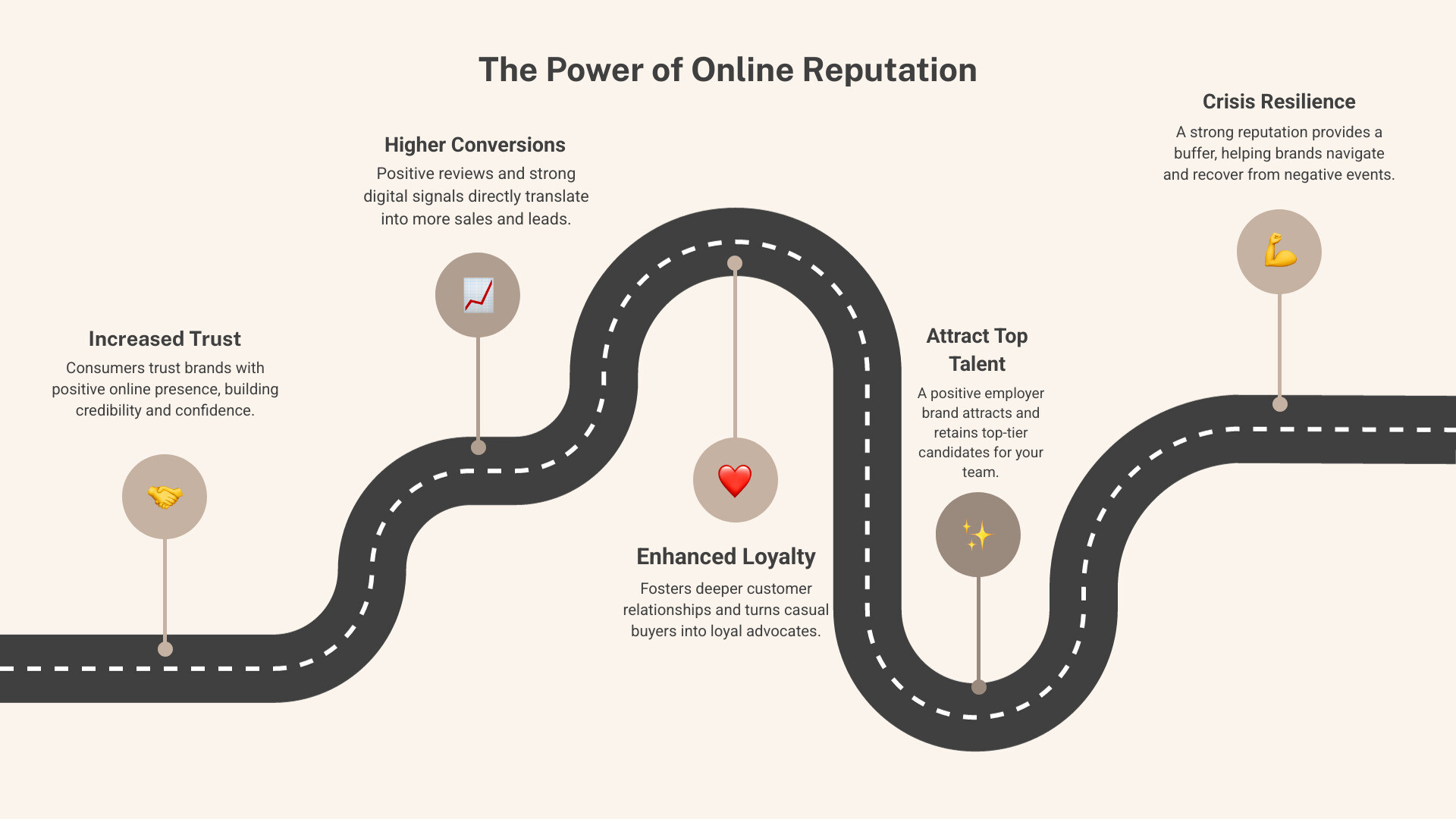
In today’s hyper-connected world, your online reputation is no longer just a reflection of your business; it is a powerful engine for growth. Effective online reputation building is built on diligent monitoring, strategic engagement, valuable content creation, and robust crisis preparedness. It demands authenticity, transparency, and consistency in every digital interaction.
This is not a one-time project, but an ongoing commitment. By continuously auditing your digital footprint, leveraging social listening, encouraging positive reviews, and responding thoughtfully to all feedback, you build a resilient digital shield. When you combine these efforts with strategic SEO and adapt to AI-driven findy, you help your positive narrative dominate online conversations.
A strong online reputation fosters lasting trust, attracts new customers, and transforms casual browsers into loyal advocates. It is an investment that pays dividends in customer loyalty, increased revenue, and sustained business success.
Are you ready to take control of your brand’s narrative and open up its full potential? Contact us today to learn how our expert reputation management services can help.
About Jay McCullough
This author hasn't written a bio yet.