
Why PPC is Critical for Plumbing Companies
PPC for plumbing companies is a digital advertising strategy where you pay only when someone clicks your ad on search engines like Google. It places your business at the top of search results when customers need you most.
- Average costs: $8-$15 per click (general), $15-$30 (emergency)
- Typical budgets: $1,500-$10,000 per month
- Expected ROI: $2-$6 for every $1 spent
- Average cost per lead: $40-$120
- Key benefit: Immediate visibility to customers actively searching for help
When a pipe bursts, homeowners don’t scroll through pages of results; they click the first reliable plumber they see. That’s the power of PPC. Unlike SEO, which takes months, PPC puts you in front of customers immediately—like when they search “emergency plumber near me” at 2 AM.
Google estimates businesses make an average of $2 in revenue for every $1 spent on Google Ads. For plumbers, conversion rates average 9.5%, with top campaigns hitting 15%.
However, PPC requires careful management. Small missteps can drain your budget. Success depends on smart keyword selection, compelling ad copy, and landing pages that convert clicks into jobs.
This guide will show you how to build a plumbing PPC campaign that generates real leads, not just clicks.
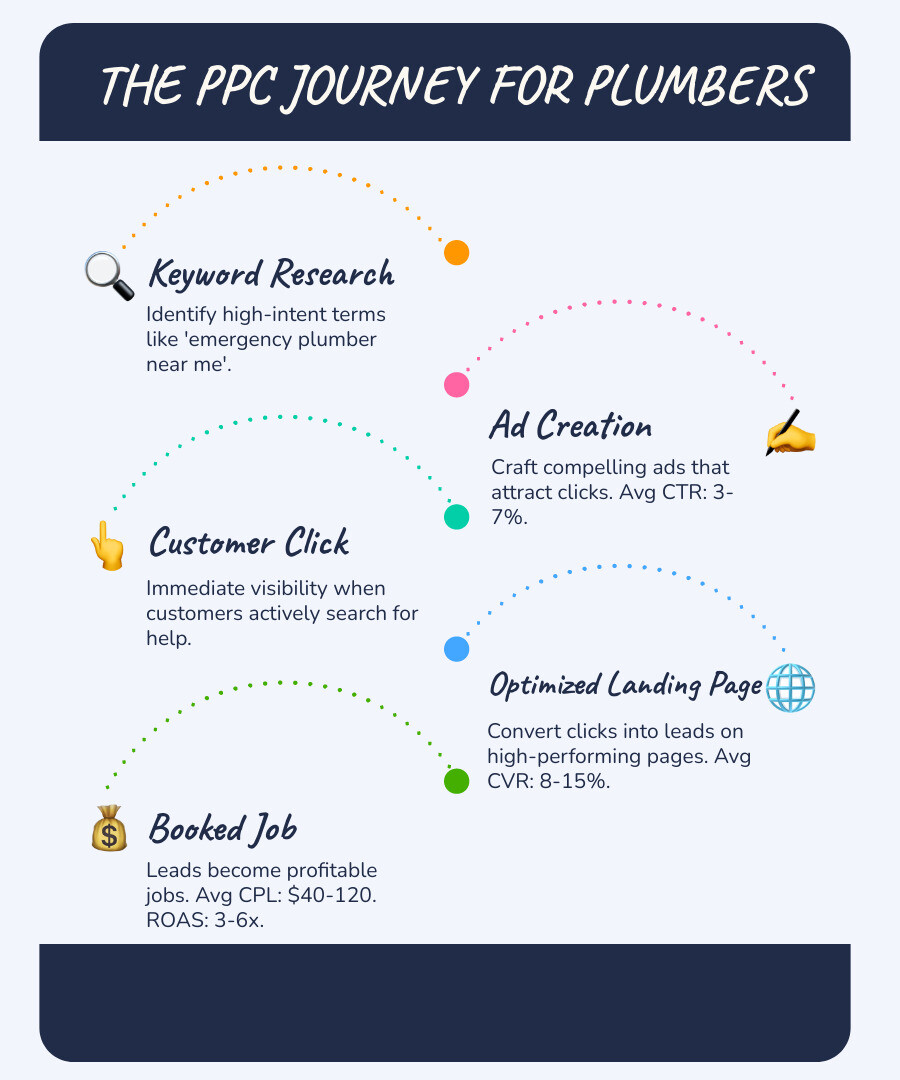
The Financial Flow: Budgeting and ROI for Plumbing PPC
Understanding the financial side of PPC for plumbing companies is crucial. It is not just about spending money, but about making a smart, trackable investment that yields a healthy return. Below is a clear breakdown of the typical costs and expected ROI.
Understanding Typical PPC Costs
Key cost components for plumbers in PPC include:
-
Cost Per Click (CPC): This is what you pay per click. Average CPCs for plumbing keywords are $8–$15, but can reach $15–$30 for high-competition or emergency keywords. Your ad’s Quality Score, keyword competitiveness, and location all influence this cost. A higher Quality Score can lower your CPC.
-
Monthly Budgets: Plumbers typically invest $1,500 to $10,000 per month on PPC. This varies based on your service area, competition, and lead goals. A company in a smaller market like Canton, OH, might spend less than one in a large metro area.
-
Factors Influencing Cost:
- Competition: More plumbers bidding on keywords drives up CPCs.
- Location: Densely populated or affluent areas often have higher CPCs.
- Service Type: Emergency services like “burst pipe repair” cost more per click than routine maintenance.
Calculating Your Expected ROI
The goal of any marketing investment is a positive Return on Investment (ROI). For PPC, this means generating more revenue from leads than the ads cost.
- Return on Investment (ROI): Google estimates businesses make an average of $2 in revenue for every $1 they spend on Google Ads. For plumbers, this can be even higher due to the high value of many services.
- Average Cost Per Lead (CPL): The average CPL for plumbing ranges from $40 to $120. This metric shows how efficiently your ad spend is generating potential customers.
- Average Conversion Rate: The average conversion rate from click to lead for home services often falls between 8% and 15%. This means you can expect roughly 8–15 leads per 100 clicks when campaigns are well optimized.
To put PPC costs into perspective, here is how it compares to traditional advertising:
| Feature | PPC Advertising for Plumbers | Traditional Newspaper Advertising |
|---|---|---|
| Targeting Precision | Highly precise (keywords, location, time) | Limited (mass audience) |
| Cost Control | Excellent (set daily budgets, bids) | Poor (fixed cost, no performance guarantee) |
| Measurability | Excellent (track clicks, leads, ROI) | Poor (difficult to attribute sales to ad) |
| Speed of Results | Near-instantaneous (campaigns can go live in hours) | Slow (dependent on publication schedules) |
| Typical Cost | CPC $8-$30; Monthly $1,500-$10,000+ | Full-page ads can cost $2,700 to over $100,000 with no targeting or performance data |
| Flexibility | High (pause, adjust, or scale anytime) | Low (changes are impossible once printed) |
| Audience Intent | High (targets active searchers who are looking for plumbing services right now) | Low (reaches general readers who may not need plumbing services at that moment) |
| Average ROI/ROAS | Often around $2 or more in revenue for every $1 spent, frequently 3x–6x ROAS | Highly variable and difficult to quantify |
This table shows why PPC for plumbing companies is generally a superior choice for predictable lead generation. If you are ready to make your advertising budget work harder, learn how to maximize your ROI with our PPC services.
Building Your Lead Pipeline: A Step-by-Step PPC Campaign Guide
Setting up a successful PPC campaign for your plumbing business is a systematic process. The goal is to turn ad clicks into booked jobs through a clearly structured approach.
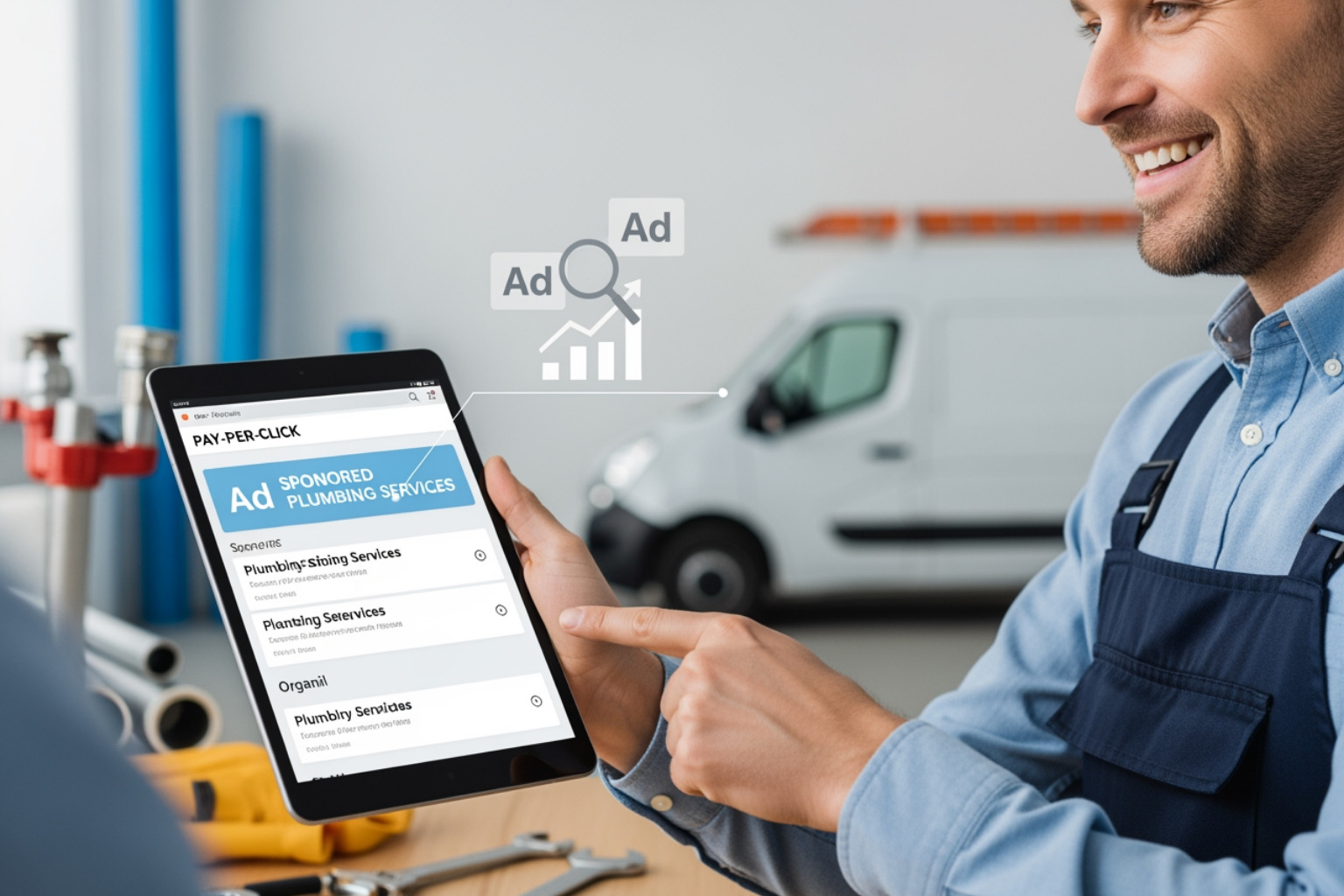
Step 1: High-Intent Keyword Research
The foundation of any PPC campaign is targeting the exact phrases customers use when they need a plumber. The goal is to focus on “high-intent” keywords that signal an immediate need.
- How to research: Brainstorm your services (for example, drain cleaning, water heater repair, sewer line replacement) and consider how a customer in Canton, OH would search for them. Use tools like Google Keyword Planner or other keyword research platforms to find terms, search volumes, and estimated costs.
- High-intent keywords: These searches often include words like “repair,” “service,” “emergency,” “cost,” or “near me.”
- Keyword types:
- Emergency: “emergency plumber near me,” “24 hour plumber Canton.”
- Service-specific: “drain cleaning services Canton,” “water heater installation cost.”
- Location-based: Always include your service area, such as “plumber in Canton, OH.”
Focusing on these keywords puts your ads in front of people who are ready to hire a plumber instead of just browsing.
Step 2: Crafting Compelling Ad Copy and Landing Pages
Once you know what people are searching for, you need to convince them to choose your company with compelling ad copy and high-converting landing pages.
-
Compelling ad copy: Your ad must grab attention and build confidence.
- Strong headlines: Include the service and location (for example, “Emergency Plumber | Canton, OH”) and a clear unique selling proposition (USP) such as “24/7 Service – Licensed & Insured.”
- USPs: Highlight what makes you different: “Same-Day Service,” “Upfront Pricing,” “Family-Owned,” or similar proof-driven benefits.
- Clear Call-to-Action (CTA): Tell users exactly what to do: “Call Now for Fast Service” or “Get a Free Estimate Today.”
-
High-converting landing pages: Your landing page is where clicks become jobs.
- Message match: The landing page must match the ad’s promise. An ad for “Water Heater Repair” should lead to a page focused on that service, not a generic homepage.
- Trust signals: Prominently display customer reviews, certifications, guarantees, and any relevant badges.
- Mobile-first design: Most plumbing searches are on phones. Your page must load fast and be easy to use on a small screen, with a clear contact form or click-to-call button.
- Simple forms: Keep forms short and straightforward—name, contact details, and a brief description of the issue are usually enough.
For assistance in crafting messages that resonate with local homeowners and property managers, explore our content marketing services for compelling copy.
Step 3: The Importance of Negative Keywords in a Plumber PPC Campaign
Negative keywords act as a filter, preventing wasted ad spend on irrelevant searches.
- Why they are crucial: They stop your ads from showing for searches that are unlikely to convert, which saves budget. For example, you can filter out people searching for “how to fix a leaky faucet” who are looking for DIY advice instead of professional help.
- How to find them: Regularly review your search term reports in Google Ads to see the actual queries that triggered your ads. This data is extremely useful for finding new negative keywords and tightening your targeting.
- Common negative keywords for plumbers:
- “DIY”
- “jobs”
- “training”
- “free”
- “salary”
- “how to”
- “plumbing school”
By proactively adding these terms, you refine your targeting and improve campaign efficiency, making sure you are not pouring budget into irrelevant clicks.
Advanced Strategies for Optimizing PPC for Plumbing Companies
Once the basics are in place, you can use advanced strategies to optimize your PPC for plumbing companies. These tactics help improve performance, lower your cost per lead, and capture more market share in your service area.
A/B Testing to Lower Your Cost Per Lead
A/B testing, or split testing, involves creating two or more variations of an ad or landing page element to see which performs better.
- What it is: You show different ad versions (for example, different headlines or descriptions) to segments of your audience to see which gets more clicks or conversions.
- How it lowers CPL: By systematically identifying the best-performing elements, you refine your campaigns over time. This can lead to higher click-through rates (CTR), better Quality Scores, and a lower cost per lead.
- What to test: Experiment with different headlines, descriptions, calls-to-action, button colors, form lengths, or landing page layouts. Test one major change at a time so you know what is driving the difference.
A/B testing is an ongoing process rather than a one-time task.
Using Remarketing to Re-engage Potential Customers
Not everyone converts on their first visit. Remarketing reminds potential customers about your services after they have left your site.
- How it works: Show ads specifically to people who previously visited your website but did not book a service. This keeps your company top-of-mind as they continue to research.
- Example: If someone visited your “water heater repair” page but did not call, you can show them display or social media ads with a special offer or reminder for that service.
- Impact: Industry data consistently shows that customers who see retargeted ads are more likely to return to your site and convert.
Tailoring PPC for Different Plumbing Services
Your PPC strategy should adapt to the specific service you are advertising.
- How strategies differ:
- Residential PPC: Focus on immediate needs and emergency services. Ad copy should emphasize speed, reliability, and safety for the home.
- Commercial PPC: Target businesses with keywords like “commercial plumbing contracts” or “grease trap cleaning.” Ads should highlight compliance, minimal downtime, and long-term partnerships.
- Service-Specific PPC (for example, Drain Repair, Water Heater Repair): Use high-urgency keywords and ad copy that stresses a fast response and clear pricing. Tailor landing pages to each service so prospects see exactly what they searched for.
Each service benefits from custom keywords and ad copy that speak directly to specific customer pain points.
The Role of Google Local Services Ads (LSAs)
Google Local Services Ads can be a powerful complement to traditional search campaigns for plumbers.
- What LSAs are: These are pay-per-lead ads appearing at the very top of Google search results. They feature your business name, rating, phone number, and service area.
- Pay-per-lead model: Unlike standard PPC, you only pay for qualified leads (such as a phone call or message), not for every click.
- “Google Guaranteed” badge: To run LSAs, businesses must pass Google’s screening process, earning a “Google Guaranteed” badge that can significantly increase trust with potential customers.
Integrating LSAs with your overall search strategy can boost both lead volume and credibility. To improve your broader local online presence, boost your local presence with our Local SEO services.
Creating Mobile-Friendly PPC Ads for Plumbers
Most plumbing searches happen on mobile devices, often during a stressful situation like a leak or backup.
- Best practices for mobile:
- Search behavior: Most plumbing searches happen on phones, which makes mobile optimization a core requirement.
- Click-to-call extensions: These are essential, allowing users to call you directly from the ad with one tap.
- Mobile-optimized landing pages: Ensure your landing pages load quickly, have large, tappable buttons, and display a prominent phone number and simple form.
- Short, clear copy: Use concise headlines and bullet points so stressed users can understand your offer instantly.

Measuring Success and Overcoming Challenges
Running PPC for plumbing companies requires constant monitoring and adaptation. Tracking the right metrics and knowing how to address challenges is key to long-term success.
Key Metrics to Track for Campaign Performance
Continuously monitor these key performance indicators (KPIs) to ensure your campaigns are effective:
- Click-Through Rate (CTR): The percentage of people who see your ad and click it. A healthy CTR for home services is often in the 3%–7% range, indicating that your ad copy and targeting are relevant.
- Conversion Rate: The percentage of clicks that result in a lead (call, form submission). A solid rate for plumbers is generally around 8%–15%, which shows your landing page and offer are effective.
- Cost Per Lead (CPL): The average cost to acquire one lead. For plumbers, this is typically $40–$120.
- Return on Ad Spend (ROAS): The revenue generated for every dollar spent on ads. Many plumbing campaigns aim for a ROAS in the 3x–6x range or better.
- Quality Score: A Google Ads metric (1–10) that evaluates the relevance of your ads, keywords, and landing pages. A higher score can lead to lower CPCs and better ad positions.
Monitoring these metrics helps you refine your strategy and budget over time. For comprehensive tracking, our analytics services can help you measure performance accurately and consistently.
PPC vs. Other Marketing Strategies
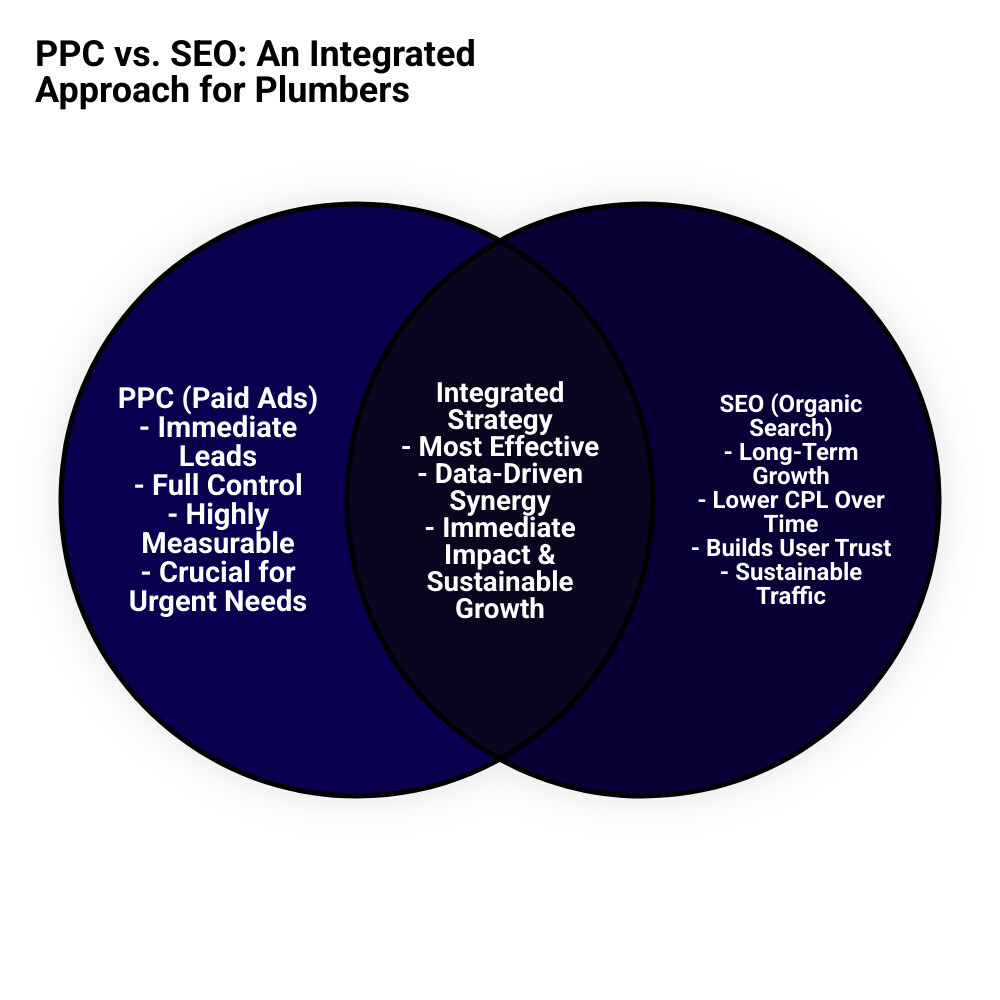
PPC and SEO are best used together for a comprehensive marketing strategy.
-
PPC Benefits:
- Immediate results: Ads can generate leads within hours, which is crucial for emergency plumbing calls.
- Control: You control your budget, keywords, and targeting, with the ability to adjust anytime.
- Measurability: Every click and conversion is trackable, providing clear data for optimizing ROI.
-
SEO Benefits:
- Long-term growth: Builds sustainable, “free” organic traffic over time.
- Lower CPL over time: Once pages are ranking, SEO can produce leads at a significantly lower marginal cost.
- Trust: Many users trust organic results more than paid ads, especially for long-term or non-emergency work.
An integrated strategy uses PPC for immediate leads while leveraging that data to inform long-term SEO efforts. To improve your organic presence, streamline Your SEO Efforts Using Outsourced Services.
Potential PPC Challenges and How to Avoid Them
Be aware of these common PPC challenges and address them proactively:
- High CPCs: Combat this with higher Quality Scores, better ad relevance, and tight keyword targeting.
- Budget waste: Regularly review search term reports and use negative keywords to filter out irrelevant clicks.
- Click fraud: Monitor for unusual click patterns and use built-in platform protections or third-party tools when appropriate.
- Lack of transparency: Make sure you or any partner managing your campaigns provides clear reporting on spend, leads, and ROI.
- Targeting errors: Use precise geo-targeting so your ads only appear in your true service area.
- Ad copy pitfalls: Avoid vague messaging; clearly state your services, location, and value propositions.
DIY vs. Hiring a PPC Agency for Your Plumbing Company
Deciding whether to manage campaigns yourself or hire a professional depends on your time, expertise, and budget.
- When to manage in-house: A DIY approach can work if you have a smaller budget (often under $2,000 per month), are comfortable learning the platform, and have time to monitor and optimize campaigns regularly.
- When to hire an agency: For larger budgets or when your time is better spent running your business, a specialized PPC agency is often more cost-effective. Experienced teams bring best practices, testing frameworks, and advanced tools that typically improve performance and ROI.
While DIY saves on management fees, inexperience can lead to wasted ad spend. An agency’s fee is often offset by more efficient campaigns and stronger results. To see how a professional approach can benefit your business, check out our use cases.
Real-World Examples of Successful PPC Ads for Plumbers
Seeing successful PPC for plumbing companies in action can provide useful inspiration. Below are examples of how plumbers can leverage different ad formats to capture leads.

Search Ad Example
A highly effective search ad for a plumbing company in Canton, OH might look like this:
Headline 1: Canton Emergency Plumber | 24/7 Rapid Response
Headline 2: Licensed & Insured | Upfront Pricing
Description: Burst Pipe? Clogged Drain? Fast, Reliable Service in Canton, OH. Call Now for Immediate Help!
Ad Extensions: Call Button, Location, Reviews (4.9 stars, 250+ reviews)
This ad uses strong headlines, clear USPs, urgency, and trust signals (licensed, insured, reviews) to appeal to someone in immediate need.
Display Ad Example
Imagine a customer in Canton, OH searches for “drain cleaning services” but does not convert. A remarketing display ad might then appear on a website they are browsing:
Image: A clean pipe or a friendly, uniformed plumber.
Headline: Clogged Drains? We Have You Covered
Description: Fast & Affordable Drain Cleaning in Canton, OH. Schedule Your Service Today.
Call to Action: Book Now
This ad keeps your brand visible and offers a solution to a specific problem, using geolocation to target people in your service area.
Social Media Ad Example
Social media ads are excellent for promoting special offers or re-engaging past website visitors.
Image: A smiling technician or a graphic promoting a discount.
Headline: Do Not Let Plumbing Problems Ruin Your Day
Description: Get $50 Off Your Next Plumbing Service in Canton, OH. Limited-Time Offer. Experienced and Trusted Team.
Call to Action: Claim Offer
This ad uses an engaging headline, a compelling incentive, and urgency to encourage a potential customer to stop scrolling and take action.
Key Takeaways
Successful PPC ads for plumbers are:
- Relevant: They match the user’s search intent and location.
- Compelling: They offer clear solutions and strong value propositions.
- Action-oriented: They include specific, direct calls-to-action.
- Trustworthy: They build confidence through reviews, guarantees, and professional imagery.
Frequently Asked Questions about PPC for Plumbers
Is PPC better than SEO for plumbers?
PPC and SEO work best together. PPC delivers immediate, high-intent leads, which is crucial for emergency services when customers need help right away. SEO builds long-term, organic visibility and trust, lowering your average lead cost over time. A balanced strategy uses both to dominate search results and create a steady pipeline of leads.
How much should a plumber spend on PPC?
A typical starting budget for a plumbing company is between $1,500 and $5,000 per month. The ideal amount depends on your service area’s competitiveness, the number of leads you want, and your overall growth goals. It is usually best to start with a test budget, measure your ROI carefully, and then scale up what is working.
What is a good cost per lead for a plumber?
The average cost per lead (CPL) for plumbers can range from $40 to $120. However, a “good” CPL depends on your average job value and profit margin. For example, if a single job brings in $500 in revenue, a $100 CPL can still be very profitable. The most important metric is ensuring your campaigns generate a positive Return on Ad Spend (ROAS).
Conclusion
PPC advertising is a powerful tool for ppc for plumbing companies to generate immediate, high-intent leads and keep their schedules full. Success is not about just spending money; it comes from strategic keyword selection, compelling ad copy, optimized landing pages, and continuous, data-driven optimization. By integrating PPC with your broader marketing efforts, you can build a resilient and profitable lead generation engine.
At MDM Marketing, we specialize in creating these data-driven strategies to help businesses achieve sustainable growth through search, paid media, and conversion-focused optimization.
About Jay McCullough
This author hasn't written a bio yet.