
Why Professional SEO Tools Are Essential for Business Growth
Professional SEO tools are software platforms designed to help businesses improve search engine rankings, analyze competitors, and track performance. These tools range from free basics to comprehensive paid suites that combine keyword research, technical audits, backlink analysis, and AI-powered optimization.
Quick answer for busy business owners:
- All-in-One Platforms integrate keyword tracking, site audits, and competitor analysis.
- Specialized Tools focus on specific tasks like technical SEO or content optimization.
- Free Foundation Tools (Google Search Console, Google Analytics) offer essential first-party data.
- AI-Powered Features assist with content creation, predictive analytics, and tracking visibility in AI search results.
The SEO software market is projected to reach $3.1 billion by 2028, a 12.6% annual growth rate, because search is changing faster than ever. AI is taking up more space in search results, and the old SEO playbook is no longer enough.
As one marketing professional who drives over 100,000 monthly visitors put it: “For some jobs, you can get by purely on your own cunning, physical abilities, or ambition alone. SEO marketer is not one of those jobs.”
You need data, insights, and the right tools. But with hundreds of options, how do you choose the ones that will actually help your business grow? The answer depends on your budget, team size, technical expertise, and business goals.
This guide will break down the professional SEO tool landscape into clear categories, explain what each type of tool does best, and help you build a toolkit that fits your needs without breaking your budget. Understanding the tool ecosystem is your first step toward sustainable online growth.
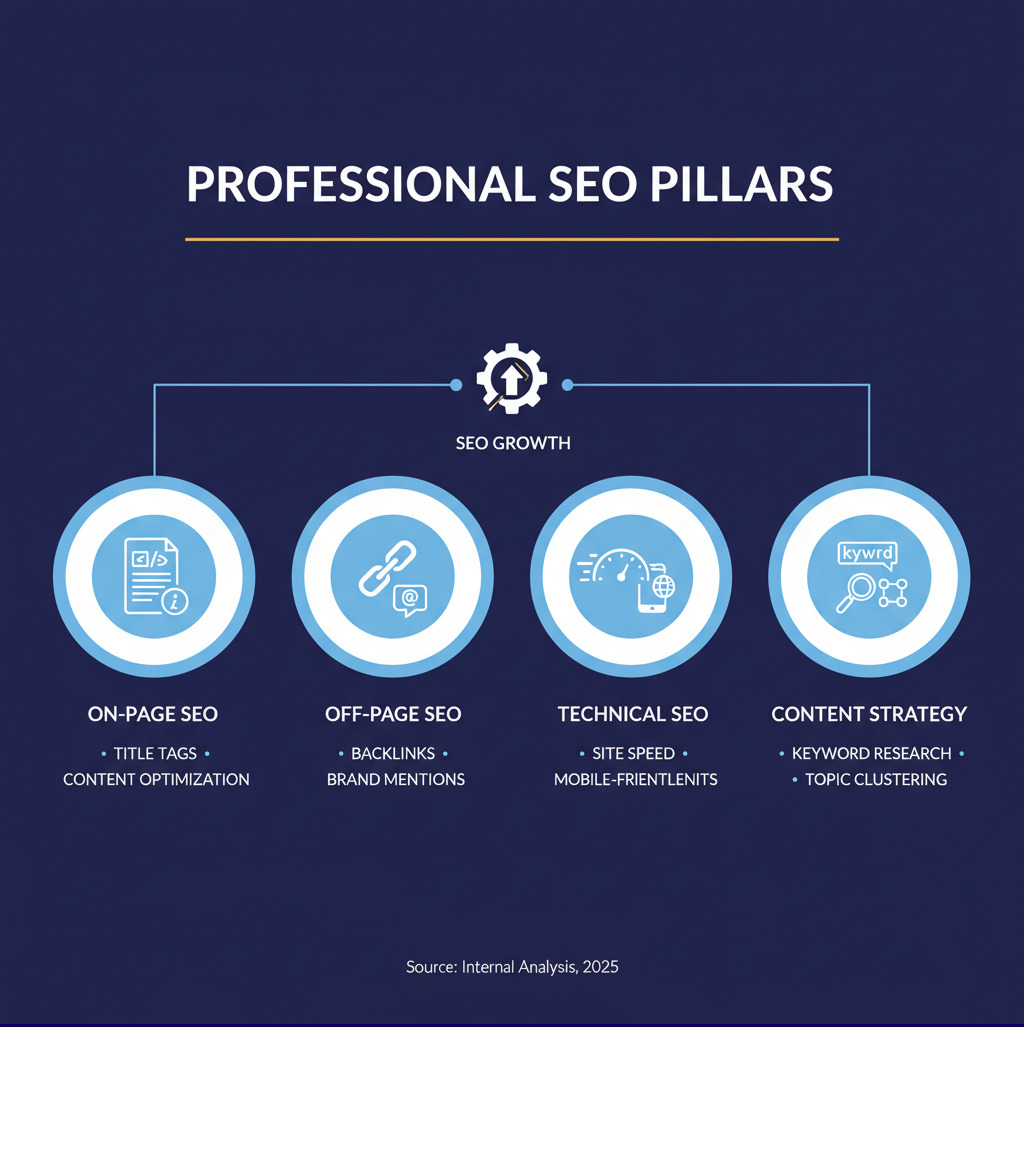
Decoding the SEO Toolkit: Categories and Core Functions
Think of professional SEO tools like a well-organized toolbox. Different challenges require different solutions, and understanding how these tools are organized makes choosing the right ones much simpler.
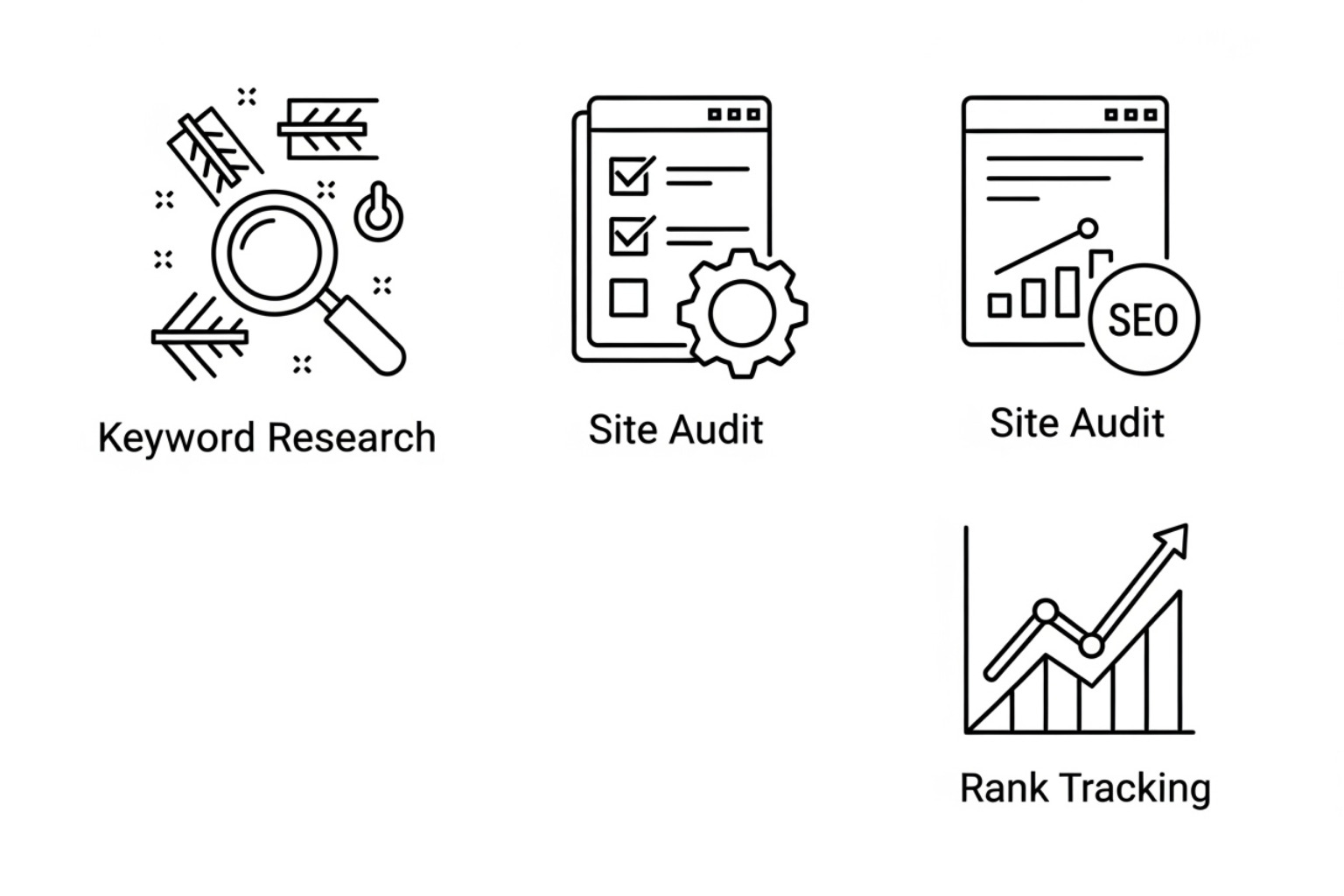
SEO tools generally fall into four main categories: all-in-one platforms, specialized keyword and content tools, technical SEO and site audit tools, and backlink analysis tools. Together, they help you save time, access critical data, understand competitors, and make smarter strategic decisions. Without them, you’re trying to steer a complex and competitive landscape in the dark. For many companies, building an efficient system is key, which is where opportunities to Streamline Your SEO Efforts Using Outsourced Services become valuable.
Let’s break down each category.
All-in-One SEO Platforms
All-in-one platforms are the Swiss Army knives of SEO, packing keyword tracking, competitor analysis, site auditing, and backlink monitoring into a single subscription. The biggest advantage is convenience—all your data lives in one dashboard, making it easier to spot patterns. This integrated approach is an excellent foundation for Mastering Effective Web Marketing Strategies for Modern Needs.
The trade-off is that these platforms can be overwhelming at first, with a steeper learning curve. They offer breadth over depth, so they may not have the power of a dedicated tool for a specific, complex task. The choice depends on your situation: if you want integrated data for a comprehensive strategy, they’re a smart choice. They also represent a significant investment, but often cost less than buying multiple specialized tools separately.
Specialized Keyword & Content Tools
When you need to understand your audience deeply, specialized keyword and content tools are essential. They help you uncover user intent, analyze search volume, evaluate keyword difficulty, and perform content gap analysis. They answer the critical question: What content should I create, and how should I structure it?
Some tools reveal the questions people ask, while others analyze top-ranking content to show you what topics to cover. AI-powered content optimization platforms provide real-time recommendations as you write, suggesting keywords, topics, and content length. These tools use proprietary databases to find low-competition opportunities and emerging trends, helping you create content that ranks, drives traffic, and converts. If content is central to your strategy, these tools are essential. Learn more about how we approach content strategy with our Content Marketing services.
Technical SEO & Site Audit Tools
If search engines can’t crawl and understand your site, even the best content is invisible. Technical SEO and site audit tools diagnose what’s happening under the hood. These tools act as website crawlers, detecting broken links, analyzing site speed, checking mobile-friendliness, and validating structured data.
Google offers free tools like Search Console for indexing issues and PageSpeed Insights for speed recommendations. For deeper analysis, desktop crawlers offer extensive configuration to find duplicate content, metadata problems, and redirect chains. Fixing these technical issues creates a solid foundation for all other SEO efforts. It’s not glamorous, but it’s essential. For businesses serious about technical excellence, explore our Technical SEO Services.
Backlink Analysis & Outreach Tools
Backlinks remain a powerful ranking factor, acting as votes of confidence from other sites. Backlink analysis and outreach tools help you understand your link profile, analyze competitor strategies, and build new high-quality connections.
The analysis side reveals who links to you, what anchor text they use, and which of your pages attract the most links. Competitor analysis shows you who links to your rivals, revealing their best link sources. Many tools also provide link quality metrics to help you focus on links that actually move the needle. The outreach side streamlines the process of building links, managing contacts, and automating follow-ups. This combination of analysis and action is essential for any serious link-building effort, as detailed in our guides on How to Build Quality Backlinks for SEO Growth and Link Building 2025.
The Rise of AI in SEO Optimization
Artificial Intelligence has moved from science fiction into our daily workflows, fundamentally changing how we approach search optimization. AI is automating time-consuming tasks, spotting patterns humans would miss, and helping us prepare for a future where search itself looks completely different.

The impact is clear in three main areas: generative AI for content creation, automation of repetitive tasks, and predictive analytics to spot opportunities. The newest frontier is Answer Engine Optimization (AEO), which focuses on ensuring your brand appears in AI-generated answers, not just traditional search results. Understanding these AI advancements is essential to stay competitive. At MDM Marketing, we’re already helping businesses steer this shift with our AI Integration services.
How AI is Revolutionizing SEO Workflows
AI’s impact on SEO is practical and powerful. In content creation, AI tools generate detailed briefs by analyzing top-ranking competitors. As you write, they offer real-time suggestions on topics and keywords, making human writers more efficient. Some tools can even draft articles in your brand’s voice.
Beyond content, AI excels at predictive keyword forecasting, identifying topics that are gaining traction before they become mainstream. Anomaly detection is another game-changer, with AI constantly monitoring your analytics to flag unusual traffic patterns instantly, allowing for a much faster response.
For technical SEO, AI-driven audits can crawl your site to identify and prioritize complex issues based on their potential impact. SEO professionals also use AI assistants as brainstorming partners to refine strategies and solve tricky problems. This automation frees up your time for the strategic thinking that truly moves the needle. As search evolves, understanding Answer Engine Visibility is increasingly important.
Optimizing for AI Search & Generative Experiences
Search results are changing. Increasingly, search engines provide a comprehensive AI-generated answer at the top of the page. This is both a challenge and an opportunity. If users get answers without visiting your site, how do you capture their attention? The opportunity lies in becoming the source that AI cites, gaining credibility and visibility in a new way.
This shift has created tools to track brand visibility in AI-generated responses. They monitor mentions of your brand, sentiment, and which sources the AI cites. To succeed, your content strategy must evolve. Creating citable, expert-driven content is paramount, as AI models are trained on authoritative, trustworthy information. Case studies, original research, and expert commentary become more valuable.
Structured data implementation is more critical than ever, as it translates your content into a language AI can easily understand. E-E-A-T signals (Experience, Expertise, Authoritativeness, and Trustworthiness) have also intensified in importance. These are the qualities AI models look for when determining which sources to trust. Businesses that adapt their strategies now will be positioned to thrive as AI reshapes search, a concept central to effective Strategic Marketing Services for Visibility.
How to Choose the Right Professional SEO Tools for Your Business
Choosing the right professional SEO tools is about finding what works for your business, not a one-size-fits-all solution. Your choice should align with your business goals, budget, and team’s technical skills. Before you get lost in feature lists, ask what you are trying to accomplish with SEO. Your objectives will determine which tools deliver real value. To see how different businesses tackle these challenges, it’s worth taking time to Explore our Use Cases.

Evaluating Your Needs, Budget, and Expertise
Start with an honest assessment of your situation. First, define your SEO goals. Are you focused on keyword research, fixing technical issues, or competitor analysis? Your primary goal should drive your tool selection.
Next, consider your budget. Tools range from free basics to expensive enterprise solutions. Free tools like Google Search Console provide foundational data, while paid subscriptions open up advanced features. Find the balance between what you can afford and what you need.
Finally, assess your team size and technical skills. A solo entrepreneur has different needs than an agency. Some user-friendly options are great for beginners, while other robust platforms are built for agencies managing multiple clients. Be realistic about your team’s ability to handle complex tools versus simpler ones.
| Criterion | All-in-One Platforms | Specialized Tools |
|---|---|---|
| Cost | Generally higher subscription tiers | Can be lower for individual tools, but adds up for many |
| Feature Depth | Broad, covers many areas, but might lack deep specifics | Deep, highly focused on a particular SEO aspect |
| Learning Curve | Moderate to High, due to extensive features | Varies, can be easier for single-purpose tools |
| Best Use Case | Comprehensive strategy, integrated workflows, agencies | Tackling specific, complex problems, expert-level analysis |
Key Features to Look for in Professional SEO Tools
When evaluating tools, prioritize data accuracy and freshness, as your strategy depends on it. A good user experience (UX) is also crucial; a confusing interface wastes time. Look for integration capabilities with other marketing software like Google Analytics and your CRM to create a complete performance picture. Good customer support and training resources are invaluable when you run into issues. For agencies or in-house teams, customizable reporting is essential for demonstrating ROI. Finally, automation features, such as Zapier integrations, can streamline repetitive tasks and multiply your effectiveness. At MDM Marketing, our philosophy is to balance functionality, value, and user experience. Learn more about our approach on our Why Us page.
The Role of Free Tools and Foundational Offerings
Don’t overlook free tools, as they provide foundational data no third-party tool can replicate. Google Search Console is your direct line to Google, showing indexing status, search queries, and crawl errors. Google Analytics offers crucial insights into user behavior and traffic sources. Other key free tools include:
- Google Keyword Planner: For keyword ideas and search volume estimates.
- Google Trends: To explore search trends and identify seasonal patterns.
- Google PageSpeed Insights & Lighthouse: To analyze site speed and performance.
- Google Rich Results Test: To validate your structured data implementation.
Bing Webmaster Tools offers similar functionality for Bing. The free version of some desktop crawlers can crawl up to 500 URLs, which is sufficient for many small sites. These free resources are an essential part of any comprehensive SEO toolkit, whether you’re on a tight budget or using premium platforms.
Frequently Asked Questions about SEO Tools
You’ve got questions about professional SEO tools. The landscape can be overwhelming, so let’s tackle the most common ones.
What are the primary benefits of using SEO tools?
Professional SEO tools transform SEO from guesswork into a data-driven strategy. The primary benefits are:
- Time Savings: They automate repetitive tasks like rank tracking and site crawling, freeing you to focus on strategy.
- Access to Critical Data: They reveal which keywords drive traffic, your site’s technical health, and content gaps.
- Deeper Competitor Insights: You can see your competitors’ top keywords, backlink sources, and content strategies.
- Improved Decision-Making: You can make choices based on real data, not just gut feelings.
- Scalability: They allow you to manage growing SEO needs without a proportional increase in manual effort.
Should I use an all-in-one platform or specialized tools?
This depends on your goals, budget, and team. All-in-one platforms are convenient, integrating all your data in one place, which is great for broad strategies and agencies. However, they can be complex and may lack the deep functionality of a dedicated tool. Specialized tools excel at one specific task, offering expert-level analysis for challenges like technical SEO or content optimization. The downside is managing multiple subscriptions and interfaces.
Many businesses adopt a hybrid approach, using an all-in-one platform for general monitoring and supplementing it with specialized tools for critical needs. The best choice depends on your primary goals and resources.
How is AI changing the landscape of SEO tools?
AI is revolutionizing SEO tools by dramatically improving their functionality and creating new optimization frontiers. Within existing tools, AI powers predictive analytics for keyword trends, automated content briefs, and real-time optimization suggestions as you write. It also enables sophisticated automated content creation, speeding up production.
Perhaps most importantly, AI is shifting optimization focus. You’re no longer just optimizing for a list of search results but also for visibility within AI-generated answers (Answer Engine Optimization). This requires a strategy focused on creating citable, expert-driven content, implementing structured data, and demonstrating strong E-E-A-T signals (Experience, Expertise, Authoritativeness, Trustworthiness). AI makes tools more powerful, but it also demands that our strategies evolve with the technology.
Conclusion: Building Your Winning SEO Strategy
You’ve steerd the maze of professional SEO tools, and the path forward should be clearer. The right tools don’t offer a magic solution, but they provide the data and insights needed to make smart, consistent decisions that build sustainable growth.
Think of professional SEO tools as your compass in the ever-changing world of search. As algorithms update and AI reshapes how people find information, these tools allow you to see the terrain, anticipate changes, and chart a course to your goals. Today’s market has something for everyone, from free foundational tools to comprehensive all-in-one platforms. The key is to build a stack that fits your business’s current stage of growth.
AI isn’t making SEO obsolete; it’s making our work more efficient and opening new frontiers like answer engine optimization. Businesses that accept these capabilities while focusing on fundamentals like data accuracy and user intent will have a significant advantage.
At MDM Marketing in North Canton, OH, we use our expertise to turn data-driven insights into a powerful online presence for your business. We craft custom strategies that combine technical precision with content that connects, because ranking is great, but converting visitors into customers is what truly matters. Building a winning strategy is about having the right tools, a clear vision, and an adaptable, data-driven approach.
Ready to stop guessing and start growing? Contact us to learn how our outsourced SEO services can help you grow. Let’s build something great together.
About Jay McCullough
This author hasn't written a bio yet.