Why On-Page SEO Still Drives Rankings in 2026
SEO on page optimization techniques are the actions you take directly on your website to help search engines understand your content and rank it higher. These include optimizing title tags, content quality, page speed, internal links, and URL structure.
If your pages aren’t ranking, they’re not serving your business goals. While getting indexed is simple, ranking for the right keywords requires a strategic approach to on-page optimization.
On-page SEO is your foundation. You have complete control over what happens on your own website, unlike off-page factors like backlinks. This makes on-page optimization the smartest place to start your SEO strategy.
The days of keyword stuffing and thin content are long gone. Google’s algorithms now prioritize user experience, content quality, and technical performance. Modern on-page SEO balances creating value for users, building pages that earn shares, and optimizing technical elements without sacrificing usability. When done right, it helps search engines understand your content while improving the experience for real visitors.
Strong on-page SEO builds sustainable, long-term traffic. Unlike paid ads that stop when you stop paying, optimized pages can drive free organic traffic for months or even years.
Content and Keyword Optimization: The Foundation of On-Page SEO
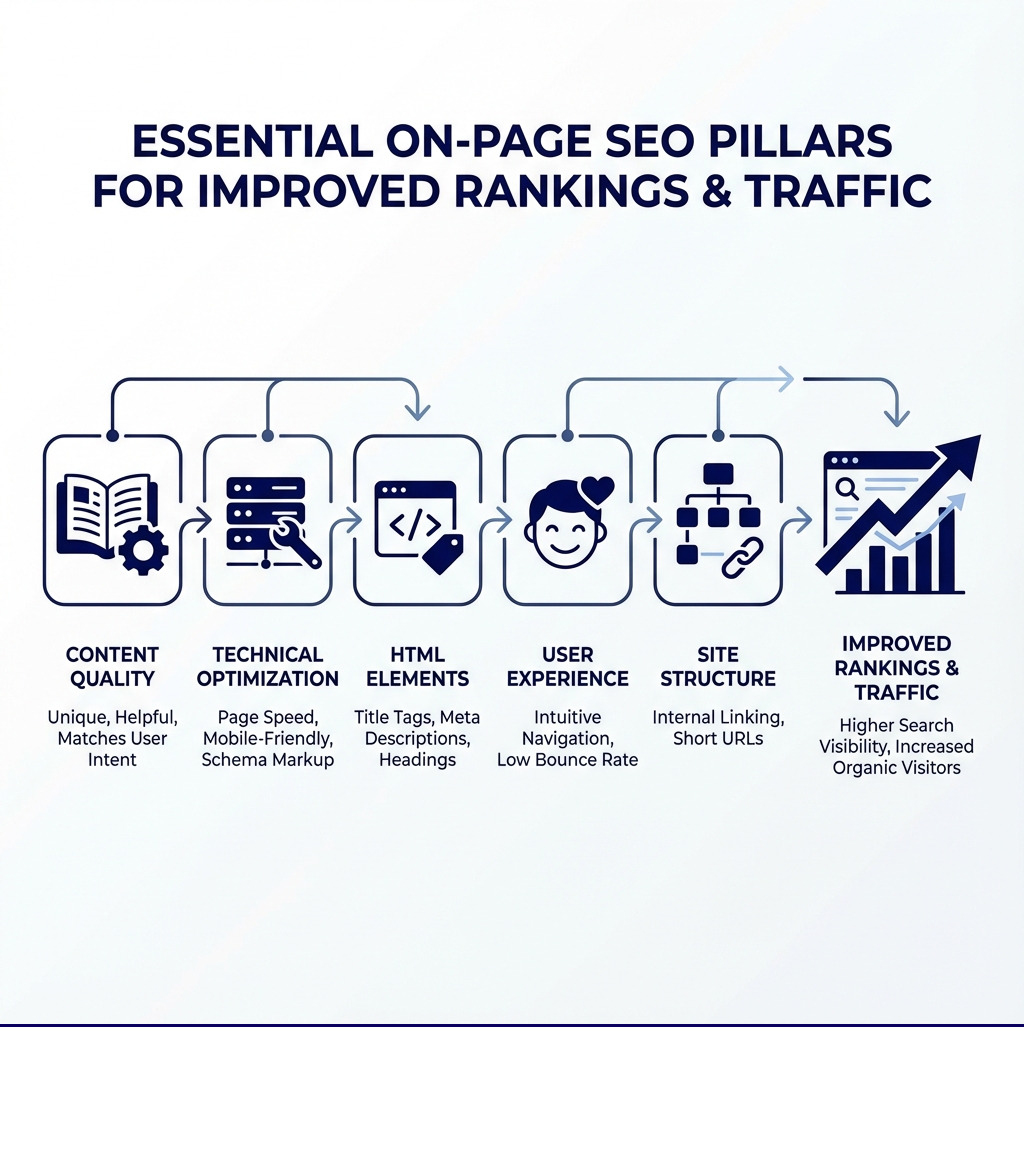
At the heart of effective SEO on page optimization techniques lies exceptional content and a clear understanding of keywords. Google’s algorithm constantly changes, but its focus on user experience remains. This means creating content that is uniquely valuable and genuinely helpful.

Matching Content to User Intent
Understanding “user intent” is crucial. Content must align with what users are searching for, whether their intent is informational (seeking answers), navigational (finding a specific site), commercial (researching a purchase), or transactional (ready to buy). To ensure your content matches user intent, MDM Marketing advises studying the top search results for your target keyword. Look at the format and content type that Google is already ranking. If your page doesn’t align, it likely isn’t meeting user intent. Google explicitly recommends focusing on “people-first content,” emphasizing that valuable content aligned with user intent is more important than ever.
The Role of Keywords in On-Page Optimization
Keywords bridge the gap between user searches and your content. Their strategic placement is a cornerstone of SEO on page optimization techniques. Strategically place keywords in your title tag, meta description, H1 heading, subheadings, the first paragraph, and throughout the body content. Also include them in image alt text and URLs for added relevance.
Don’t just chase high-volume terms. Long-tail keywords (longer, more specific phrases) often have lower search frequency but higher conversion rates. Tools like Google Keyword Planner are invaluable for finding relevant keywords. The goal is natural integration, not “keyword stuffing,” which is a spam policy violation and can harm your rankings.
Demonstrating E-E-A-T on Your Pages
Google’s quality guidelines emphasize E-E-A-T: Experience, Expertise, Authoritativeness, and Trustworthiness. While not a direct ranking factor, it’s a crucial guideline for creating high-quality content. For businesses in Canton, OH, demonstrating E-E-A-T can build significant local trust.
Here’s how to strengthen your E-E-A-T signals:
- Experience: Show first-hand experience with the topic through case studies or practical demonstrations.
- Expertise: Prove knowledge through author bios highlighting credentials and professional experience.
- Authoritativeness: Establish your site as an authority by citing reputable sources and producing comprehensive content.
- Trustworthiness: Build user confidence with transparent information, a secure site (HTTPS), and positive reviews.
MDM Marketing helps clients craft content strategies that inherently demonstrate E-E-A-T, ensuring their message resonates with both search engines and users. Learn more about how they approach this in their content marketing services. For further reading on this critical concept, explore these insights on E-E-A-T.
Optimizing On-Page HTML Elements for Search Engines and Users
Beyond the content, the underlying HTML elements of your webpage play a vital role in how search engines interpret and display your content. These elements act as crucial signals, guiding crawlers and influencing user perception in search results. Mastering these is a core part of SEO on page optimization techniques.
Crafting Click-Worthy Title Tags and Meta Descriptions
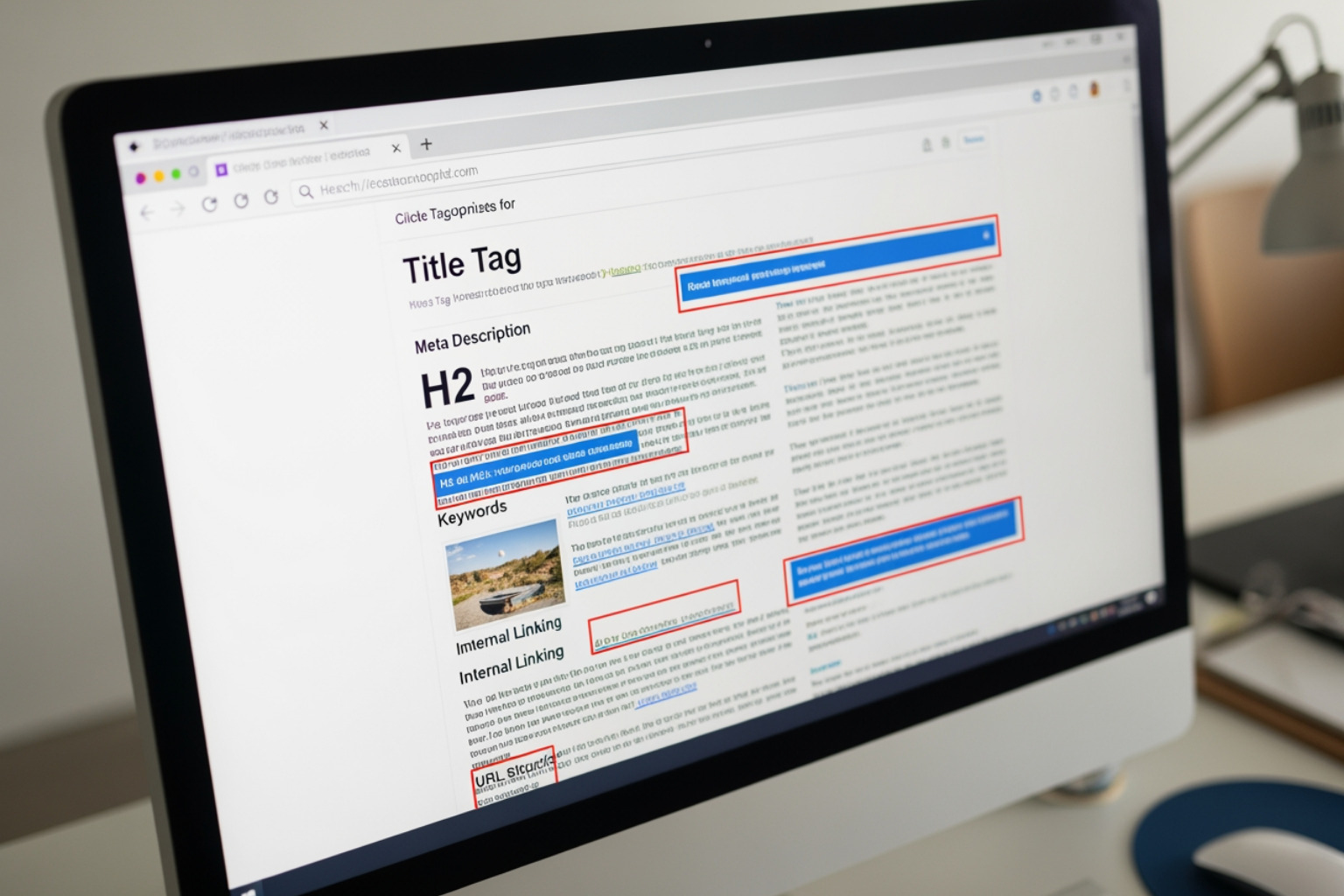
Your title tag and meta description are your page’s storefront in the search results, enticing users to click.
-
Title Tags: Arguably the most important on-page element. Keep them unique, 50-60 characters long, and place your primary keyword near the beginning. In MDM Marketing’s experience, this improves ranking chances. Use modifiers like “best” or “guide” to add appeal.
-
Meta Descriptions: While not a direct ranking factor, they impact click-through rates (CTR). Keep them around 120 characters for mobile, include your target keyword, use an active voice, and add a call-to-action (CTA) like “Learn more.”
A compelling title and meta description can be the difference between a user clicking your result or a competitor’s.
Structuring Content with Headings (H1-H6)
Headings provide structure for both users and search engine crawlers, making them a key part of SEO on page optimization techniques.
- H1 Tag: This is your main headline. Use only one H1 per page, and include your primary keyword.
- H2 and H3 Tags: Use these for subtopics. H2s break down the main topic, while H3s elaborate on points within an H2 section. For example, an H1 on “Local SEO Guide for Canton Businesses” could have an H2 for “Optimizing Your Google Business Profile.”
- H4, H5, H6 Tags: These are used for even finer details, though they are less common.
A clear heading hierarchy improves readability and helps search engines understand the content’s organization, contributing to better indexation.
Creating SEO-Friendly URLs
Your URL is a descriptor that influences both user experience and search engine understanding. Crafting SEO-friendly URLs is a straightforward yet impactful SEO on page optimization technique.
Google advises using simple URLs. Best practices include keeping them short and descriptive, including your primary keyword, using hyphens (-) to separate words, and using only lowercase letters. Avoid clutter like random numbers or parameters. An optimized URL for this article might be mdmmarketing.io/blog/seo-on-page-optimization-techniques/.
Well-structured URLs help Google create cleaner breadcrumbs in SERP snippets, which can improve visibility. For more tips on crafting effective online content, you can always read our blog.
A Deep Dive into Advanced SEO On-Page Optimization Techniques
As search engines become more sophisticated, so do the SEO on page optimization techniques required to excel. This section explores advanced strategies that go beyond basic content and HTML, focusing on performance, improved visibility, and comprehensive site architecture.

Mastering Page Speed and Core Web Vitals
Page speed is a confirmed Google ranking factor. If a page takes more than 3 seconds to load, users are likely to leave. Google’s Core Web Vitals measure real-world user experience for loading, interactivity, and visual stability:
- Largest Contentful Paint (LCP): Measures perceived load speed.
- First Input Delay (FID): Measures responsiveness.
- Cumulative Layout Shift (CLS): Measures visual stability.
Test your page speed with Google’s free PageSpeed Insights tool. It provides scores for mobile and desktop and offers actionable tips. With Google’s mobile-first indexing, optimizing for mobile speed is critical.
Winning with Schema Markup and Rich Snippets
Schema markup (structured data) is a powerful SEO on page optimization technique that improves visibility. It’s a vocabulary (from Schema.org) you add to your HTML to help search engines better understand your content.
While schema doesn’t directly boost rankings, it enables “rich snippets”—visually improved search results that stand out. These can include review stars, product prices, FAQ dropdowns, and event details. By providing this extra context, your listing becomes more appealing, leading to higher click-through rates. You can test your implementation using Google’s Rich Results Test.
Optimizing for AI Overviews and Featured Snippets
The rise of AI in search, including Google’s AI overviews, means optimizing for concise, direct answers is more important than ever. These features pull information from top-ranking pages to provide users with quick summaries.
To optimize for these coveted spots:
- Concise Answers: Provide clear, succinct answers to common questions early in your content.
- Q&A Format: Structure sections with explicit questions and direct answers.
- Lists and Tables: Use lists and tables to present information in an easily scannable format.
- Match User Intent: Ensure your content directly addresses the user’s query.
Search engines use AI to provide answers, and if your content isn’t optimized for these summaries, you risk losing visibility. MDM Marketing also helps businesses leverage AI; you can explore their AI integration services to see how.
Building a Logical Site Structure and Navigation
A well-organized website is essential for both users and search engine crawlers. A logical site structure and intuitive navigation are fundamental SEO on page optimization techniques.
- User Experience (UX): A clear structure helps users find information quickly. The “three-click rule” suggests a user should find any information with no more than three clicks from the homepage.
- Crawler Accessibility: A logical structure helps search engines find all your pages and understand your site’s hierarchy.
- Hub-and-Spoke Model: This involves creating comprehensive “pillar pages” (hubs) on broad topics that link to more detailed “cluster pages” (spokes). This model signals topical authority.
- Breadcrumbs: These navigational aids show users their location within the site hierarchy (e.g., Home > Blog > SEO), improving UX and providing context for search engines.
A robust site structure guides users and distributes “link equity” throughout your site. MDM Marketing specializes in building strategic websites that are both user-friendly and optimized for search. Discover how they build strategic websites that perform.
Technical Foundations for On-Page Success
Beyond content and HTML, technical elements ensure your site is understood by search engines and provides a seamless visitor experience. These are crucial SEO on page optimization techniques.
The Impact of Internal and External Linking
Linking strategies are critical for user experience and search engine understanding.
-
Internal Linking: These links connect pages within your website, helping crawlers find all your content and passing “link equity” (ranking power) between pages. Use descriptive, relevant anchor text (the clickable text) instead of “click here.”
-
External Linking: Linking to authoritative, high-quality external sources adds credibility to your content and builds trust. It shows you’ve done your research and can be a positive signal to Google.
MDM Marketing understands the power of a strategic linking strategy. They offer specialized link building services designed to improve your site’s authority and visibility.
Essential image optimization for seo on page optimization techniques
Images make content engaging, but they must be optimized to avoid slowing down your site. This vital SEO on page optimization technique includes:
- Alt Text: Write a descriptive alt text for each image. This helps screen readers for accessibility and tells search engines what the image is about. Keep it concise and include relevant keywords naturally.
- Descriptive Filenames: Use keyword-rich filenames like
canton-oh-pizza-restaurant.jpginstead ofIMG_12345.jpg. - Image Compression: Compress images to reduce file size (aim for under 100kB) without losing quality to improve page speed.
- Lazy Loading & Modern Formats: Implement lazy loading so images load as users scroll, and use efficient formats like WebP.
The Importance of Mobile-Friendliness and HTTPS
Two non-negotiable technical aspects for modern SEO are mobile-friendliness and security.
-
Mobile-Friendliness: With a majority of internet traffic coming from mobile, optimization is critical. Google operates on a “mobile-first indexing” principle, meaning it primarily ranks your site based on its mobile version. A responsive design that adapts to any screen size is the best practice.
-
HTTPS (Website Security): HTTPS is a lightweight ranking signal that encrypts data and builds user trust. Browsers often flag non-secure HTTP sites, deterring visitors. Obtaining an SSL certificate is easy, with free options available from providers like Let’s Encrypt.
Monitoring Website Uptime and Accessibility
Your site’s technical health includes its availability and inclusivity.
-
Website Uptime: Frequent downtime means search engines can’t crawl your site and users can’t access it, leading to lost rankings. Monitoring uptime helps you resolve outages quickly.
-
Accessibility: Making your site accessible to users with disabilities is good practice and aligns with SEO principles. Following the Web Content Accessibility Guidelines (WCAG) often improves user experience for everyone, which search engines favor.
Ensuring your website is always online and accessible to all users strengthens its foundation. If you’re looking for an expert review of your site’s technical health and accessibility, don’t hesitate to contact us for a site audit.
Frequently Asked Questions about On-Page SEO
How does on-page SEO differ from off-page SEO?
On-page SEO involves optimizations you apply directly on your website, like content and HTML code. It’s what you can control. Off-page SEO involves activities outside of your website that build authority, such as earning backlinks and brand mentions. Both are crucial, but on-page SEO is the foundation.
How often should I update existing content for SEO?
Regularly refreshing content is a vital SEO on page optimization technique. Review high-impact pages every 6 to 12 months to keep them relevant, accurate, and aligned with user intent. Updating content signals to Google that your site is current and valuable, which can help maintain or improve rankings.
What are the most common on-page SEO mistakes to avoid?
Avoiding common pitfalls is as important as implementing best practices. Key mistakes to steer clear of include:
- Keyword Stuffing: Unnaturally repeating keywords, which harms readability and can lead to penalties.
- Duplicate or Thin Content: Publishing pages with identical or low-value content.
- Ignoring User Intent: Creating content that doesn’t match what users are looking for.
- Slow Page Speed: Neglecting load times, which leads to high bounce rates.
- Neglecting Mobile Optimization: Failing to ensure your site works well on mobile devices.
- Weak Metadata: Using generic or missing title tags and meta descriptions.
- Poor Internal Linking: Not strategically linking related pages together.
- Unoptimized Images: Using large files or missing descriptive alt text.
- No Structured Data: Missing out on rich snippets by not using schema markup.
Conclusion
Mastering SEO on page optimization techniques is not a one-time task but an ongoing commitment to excellence. It’s about continuously refining your content, perfecting your HTML elements, enhancing your site’s technical performance, and always prioritizing the user experience. By focusing on these core principles, businesses in Canton, OH, and beyond can build a robust online presence that stands the test of time and algorithm updates.
The digital landscape is changing, with new challenges like AI overviews and Core Web Vitals constantly reshaping the rules. Staying ahead requires vigilance, adaptability, and a deep understanding of what makes a website truly valuable.
MDM Marketing is dedicated to helping businesses steer this complexity. They bring expertise in crafting data-driven strategies that deliver measurable results, ensuring your website isn’t just visible, but also authoritative and effective. If you’re looking to lift your organic presence and achieve sustainable growth, partnering with experts can make all the difference. Explore their comprehensive outsourced SEO services to see how they can transform your digital strategy.
About Jay McCullough
This author hasn't written a bio yet.