
Why the Importance of Transparent Reporting in Digital Marketing Cannot Be Ignored
The importance of transparent reporting in digital marketing comes down to one thing: trust. When clients can see exactly what their budget is doing and why decisions are being made, the entire agency-client relationship gets stronger.
Here is a quick summary of why it matters:
- Builds trust – Clients feel confident when they can see real data, not polished summaries
- Drives better decisions – Accurate, honest metrics help both sides act on facts, not guesswork
- Reduces wasted spend – Companies with transparent marketing analytics have reduced wasted ad spend by up to 28%
- Improves accountability – Clear reporting holds agencies responsible for results
- Strengthens long-term relationships – Honesty about both wins and losses creates partnerships that last
Most businesses hiring a digital marketing agency want one thing above all else: to know their investment is working. But too often, reports are filled with vanity metrics, confusing jargon, or numbers that look good on paper but say nothing meaningful.
That gap between what clients receive and what they actually need to make decisions? That is the transparency problem.
And it is a big one. According to research, 86% of consumers say authenticity is a key factor when choosing which brands to support. The same expectation applies to the agencies those brands hire.
Transparent reporting is not just about sharing numbers. It means being open about strategies, explaining what is working and what is not, and giving clients real ownership over their own data.
This guide covers everything you need to know about building a transparent reporting culture, from the right tools and KPIs to handling poor results without spinning the story.
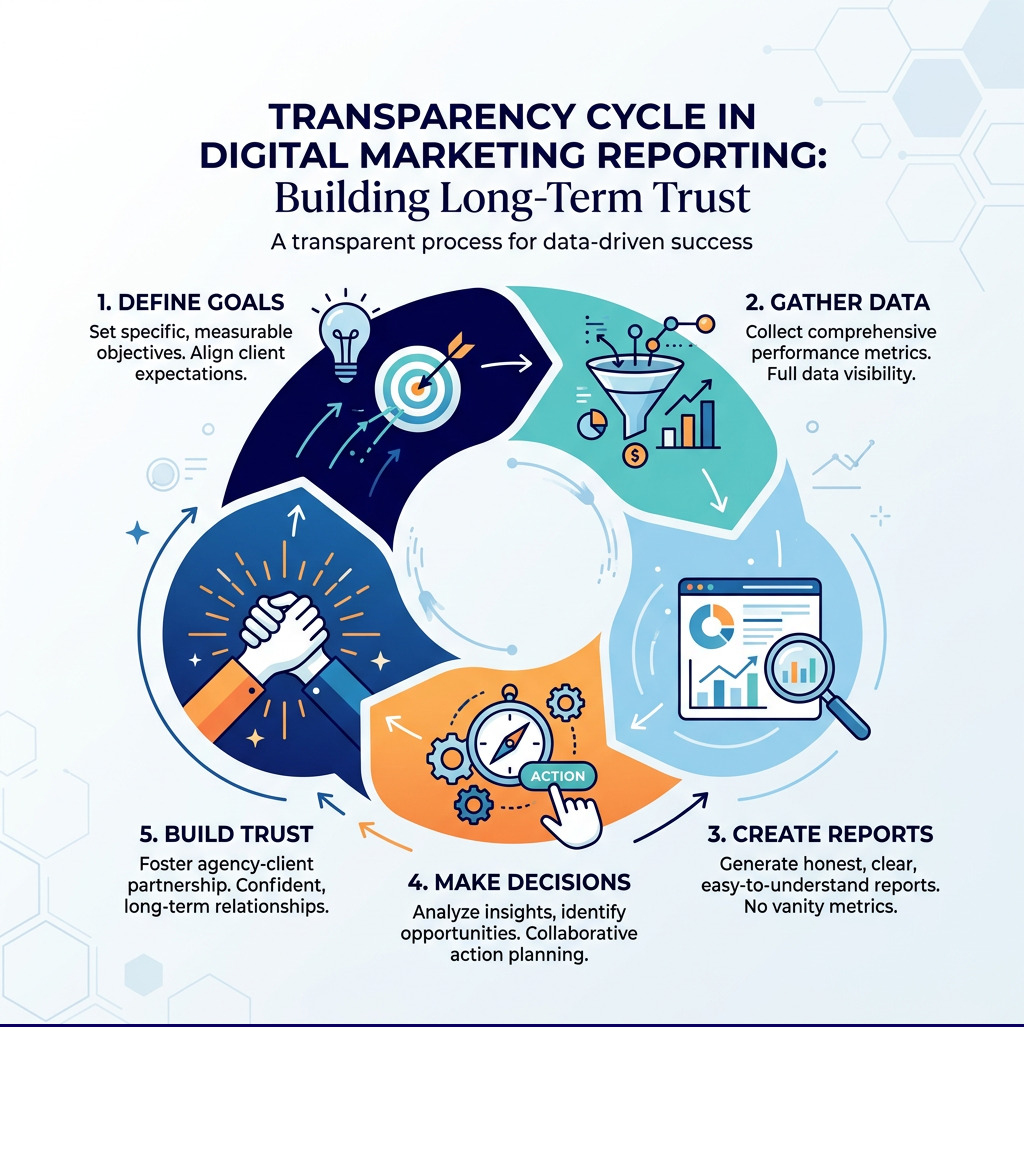
The Importance of Transparent Reporting in Digital Marketing for Long-Term Success
In the world of online advertising, transparency is no longer a “nice-to-have” feature; it is a competitive necessity. Indeed defines transparent marketing as an approach where an organization strategically makes its logistical and personal information available, such as budgets and staff names. In a reporting context, this means pulling back the curtain on exactly how a campaign is performing, where the money is going, and who is doing the work.

When an agency embraces the importance of transparent reporting in digital marketing, they are essentially inviting the client to be a partner rather than just a paycheck. This openness leads to higher client loyalty because there are no “black boxes” or hidden agendas. According to Forbes on building trust, transparency naturally builds a bridge between a business and its customers, making the brand feel more approachable and familiar.
For a business owner, knowing the strategy behind the numbers is just as important as the numbers themselves. Transparent reporting provides a clear view of the agency’s process, from keyword selection in SEO to audience targeting in PPC. This level of disclosure ensures that the agency’s efforts stay perfectly aligned with the client’s brand voice and long-term vision.
The Importance of Transparent Reporting in Digital Marketing for Accountability
Accountability is the bedrock of any professional service. In digital marketing, this means providing verifiable metrics and auditable data. Instead of sending a static PDF once a month that only shows the “good” numbers, transparent agencies provide real-time insights. This allows clients to see the raw data as it happens, ensuring that the messaging remains honest and the results are not being “sugarcoated.”
Learning how to interpret this data is a journey in itself. Mastering marketing analytics involves understanding the specific skills and data points that actually move the needle for a business. By focusing on auditable data, agencies prove they have nothing to hide. If a campaign hits a snag, the data will show it—and a transparent agency will be the first to point it out and suggest a fix.
Driving Growth Through the Importance of Transparent Reporting in Digital Marketing
Transparency doesn’t just make people feel good; it drives actual business growth. When data is shared openly, it empowers stakeholders to make informed decisions. If the reports show that a specific social media channel is underperforming while email marketing is booming, the budget can be shifted immediately to maximize returns.
This makes ROI much more predictable. When you calculate your content marketing ROI, you need honest numbers to know if your investment is paying off. Transparent reporting ensures that the “Return” part of that equation is based on actual revenue and conversions, not just “likes” or “impressions.” This accuracy fosters long-term loyalty, as clients are more likely to stick with an agency that consistently demonstrates its value through clear, honest growth metrics.
Essential Tools and Data Practices for Reliable Reporting
To provide truly transparent reports, agencies must move beyond manual spreadsheets, which are prone to human error and “cherry-picking.” The right tools can automate data collection, ensuring that the information is both accurate and up-to-date.

One of the most critical steps in reliable reporting is data cleaning. This involves removing “noise” like bot traffic or internal clicks that can skew results. For example, a sudden spike in website traffic might look great on a report, but if 90% of that traffic came from a bot farm, it’s a vanity metric that doesn’t help the business. Proper data validation ensures that every click and conversion reported is legitimate.
Several platforms make this process easier:
- Interactive Dashboards: Powerful tools that connect naturally with platforms like Google Ads and GA4 to create dynamic, real-time visualizations.
- Enterprise Analytics: Solutions ideal for large teams that turn complex data sets into clear visualizations with detailed drill-down capabilities.
- Data Connectors: Essential services that pull marketing data from various sources (Meta Ads, LinkedIn, TikTok) into a single destination for easier analysis.
For agencies that want to provide a professional, branded experience, white label SEO reports allow the data to be presented in a clean, easy-to-digest format that reinforces the agency’s brand while maintaining total data integrity.
Defining Goals, KPIs, and Reporting Frequency
Transparency starts long before the first report is sent. It begins with defining SMART goals (Specific, Measurable, Achievable, Relevant, and Time-bound). If the client and agency aren’t on the same page about what “success” looks like, the reports will never feel transparent.
Agencies should work with clients to select 5–7 Key Performance Indicators (KPIs) that directly impact the bottom line. Once these are set, a reporting rhythm should be established:
- Weekly Check-ins: Brief updates via email or messaging to track immediate campaign activity.
- Monthly Strategy Calls: A deeper dive into the data to see what worked, what didn’t, and how to adjust for the next month.
- Quarterly Business Reviews (QBRs): High-level meetings to discuss long-term growth, budget shifts, and overall ROI.
Using a white label SEO dashboard gives clients 24/7 access to their metrics, so they never have to wait for a meeting to know how their campaigns are performing.
Overcoming Challenges and Handling Negative Performance
Even the best marketing campaigns face challenges. The real test of an agency’s transparency is how they handle bad news. A common struggle in the industry is campaign attribution—knowing exactly which ad or blog post led to a sale. In fact, 78% of marketers struggle with attribution.
Instead of hiding behind vanity metrics (like “total impressions”) when sales are down, a transparent agency will dig into the “why.” They might find that a dip in performance is due to seasonality, a technical glitch on the website, or a change in a search engine’s algorithm.
| Metric Type | Examples | Value to Business |
|---|---|---|
| Vanity Metrics | Impressions, Likes, Follows | Low (Good for awareness only) |
| Business KPIs | Conversion Rate, Cost Per Lead, ROI | High (Directly impacts revenue) |
When performance is negative, the rule is: No sugarcoating. If a campaign failed, say so. Explain the factors involved, show the data, and—most importantly—present a clear plan for optimization. This data-driven marketing approach turns a “failure” into a learning opportunity that actually strengthens the client’s trust.
Fostering an Internal Culture of Transparency
Transparency isn’t just an external promise; it has to be part of the agency’s DNA. This means training and upskilling staff to value honesty over “looking good.” Internal project management tools can help track tasks and progress, making it easy for anyone on the team to provide a status update to a client at a moment’s notice.
Open dialogue should be encouraged within the agency. If a junior account manager notices a campaign isn’t performing well, they should feel empowered to bring it up to leadership so it can be addressed with the client immediately. This internal accountability ensures that the external reports are always backed by a team committed to the truth.
Frequently Asked Questions about Transparent Reporting

How does transparency impact client retention?
Transparency is the “secret sauce” for high retention. When clients feel they have a clear view of their investment, they are less likely to feel anxious during slow months. Authenticity and credibility create a foundation of trust that can weather the ups and downs of the market. MDM Marketing, for example, maintains a 93% client retention rate largely because of its commitment to clear communication and measurable outcomes.
What are the most important KPIs to track?
While every business is different, the most impactful KPIs usually include:
- Conversion Rate: The percentage of visitors who take a desired action.
- Cost Per Lead (CPL): How much it costs to acquire a potential customer.
- Customer Lifetime Value (CLV): The total revenue a business can expect from a single customer account.
- Return on Investment (ROI): The ultimate measure of whether the marketing spend is generating profit.
How should agencies handle poor campaign results?
The best approach is a three-step process:
- Acknowledge: Don’t wait for the client to ask about the dip.
- Analyze: Use data to identify the cause (e.g., seasonality or competitor activity).
- Action: Present a concrete plan for next steps and optimizations.
Conclusion
When 95% of consumers read reviews before making a purchase, your reputation as a business—and as an agency—is everything. The importance of transparent reporting in digital marketing cannot be overstated. It is the difference between a short-term vendor and a long-term strategic partner.
MDM Marketing understands that ethical advertising and data-driven strategies are the keys to sustainable growth. By providing end-to-end services with a heavy emphasis on transparent reporting, they help businesses in Canton, OH, and beyond transform their online presence. Whether it is through Local SEO, link building, or advanced PPC management, the goal remains the same: measurable outcomes and total honesty.
If you are ready to move away from confusing reports and toward a partnership built on trust and results, it is time to take the next step.
Contact MDM Marketing today to see how transparent, data-driven strategies can drive your business forward.
About Jay McCullough
This author hasn't written a bio yet.