
Why Marketing Data Analysis is Your Path to Measurable Growth
Marketing data analysis is the process of collecting, measuring, and interpreting data from your marketing efforts to make better business decisions. Here is what you need to know:
- What it is: Tracking metrics like website traffic, email performance, and ad spend to understand what is working.
- Why it matters: It turns guesswork into strategy, helping you spend smarter and grow faster.
- Key benefit: Shows exactly where your marketing dollars deliver the best return.
- Common challenge: 41% of marketing teams admit they are not confident collecting or analyzing data.
- The solution: Start with clear questions, focus on relevant metrics, and use tools that match your skill level.
You might be looking at dashboards where traffic is up, but sales are flat. While 59% of marketing teams say they are data-driven, many struggle to turn numbers into decisions that move the needle. Marketing data analysis is a learnable skill that starts with asking the right questions for your specific business goals.
To make that practical, it helps to separate vanity metrics (numbers that look good but do not reliably drive revenue) from decision metrics (numbers you can act on). For example, a spike in impressions or followers can be encouraging, but it is only useful if it leads to measurable progress like more qualified leads, lower acquisition costs, or higher repeat purchase rates.
A simple way to keep your analysis grounded is to translate business goals into questions like:
- Which channel is bringing the highest-quality leads, not just the most clicks?
- Where in the funnel are prospects dropping off (landing page, form, checkout, or follow-up)?
- What messages, offers, or audiences improve conversion rate without increasing costs?
This guide walks you through the tools, challenges, and strategies to turn spreadsheets into actions that grow your business.
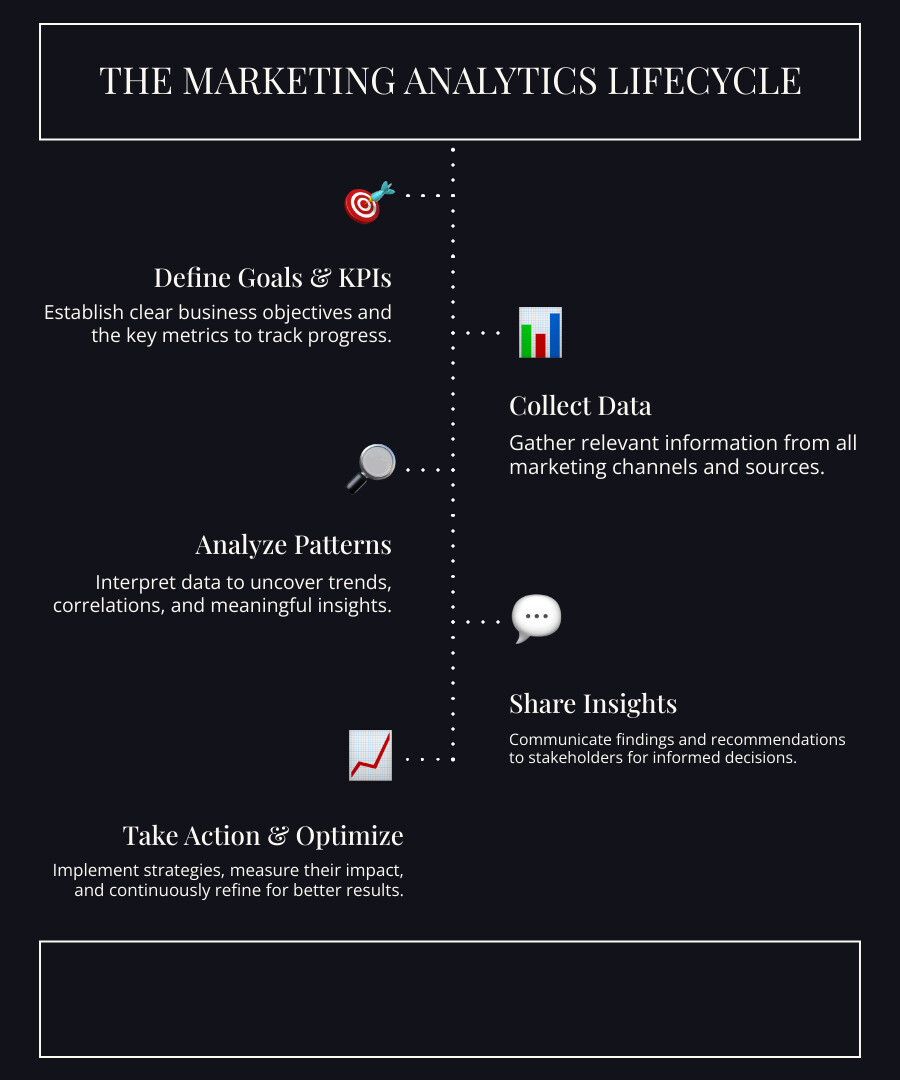
What is Marketing Data Analysis and Why Does It Matter?
Marketing data analysis involves changing raw data into meaningful business insights to optimize your strategies. It acts as a compass in an increasingly complex digital landscape. As Harvard Business Review notes, marketing analytics provides “improved precision and performance” Quantifying the Impact of Marketing Analytics.
Data-driven marketing allows you to move beyond guesswork, ensuring your efforts are targeted and effective. It helps you:
- Understand Your Customer: Gain deep insights into behaviors and preferences.
- Optimize Performance: Identify what is working to refine campaigns and allocate resources efficiently.
- Boost Profitability: Make informed decisions that lead to increased sales and better customer retention.
- Stay Ahead: Anticipate market shifts and consumer behavior changes.
Translating customer data into actionable decisions is key to data-driven marketing, which is essential for success in the digital age.

Strategic, Operational, and Tactical Frameworks
-
Strategic Analytics: This big-picture view focuses on long-term planning and high-level decisions, such as market entry or customer lifetime value trends. It ensures marketing efforts align with core objectives and strategic marketing services visibility.
-
Operational Analytics: This framework deals with day-to-day optimization, such as identifying the best times for social media engagement or identifying bottlenecks in an email marketing funnel.
-
Tactical Analytics: Supporting short-term decision-making, tactical analytics focuses on immediate adjustments to active campaigns, such as real-time changes to ad creative or budget allocation.
Key Benefits for Modern Businesses
- Improved Decision-Making: Marketing teams can make informed, data-backed decisions instead of relying on gut feelings.
- Improved Customer Understanding: Analyzing behavior enables personalized messaging. Mastering Effective Web Marketing Strategies for Modern Needs emphasizes this customer-centric approach.
- Optimized Marketing Performance: Pinpoint underperforming campaigns to cut wasted budget and double down on high-ROI strategies.
- Predictive Capabilities: Forecast outcomes like customer churn or purchase propensity. ASOS, for instance, uses predictive analytics to manage inventory and improve satisfaction.
- Budget Efficiency: Allocate your marketing budget with precision. Limango reduced cost-per-lead by 20% after automating product feed exclusions.
Essential Tools for Modern Marketing Analytics
The right tools automate data collection and provide platforms for visualization, turning complex data into manageable insights.
Core Technologies for Marketing Data Analysis
- Web Analytics Platforms: Tools track website traffic and user behavior.
- CRM Systems: Platforms manage customer interactions throughout the sales funnel.
- SEO Tools: Professional software is vital for monitoring keyword rankings and competitor analysis, often integrated with automated SEO solutions.
- Social Media & Email: Platforms track engagement and conversion metrics for social and email campaigns.
- Customer Data Platforms (CDPs): Systems consolidate data from various sources to create a unified customer profile, contributing to an online visibility boost.
Visualization and Business Intelligence Platforms
- Data Visualization Tools: Business intelligence platforms transform raw numbers into interactive dashboards and charts.
- Data Storytelling: Visualizing findings helps communicate takeaways to stakeholders and showcases results-driven SEO outcomes.
- Interactive Reporting: Modern BI platforms allow users to drill down into data to answer specific questions proactively.
Overcoming Common Implementation Challenges
While the promise of analytics is immense, businesses often encounter technical and human problems.
Solving Data Quality and Integration Issues
- Data Quality: “Dirty data” can lead to inaccurate insights. Best practices include implementing automated validation checks and conducting regular audits to rectify inconsistencies.
- Data Integration: Marketing data often resides in silos. A unified strategy using a CDP or APIs can consolidate this information. A unified view is essential for accurate analysis. Services like SEO audit services white label and white label SEO services help ensure accuracy. Some businesses use outsourced SEO to manage these complexities.

Navigating Privacy and Skills Gaps
- Privacy Concerns: Regulations like GDPR and CCPA require responsible data handling. Balancing deep insights with ethical standards is a crucial act.
- Skill Gaps: Many teams lack the technical literacy to analyze data effectively. Investing in training or hiring specialists is necessary to bridge this gap.
- Resource Constraints: Small businesses may face tool overload. Prioritizing initiatives and leveraging automation—like Mazama, which cut reporting time by 85%—is key.
- Conversion Problems: Analytics can diagnose why 70% of shoppers abandon carts, helping fix conversion issues rather than just acquisition.
Turning Raw Data into Actionable Insights
Change happens when you move from “what happened” to “why it happened” and “what to do next.”
| Metric Aspect | Correlation | Causation |
|---|---|---|
| Definition | Two variables move in tandem. | One variable directly causes the other to change. |
| Marketing Example | Social media likes and website traffic both increasing. | A 20% discount code directly resulting in 50 new sales. |
| Strategic Value | Identifies potential areas for deeper investigation. | Provides a proven lever for scaling results. |
Applying Insights Across Marketing Channels
- Social Media: Analyze engagement and reach to identify top-performing content and optimal posting times.
- Email Marketing: Monitor open rates and CTR. A/B testing can reveal if emojis or specific send times improve performance.
- Content Marketing: Track time spent on page and bounce rates to understand what resonates. Conversion rate optimization SEO helps refine these pages.
- Paid Advertising: Optimize ROAS and revenue and customer acquisition costs by using attribution models.
- UX: Heatmaps and funnels visualize user journeys, highlighting where mobile or desktop users drop off.
Emerging Trends
- AI and Machine Learning: Power predictive modeling and automated insights generation.
- Real-Time Analytics: Enables immediate responses to campaign performance fluctuations.
- Advanced Attribution: Multi-touch models provide a clearer view of the customer journey.
- Voice and Visual Search: Analyzing these modalities informs future SEO and content strategies.
- Augmented Analytics: Uses AI to make data preparation and explanation accessible to a broader range of users.
Frequently Asked Questions about Marketing Analytics
How can small businesses leverage marketing analytics effectively?
Start simple by using web analytics tools. Focus on 2-3 “North Star” metrics tied to business goals, such as lead generation or customer acquisition cost. Use these insights to refine messaging and optimize campaigns iteratively.
What is the difference between marketing analytics and market analysis?
Marketing analytics focuses on your own performance (e.g., did an email drive sales?). Market analysis examines the external environment, including industry trends, competitors, and overall market demand. One looks inward; the other looks outward.
How do predictive analytics transform marketing strategies?
Predictive analytics uses historical data and machine learning to forecast future behaviors. It allows marketers to anticipate customer churn, personalize experiences at scale, and optimize resource allocation proactively rather than reactively. This strengthens brand equity and improves lead scoring efficiency.
Conclusion
Mastering marketing data analysis provides the clarity needed to thrive in a competitive landscape. It transforms information into a strategic advantage, driving measurable growth. For businesses looking to steer this complexity, partnering with experts can accelerate results.
MDM Marketing, based in Canton, OH, helps brands grow through data-driven strategies. With a 93% client retention rate and an average 280% ROI increase, the agency emphasizes continuous monitoring and performance marketing company standards to ensure sustainable growth.
Don’t let your data go to waste. Transform your numbers into actionable insights today.
About Jay McCullough
This author hasn't written a bio yet.