
Why Competitive Analysis Marketing Is Your Secret Weapon
Competitive analysis marketing is the systematic process of identifying, researching, and evaluating your competitors to inform your own marketing strategy and gain a sustainable advantage in your market.
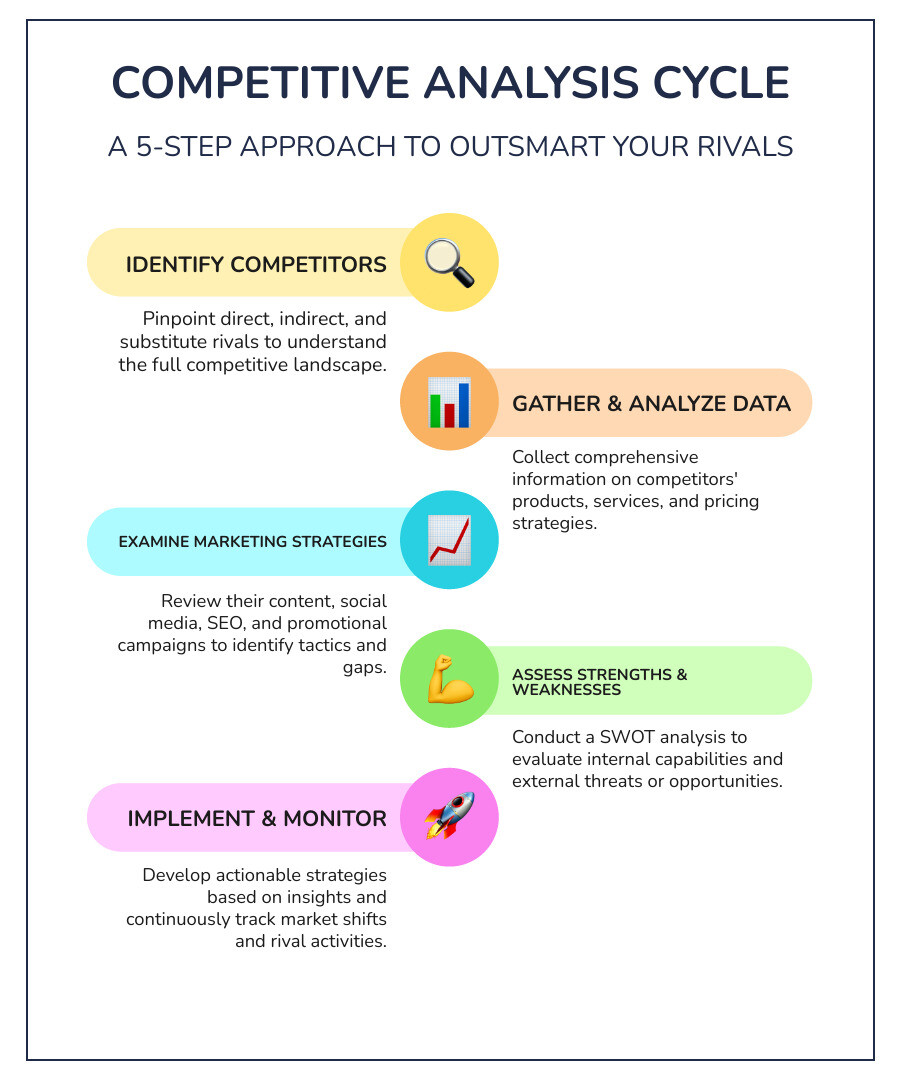
Quick Answer: How to Conduct Competitive Analysis Marketing
- Identify competitors – Find direct, indirect, and substitute rivals serving your target market
- Gather data – Collect information on their products, pricing, marketing tactics, and digital presence
- Analyze products and services – Compare features, quality, and positioning against your own
- Study pricing strategies – Understand how competitors price and structure their offers
- Examine marketing efforts – Review their content, social media, SEO, and promotional campaigns
- Perform SWOT analysis – Map strengths, weaknesses, opportunities, and threats
- Create action plan – Turn insights into concrete marketing and business strategies
- Monitor continuously – Update your analysis every 6-12 months or when market conditions shift
Here’s why this matters: businesses that regularly conduct competitive analysis are 3x more likely to achieve significant revenue growth. They don’t just react to market changes—they anticipate them.
Think about it. Without understanding what your competitors are doing, you’re essentially marketing blind. You might invest thousands in a campaign only to find a competitor already owns that messaging. Or worse, you might miss a massive market gap that could have been yours.
The irony is that many businesses skip this step entirely or do it once and never revisit it. As one academic researcher noted, “Managerial myopia in identifying competitive threats is a well-recognized phenomenon.” Companies focus on obvious rivals while missing threats from new market entrants or indirect competitors offering substitute solutions.
But competitive analysis isn’t about copying what others do. It’s about understanding the landscape so you can carve out your own unique position. It’s about learning from others’ successes and failures. And most importantly, it’s about making data-driven decisions instead of guessing.
Whether you’re a startup fighting for visibility or an established business defending market share, competitive analysis gives you the intelligence you need to win.
What is Competitive Analysis Marketing and Why It Matters
At its core, competitive analysis marketing is a strategic evaluation that goes beyond just “keeping an eye on the other guy.” It is a disciplined investigation into the marketing tactics of your rivals—whether they are the shop next door in Canton, OH, or a national digital powerhouse.
When you engage in Strategic Marketing Services for Visibility, you are essentially building a defensive and offensive playbook. Offensively, you are looking for market gaps—unmet customer needs that your competitors are ignoring. Defensively, you are identifying potential threats to your market share before they become crises.
Research shows that companies actively monitoring their rivals are 2.5x more likely to capitalize on market gaps. This isn’t just about being “stalker-ish” (though some marketers joke about it); it’s about understanding consumer behavior and economic trends to reduce business risk. By performing a Scientific research on competitor identification, businesses can move from a reactive posture to a proactive strategy.
Imagine you’re an athlete. You wouldn’t walk onto the field without watching film on your opponent, right? Marketing is no different. Over 70% of businesses report that competitive analysis has directly led to improvements in their product development. It provides a benchmark for performance, ensuring your unique value proposition actually remains unique.
Identifying Your Direct, Indirect, and Substitute Rivals
One of the biggest mistakes in competitive analysis marketing is having a narrow field of vision. If you only look at your most obvious rivals, you might fall victim to “competitor myopia.” To build a truly comprehensive view, you must categorize rivals based on market commonality (the needs they serve) and resource similarity (how they serve them).
A great starting point for local businesses is the North American Industry Classification System (NAICS). This system provides codes for every type of business, allowing you to find industry benchmarks for average company size, operating expenses, and even employee wages. It helps you see where you stand against the “standard” for your niche.
Beyond the basics, you should also look for aspirational competitors—the “big fish” who are setting the trends you want to follow. Achieving an Online Visibility Boost often requires looking at how these top-tier players engage their audience and then adapting those high-level tactics for your local market.
Categorizing Competitors for Effective Competitive Analysis Marketing
To keep your research organized, it helps to break competitors into three distinct buckets:
- Direct Competitors (Brand Competition): These businesses offer the same products or services to the same audience at similar price points. If you sell coffee in Canton, the other coffee shop three blocks away is your direct competitor.
- Indirect Competitors (Generic/Form Competition): These businesses serve the same customer need but with different products. For our coffee shop, a juice bar or a fast-food restaurant that serves breakfast is an indirect competitor.
- Substitute Competitors: These are the “wild cards.” They offer a completely different solution to the same problem. A grocery store selling “at-home” espresso kits is a substitute competitor for a local cafe.
| Competitor Type | Product/Service | Target Audience | Example (Local Context) |
|---|---|---|---|
| Direct | Nearly identical | Same as yours | Local construction firm vs. local builder |
| Indirect | Different but related | Overlapping | Home Depot (DIY) vs. Professional Contractor |
| Substitute | Different solution | Same problem solved | Rental property vs. Home buying |
6 Essential Steps to Conduct a Comprehensive Analysis

Now that you know who you’re looking at, it’s time to roll up your sleeves and get to work. Effective competitive analysis marketing follows a structured process to ensure no data point is missed.
- Define Your Goals: Are you trying to optimize your pricing, improve your SEO, or launch a new product? Knowing your objective keeps you from getting overwhelmed by data.
- Identify Your Top 5-10 Rivals: Use a mix of direct and indirect competitors, including both established leaders and scrappy startups.
- Gather the Intel: Look at the “Four Ps”—Product, Price, Place, and Promotion. What are they selling? How much does it cost? Where are they selling it? How are they talking about it?
- Analyze Their Digital Presence: Use tools to check their search engine rankings, social media engagement, and website traffic. This is where Business Scaling Solutions often begin—by finding out where the competition is winning online.
- Evaluate Customer Sentiment: Read their Google reviews and social media comments. What are their customers complaining about? Those complaints are your opportunities.
- Synthesize and Act: Don’t just collect data; use it. Translate your findings into Mastering Effective Web Marketing Strategies for Modern Needs.
Gathering Data and Estimating Private Company Revenue
One of the hardest parts of competitive research is finding financial data for private companies. Since they don’t have to publish annual reports, you have to get a little creative. A useful trick involves using LinkedIn metrics and “financial proxies.”
First, find the competitor’s company profile on LinkedIn to see their employee count. Then, apply a multiplier based on their funding status:
- Heavily-funded/High-growth: Estimate $100,000 in revenue per employee.
- Well-funded/Stable: Estimate $150,000 per employee.
- Modestly funded/Established: Estimate $200,000 per employee.
While this isn’t an exact science, it provides a “ballpark” figure to help you understand their resource levels. You can supplement this with Market Research and Competitive Analysis resources from the SBA, which offer free data on industry trends and economic indicators.
Leveraging SWOT and Porter’s Five Forces in Competitive Analysis Marketing
To turn raw data into a strategy, you need frameworks. Two of the most powerful are SWOT and Porter’s Five Forces.
A SWOT analysis helps you map out:
- Strengths: What does the competitor do better than everyone else?
- Weaknesses: Where do they struggle? (e.g., poor mobile website, slow response times).
- Opportunities: Can you fill a gap they’ve left open?
- Threats: Are they moving into your territory or lowering prices?
Meanwhile, Porter’s Five Forces Analysis looks at the broader market attractiveness:
- Competitive Rivalry: How intense is the fight for customers?
- Threat of New Entrants: How easy is it for a new company to start up?
- Supplier Power: Can your suppliers easily raise prices on you?
- Buyer Power: Do your customers have many other options to choose from?
- Threat of Substitutes: How likely are customers to switch to a different type of solution?
Using these frameworks in conjunction with SEO Audit Services (White Label) allows you to see the “big picture” and the technical details at the same time.
Frequently Asked Questions about Competitive Analysis
How often should a competitive analysis be updated?
Think of your competitive analysis like a living document, not a “one-and-done” project. It’s good business practice to conduct a full, deep-dive report at least once a year. However, in fast-moving industries, a quarterly refresh is highly recommended.
If you notice a sudden drop in your leads or a new player enters the Canton market, you should do a real-time check. Regularly updating your reports can increase your ability to adapt to market changes by up to 50%.
What are the risks of focusing too much on competitors?
While knowledge is power, “competitor obsession” can be dangerous. One major risk is confirmation bias—only looking for data that proves you’re better than the competition while ignoring areas where they are actually winning.
Another risk is strategic myopia, where you become so focused on copying a rival’s moves that you lose your own innovative edge. You don’t want to be a “market follower” who just imitates; you want to be a leader who uses competitive data to forge a new path. Always balance competitive insights with your own unique brand identity.
How can I use competitive insights to improve my SEO?
This is where competitive analysis marketing gets really technical and rewarding. By analyzing your rivals’ digital footprints, you can identify “keyword gaps”—terms they are ranking for that you haven’t targeted yet.

You can also look at their backlink profiles to see which websites are pointing to them. If a local Canton news site or trade association links to your competitor, they might be willing to link to you too. Monitoring “share of voice” (how often your brand is mentioned compared to others) helps you understand your market authority. Businesses that use these insights are 40% more likely to achieve a unique market positioning.
Conclusion
Mastering competitive analysis marketing is the difference between guessing your way through a campaign and executing a data-driven growth plan. By identifying your rivals, gathering deep intelligence on their tactics, and applying frameworks like SWOT, you can turn their weaknesses into your greatest opportunities.
At MDM Marketing, we specialize in helping businesses in Canton, OH, and beyond transform these insights into measurable outcomes. With a 93% client retention rate and an average 280% ROI increase, our team knows how to steer the competitive terrain to find the path to sustainable growth. We don’t just provide data; we provide a blueprint for success.
Ready to outsmart your competition and claim your place as a market leader? Contact Us today for a custom strategy that puts you ahead of the curve.
About Jay McCullough
This author hasn't written a bio yet.