
Why Data-Driven Advertising Matters Now More Than Ever
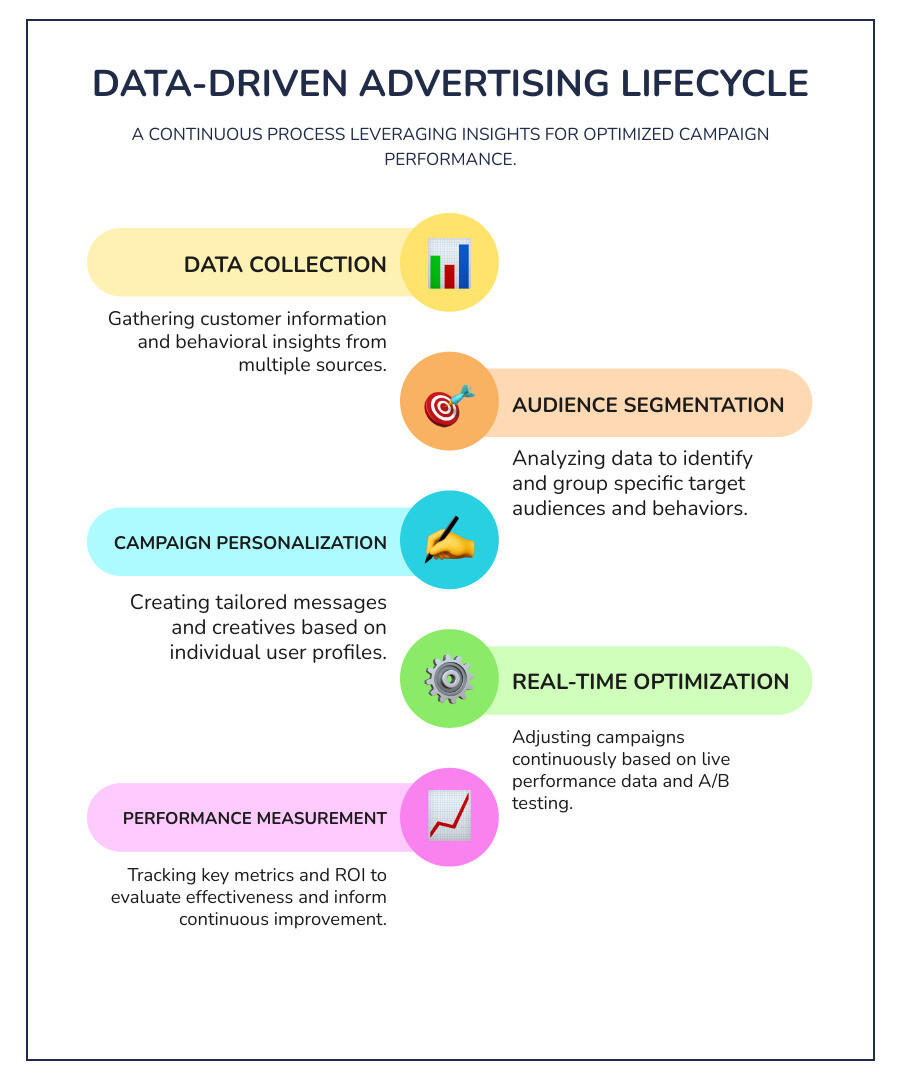
Data-driven advertising is a marketing approach that uses customer information, behavioral insights, and analytics to create, target, and optimize ad campaigns. Here’s what makes it different:
Key Components:
- Audience Targeting: Uses real customer data to reach specific demographics and behaviors
- Personalization: Delivers customized messages based on individual preferences and actions
- Performance Tracking: Measures results in real-time and adjusts campaigns automatically
- Predictive Analytics: Uses patterns to forecast what customers will do next
- ROI Optimization: Allocates budget to channels and tactics that perform best
The shift to data-driven methods isn’t just a trend—it’s reshaping how businesses advertise. The global market was valued at $700.5 billion in 2022 and is growing at 14.2% annually. By 2025, this approach will account for over 80% of all digital ad spending.
Why the massive shift? Because it works. Companies using data-driven strategies see 10-20% higher conversion rates compared to traditional methods. Personalized ads—powered by data—can boost click-through rates by up to 200% and conversions by 50%.
For small and mid-sized businesses, this matters even more. You don’t have unlimited budgets to waste on ads that don’t work. Data-driven advertising lets you spend smarter, target better, and measure everything.
The technology behind it—from artificial intelligence to real-time bidding platforms—makes precision targeting accessible to businesses of all sizes. AI alone can improve campaign effectiveness by 30% on average.
But there’s a catch. With great data comes great responsibility. Privacy regulations, changing consumer expectations, and the phase-out of third-party cookies mean you need to do this right.
The Evolution of Data Driven Advertising
In the “old days” of advertising (think Mad Men era), a business owner in Canton, OH, might buy a billboard on I-77 or a spot in the local newspaper. They hoped their target audience saw it, but they couldn’t be sure who looked, for how long, or if it actually led to a sale. This was the “spray and pray” method.
Today, data driven advertising has flipped the script. Instead of guessing, advertisers use hard facts. This evolution is driven by the sheer volume of digital footprints users leave behind. Every click, search, and purchase provides a breadcrumb that helps brands understand exactly what a person needs at any given moment.
| Feature | Traditional Advertising | Data-Driven Advertising |
|---|---|---|
| Targeting | Broad demographics (e.g., “Men 18-35”) | Individual intent and specific behaviors |
| Speed | Static; takes weeks to change | Real-time; updates in milliseconds |
| Measurement | Estimated reach and “brand awareness” | Precise ROI, CPA, and conversion tracking |
| Cost | Fixed rates regardless of performance | Dynamic bidding based on value |
| Creative | One-size-fits-all messaging | Hyper-personalized dynamic content |
As businesses look to scale, Mastering Effective Web Marketing Strategies for Modern Needs requires moving away from these legacy methods and embracing the precision of the digital age.
The Core Pillars of Data Driven Advertising
To master this discipline, one must understand the three pillars that support every successful campaign:
- Audience Segmentation: This is the process of dividing a broad market into subsets of consumers who have common needs or interests. Instead of talking to “everyone,” a business might target “frequent travelers who enjoy boutique hotels.”
- Personalization: Once you know who the audience is, you tailor the message. If a user recently looked at hiking boots on your site, the ad they see should show those exact boots, perhaps with a local Canton discount code.
- User Behavior: Tracking how people interact with your website or app allows you to serve ads at the perfect time in the buyer’s journey.
For a deeper dive into how these elements work together, check out our guide on Data-Driven Marketing.
Strategic Benefits and Market Growth
The numbers don’t lie: the data driven advertising market is exploding. With a projected 14.2% CAGR through 2030, the industry is moving toward a future where almost all digital spend (over 80% by 2025) will be data-reliant.
The primary benefit is efficiency. When you stop wasting money on people who aren’t interested in your product, your cost per acquisition drops. This is why partnering with a Performance Marketing Company is often the most cost-effective way to manage a growing ad budget.
Data Collection and Privacy Compliance
Before you can run an ad, you need data. But not all data is created equal. In the modern landscape, how you collect information is just as important as what you collect.

Types of Valuable Data
- First-Party Data: This is the “gold standard.” It is information you collect directly from your audience (website visitors, customers, social media followers). It’s accurate, free, and yours to keep.
- Zero-Party Data: This is data a customer intentionally shares with you, such as survey responses or preference center selections.
- CRM Integration: Connecting your Customer Relationship Management system to your ad platforms allows you to target existing customers with upsells or exclude them from “new customer” promotions.
Using these insights can drastically improve your Strategic Marketing Services Visibility. However, as noted by Pew Research, consumers are increasingly concerned about how their information is used.
Maximizing ROI with Data Driven Advertising
The ultimate goal of any campaign is to get more out of it than you put in. By analyzing the customer journey, businesses can identify “drop-off” points where potential leads are lost.
For instance, if data shows users click your ads but leave your landing page without buying, the issue might be your site’s user experience. This is where Conversion Rate Optimization SEO comes into play, ensuring that the traffic you pay for actually turns into revenue.
Ethical Considerations and Regulations
You can’t talk about data driven advertising without talking about the law. Regulations like GDPR (Europe) and CCPA (California) have set the stage for a privacy-first internet. Even if you are a local business in Canton, OH, if you have customers in these regions, you must comply.
Best practices for ethical data use:
- Transparency: Clearly state what data you are collecting in your privacy policy.
- Consent: Use cookie banners and opt-in forms.
- Data Governance: Keep your data secure and delete what you no longer need.
- Value Exchange: Give the customer a reason to share their data (e.g., a better user experience or exclusive discounts).
Technologies and Measurement Frameworks
To execute these strategies, you need a “MarTech” (Marketing Technology) stack. This isn’t just one tool; it’s an ecosystem of platforms that talk to each other.
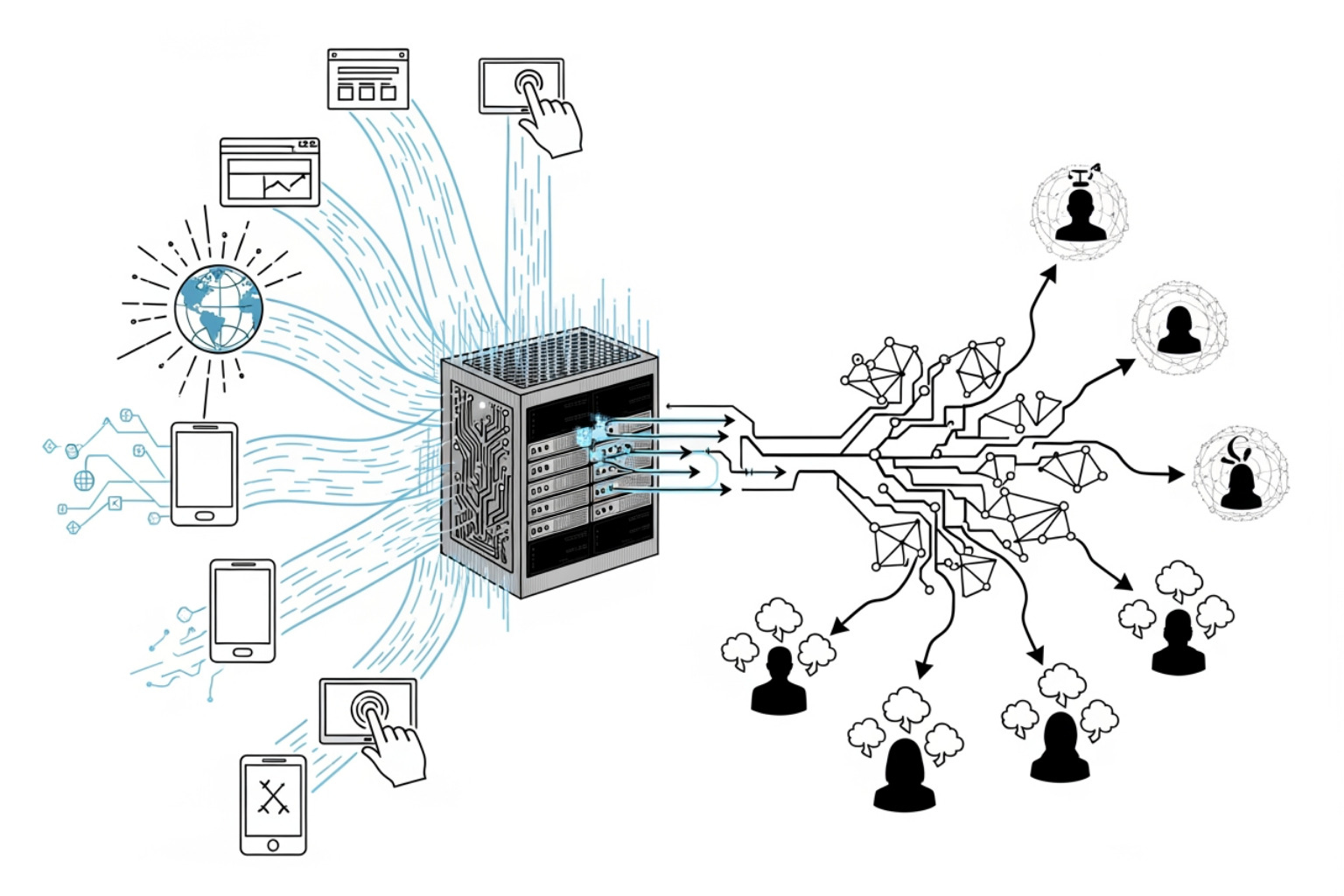
- DSPs (Demand Side Platforms): Software that allows advertisers to buy ad placements automatically.
- DMPs (Data Management Platforms): Warehouses that store and sort audience data.
- AI and Machine Learning: These technologies analyze millions of data points in seconds to decide which ad to show to which person. According to Gartner research, AI is no longer optional for high-performing teams.
For businesses that don’t want to manage these complex tools in-house, MDM Marketing offers comprehensive Analytics Services to make sense of the noise.
Key Metrics for Campaign Success
If you aren’t measuring, you aren’t doing data driven advertising—you’re just guessing with extra steps. To see if your strategy is working, focus on these metrics:
- ROAS (Return on Ad Spend): For every dollar spent, how many dollars did you earn?
- CPA (Cost Per Acquisition): How much does it cost to get one new customer?
- Attribution Modeling: Which touchpoint actually caused the sale? Was it the first ad they saw, or the final email?
Focusing on these results is the hallmark of Results-Driven SEO and advertising.
Maximizing ROI with Data Driven Advertising
Predictive analytics is the “secret sauce” of modern ROI. By looking at historical data, AI can predict when a customer is likely to buy again. If your data shows that customers in Ohio tend to buy snow tires in October, your PPC Services should automatically ramp up spending in that window.
Dynamic creative also plays a role. This technology automatically changes the images or text in an ad to match the viewer’s interests. If a user loves dogs, the ad shows a dog; if they love cats, it shows a cat. It’s not magic—it’s just good data.
Overcoming Challenges and Future Trends
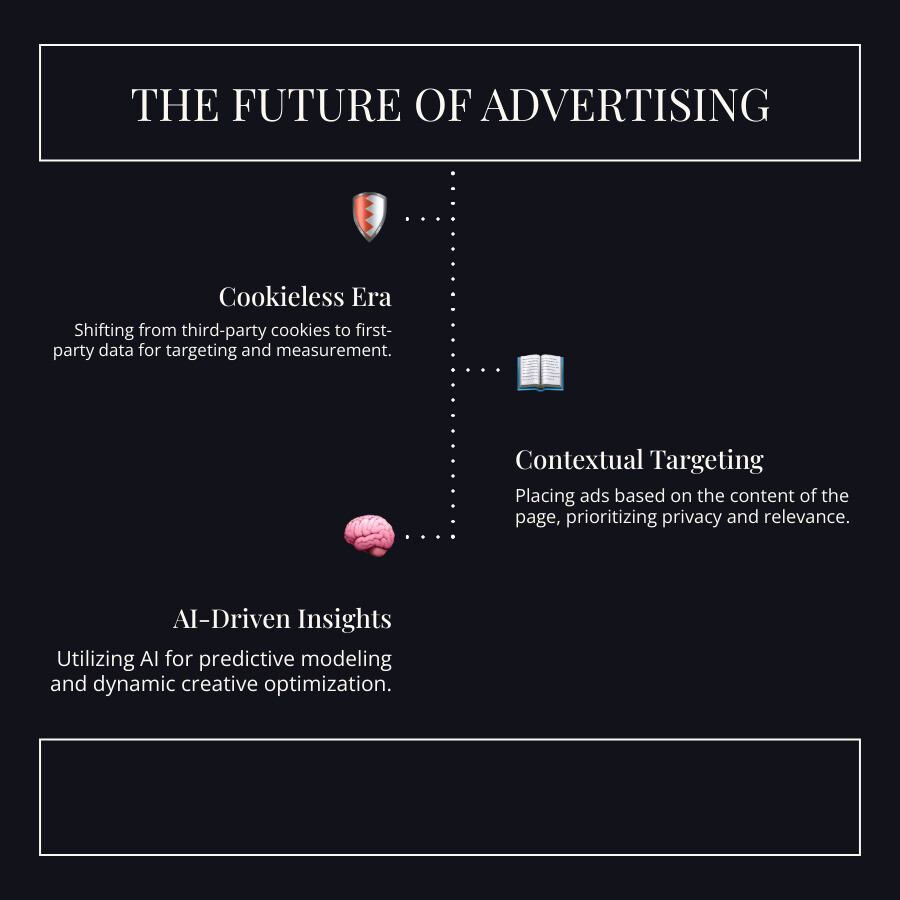
The road to data-driven mastery isn’t without its potholes. The biggest challenge currently facing the industry is the “cookieless future.” As Google Chrome phases out third-party cookies, advertisers must rely more heavily on their own first-party data.
Another hurdle is “data silos.” This happens when your email data doesn’t talk to your ad data, which doesn’t talk to your sales data. Breaking these silos is essential for a true Online Visibility Boost.
Best Practices for Effective Campaigns
- Continuous Testing: Never assume your first ad is the best. Run A/B tests on headlines, images, and call-to-action buttons.
- Quality Over Quantity: It is better to have 1,000 accurate data points than 1,000,000 “dirty” ones that lead to wrong conclusions.
- Cross-Channel Consistency: Ensure your message is the same whether the user sees you on Facebook, Google, or in their inbox.
- Leverage AI: Use AI Integration to handle the heavy lifting of data analysis, leaving your team free to focus on creative strategy.
The Future of Programmatic Buying
Programmatic buying—the automated purchase of ad space—is becoming more sophisticated. We are moving toward “contextual targeting,” where ads are placed based on the content of the page rather than the personal history of the user. This is a massive win for privacy and can be just as effective when powered by modern AI.
Frequently Asked Questions about Data-Driven Advertising
What is the difference between first-party and third-party data?
First-party data is information you own and collected yourself (like your email list). Third-party data is bought from outside aggregators who collected it from various sources. With new privacy laws, first-party data is much more valuable and “future-proof.”
How does AI improve ad performance?
AI can process data at a scale humans can’t. It can adjust bids 24/7, identify patterns in consumer behavior that aren’t obvious, and automatically show the most effective version of an ad to each individual user. On average, it boosts effectiveness by about 30%.
Is data-driven advertising expensive for small businesses?
Actually, it’s often cheaper in the long run! While setting up the tools requires an initial investment, the precision of data driven advertising means you stop wasting money on “junk” traffic. You can start small, prove the ROI, and then scale your budget as you grow.
Conclusion
Mastering data driven advertising is no longer a luxury reserved for global corporations. For businesses in Canton, OH, and beyond, it is the most reliable path to sustainable growth and scalability. By moving beyond the hype and focusing on high-quality data, ethical practices, and smart technology, you can transform your marketing from a cost center into a high-performance revenue engine.
At MDM Marketing, we specialize in taking the complexity out of the equation. Our methodology combines deep findy with precise implementation to ensure your brand doesn’t just get seen—it gets results.
Ready to see what data can do for your bottom line? Contact Us today to start building your custom strategy.
About Jay McCullough
This author hasn't written a bio yet.