Why Brand Chaos Costs You Revenue
Brand asset management is the process of organizing, storing, and controlling all the digital files that make up your brand—like logos, colors, fonts, images, templates, and guidelines—in a centralized system. It ensures that everyone using your brand assets has access to the correct, up-to-date versions, maintaining consistency across all channels and touchpoints.
What Brand Asset Management Does:
- Centralizes Assets: Stores all brand files in one secure, searchable location
- Ensures Consistency: Guarantees teams use approved, current brand materials
- Saves Time: Eliminates hours spent searching for files or recreating assets
- Controls Access: Defines who can view, edit, or distribute specific assets
- Increases Revenue: Consistent branding can boost revenue by up to 23%
Does your team waste time hunting through shared drives for the latest logo? Do your sales reps use outdated product images? Are your franchise partners creating off-brand marketing materials?
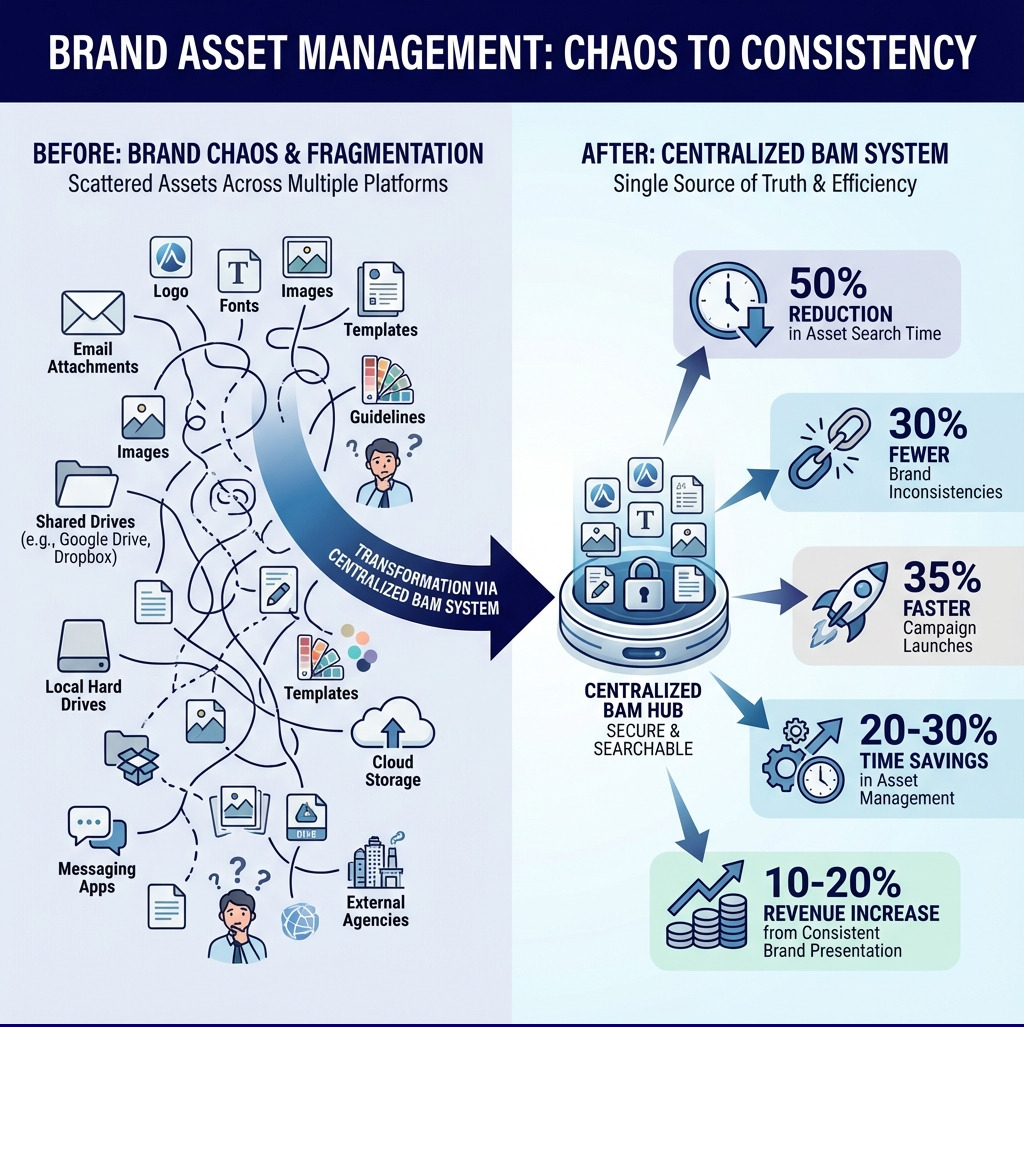
You’re not alone. Marketing teams waste 91 hours per week searching for assets or creating duplicates. Employees spend 4.2 hours per day searching for information—that’s over half their workday lost to disorganization.
The cost isn’t just time. When your brand appears inconsistent across channels, you lose customer trust and recognition. 35% of organizations saw 10-20% revenue growth simply by presenting their brand consistently. That’s the difference between chaos and control.
A brand asset management system transforms that chaos into a strategic advantage. It’s your single source of truth—a centralized hub where approved brand materials live, where teams collaborate efficiently, and where your brand integrity stays protected as you scale.
What Are Brand Assets and Why Do They Matter?

At its core, a brand is more than just a name or a product; it’s the sum of every interaction a person has with your organization. Brand assets are the tangible and intangible elements that collectively define this identity, making your brand recognizable and memorable. These assets are the building blocks of your brand identity, and their consistent use is paramount for establishing strong brand recognition, fostering customer trust, and ultimately driving revenue impact.
Without proper management, these vital components can become a source of chaos. Businesses often struggle with:
- Wasted Time: Employees spend an average of 4.2 hours per day searching for relevant information, with marketing teams alone wasting approximately 7 hours each week due to duplication of marketing work processes.
- Inconsistent Messaging: Different teams or partners using varied versions of logos, colors, or messaging, leading to a fractured brand image.
- Off-Brand Content: Materials being created that don’t align with brand guidelines, diluting the brand’s intended perception.
- Brand Dilution: A lack of cohesive presentation weakens the brand’s overall impact and memorability.
- Legal Risks: Using outdated or unapproved assets can lead to copyright infringements or misrepresentation.
- Damaged Reputation: Inconsistent or incorrect branding can erode customer confidence and trust.
Examples of Powerful Brand Assets
Brand assets come in many forms, both visual and non-visual, digital and physical. Here’s a list of common types:
- Logos: The primary visual identifier of your brand.
- Color Palettes: The specific set of colors used consistently across all brand materials.
- Typography: The fonts and typefaces that convey your brand’s personality.
- Imagery: Photos, graphics, illustrations, and icons that represent your brand’s aesthetic.
- Brand Voice: The consistent tone and style of all written communications.
- Slogans/Taglines: Short, memorable phrases that capture your brand’s essence.
- Mascots: Characters that embody your brand’s personality.
- Packaging: The design and materials used for product presentation.
- Templates: Pre-designed layouts for presentations, social media, and marketing materials.
- Mission and Value Statements: Core principles guiding the brand.
Consider these iconic examples:
- A memorable mascot: A well-known marketing platform’s mascot is more than just a logo element; it embodies the company’s playful and approachable personality. Coupled with a robust content style guide that outlines its unique voice and tone, the mascot ensures consistency across all communication channels.
- Coca-Cola’s contour bottle: Perhaps the ultimate example of a distinctive physical asset, Coca-Cola’s contour bottle was designed in 1915 to be recognizable even in the dark. This shape is so powerful it’s legally protected and instantly identifiable worldwide.
- Apple’s unboxing experience: Apple has transformed product packaging from a mere container into a distinctive brand asset. Their carefully designed packaging creates an “unboxing experience” that builds anticipation and reinforces the brand’s premium, user-friendly image.
- An iconic multi-color logo: A major tech company’s four-color logo symbolizes its diverse range of products, instantly recognizable across its platforms and products.
- Amazon’s packaging: Amazon’s packaging with its smiling arrow logo has become an essential brand asset, instantly recognizable and conveying a positive, trustworthy image.
The High Cost of Disorganization
The failure to properly manage brand assets exacts a heavy toll on businesses. The statistics speak volumes: employees spending over half their day searching for information, and marketing teams duplicating work for hours each week. This isn’t just an inconvenience; it’s a drain on productivity, resources, and morale.
When assets are scattered across various drives, cloud storage, and individual computers, the consequences are severe:
- Lost Productivity: Time spent hunting for files is time not spent on creative work, strategic planning, or customer engagement.
- Duplicated Work: If assets can’t be found, they’re often recreated from scratch, leading to redundant effort and wasted budget.
- Brand Dilution: Inconsistent application of brand elements across different channels confuses customers and weakens the brand’s message.
- Legal and Compliance Risks: Using outdated or unapproved images, logos, or messaging can lead to legal issues related to licensing, copyright, or regulatory compliance.
- Damaged Reputation: A disjointed brand presentation can make a company appear unprofessional, untrustworthy, and disorganized, negatively impacting its reputation and customer perception.
These challenges highlight why effective brand asset management is not merely a “nice-to-have” but a strategic necessity for any business aiming to thrive in a competitive market. To avoid these pitfalls and ensure your brand communicates a unified, powerful message, implement robust strategies and systems.
To explore how effective content strategies can transform your brand’s presence, explore our content marketing services.
The Core of Brand Asset Management: Systems & Features

At its heart, a brand asset management (BAM) system is a centralized, intelligent platform designed to be the “single source of truth” for all your brand’s digital materials. It moves beyond simple file storage, offering sophisticated tools that bring efficiency, control, and scalability to your brand operations. The purpose of BAM is to make storing, managing, and sharing digital brand materials easy, ensuring consistency and compliance across all touchpoints. This structured approach helps businesses maintain brand integrity throughout company campaigns and projects.
Understanding the systematic approach to managing your brand’s digital presence is crucial. To see how a structured process can benefit your overall marketing efforts, learn about our process.
Brand Asset Management vs. Digital Asset Management (DAM)
The terms Brand Asset Management (BAM) and Digital Asset Management (DAM) are often used interchangeably, but there’s a nuanced yet important distinction. Think of BAM as a specialized subset of DAM.
- Digital Asset Management (DAM) is a broader category of software that stores, organizes, and retrieves all types of digital files—images, videos, audio, documents, presentations, and more—for an entire organization. It’s designed to manage the lifecycle of any digital content.
- Brand Asset Management (BAM), on the other hand, focuses specifically on assets related to a company’s brand identity. These are the finalized, approved assets that represent the brand to the world. While a DAM might store every version of an image, from raw file to final edit, a BAM system typically curates and manages only the final, brand-approved versions of logos, marketing collateral, brand guidelines, and other brand-specific content.
Here’s a quick comparison:
| Criteria | Digital Asset Management (DAM) | Brand Asset Management (BAM) |
|---|---|---|
| Primary Goal | Organize, store, and manage all digital content for an organization | Ensure brand consistency and compliance across all channels |
| Content Type | Any digital file (raw, in-progress, final) | Curated, finalized, brand-approved assets (logos, guidelines, templates) |
| Users | Broad (all departments, creators, legal, sales) | Primarily marketing, brand, design, sales, external partners |
| Key Features | Storage, search, workflow, versioning, rights management | Centralized brand guidelines, templates, controlled access, brand-specific analytics |
BAM systems are particularly ideal for industries like retail or e-commerce, where organizing assets by product or brand is critical. While DAM handles the vast ocean of digital content, BAM provides the precision tools needed to safeguard and leverage your brand’s most valuable assets.
Essential Features of a Brand Asset Management System
A robust brand asset management system comes equipped with a suite of features designed to streamline operations and fortify brand consistency:
- Centralized Library: This is the core. All approved brand assets—logos, images, videos, fonts, guidelines, templates—are stored in one secure, easily accessible location. This eliminates scattered files and ensures everyone works from the same, correct source.
- Advanced Search and AI Tagging: Forget endless folder diving. Powerful search capabilities, often improved with AI-powered tagging and metadata, allow users to quickly find assets based on keywords, categories, file types, or even visual characteristics. This can reduce search time from minutes to seconds.
- Version Control: Brands evolve, and so do their assets. A BAM system carefully tracks changes, maintains a complete history of all asset versions, and clearly indicates the most current iteration. Some systems even notify users who have downloaded older versions when a new one becomes available, ensuring everyone stays updated.
- Granular Access Permissions: Not everyone needs access to everything. BAM systems allow administrators to define role-based access, controlling who can view, edit, download, or share specific assets. This protects sensitive materials and ensures compliance.
- Integrated Brand Guidelines: Beyond just storing a PDF, many BAM systems integrate interactive brand guidelines directly into the platform. This makes it easy for users to understand proper usage, color codes, typography rules, and brand voice, leading to higher compliance rates than traditional documentation.
- Branded Templates: To ensure consistency in marketing collateral, BAM systems often provide pre-approved templates for presentations, social media posts, email campaigns, and more. This empowers teams to create on-brand content quickly without needing constant designer oversight.
- Analytics and Reporting: Gain insights into how assets are being used, downloaded, and shared. These analytics help identify popular assets, track user adoption, and inform future content strategy and investment.
- Workflow Automation: Streamline the review and approval process for new assets or content. Built-in collaboration tools with commenting and feedback features can significantly reduce approval cycles.
- Expiry Dates and Archiving: For time-sensitive assets (like seasonal campaigns or licensed content), BAM systems can set expiry dates, automatically flagging or archiving assets that are no longer valid. This prevents accidental use of outdated content.
- Integrations: Seamless connectivity with other marketing and creative tools (e.g., design software, social media management platforms, e-commerce platforms) allows for smoother workflows and direct publishing of assets.
These features collectively empower businesses to maintain a cohesive brand identity, boost operational efficiency, and accelerate campaign delivery. To dive deeper into digital marketing concepts and strategies, check out our other guides on the blog.
How to Implement and Use a BAM System Effectively

Implementing a brand asset management (BAM) system is a strategic undertaking that requires careful planning and execution. It’s not just about installing software; it’s about changing how your organization creates, shares, and uses its brand identity. An effective implementation strategy considers existing assets, user needs, and future brand growth.
Best Practices for Implementing Brand Asset Management
To ensure a smooth transition and maximize the benefits of your BAM system, consider these best practices:
- Conduct a Comprehensive Asset Audit: Before moving anything, take stock of your current assets. Identify what you have, where it’s stored, its format, and whether it’s current or outdated. This helps you understand the scope of the migration and identify any gaps.
- Develop a Logical Folder Structure: Organize your assets in a way that makes intuitive sense to all users. Categories could include asset type (logos, images, videos), campaigns, product lines, or brand guidelines. A well-planned structure is key to easy navigation.
- Implement Robust Metadata and Tagging: This is crucial for findability. Tag assets with relevant keywords, descriptions, and usage rights. AI-powered tagging can automate much of this process, making assets searchable by concepts, not just filenames.
- Define Clear User Roles and Access Levels: Determine who needs access to which assets and what actions they can perform (view, download, edit, approve). Role-based permissions protect sensitive assets and streamline workflows.
- Provide Thorough Training and Onboarding: A powerful BAM system is only effective if people know how to use it. Offer comprehensive training sessions and accessible resources to ensure all users—from designers to sales reps—are comfortable with the platform.
- Integrate with Existing Tools: Connect your BAM system with other essential software like design software, social media management platforms, or e-commerce platforms. This creates seamless workflows, allowing designers to pull assets directly into projects or marketing teams to publish content directly to social media.
- Monitor Usage and Performance: Use the analytics features of your BAM system to track asset downloads, shares, and overall engagement. This data provides valuable insights into which assets are most effective and helps optimize your content strategy.
- Ensure Ongoing Organization: Brand assets have a lifecycle. Implement processes for regularly reviewing and updating assets, setting expiry dates for time-sensitive materials, and maintaining version control to prevent the use of outdated content.
By following these best practices, businesses can transform their brand asset management from a chaotic chore into a streamlined, strategic advantage. To see how these principles translate into real-world success, see our successful use cases.
Who Uses BAM Software?
Brand asset management software is beneficial for a wide array of roles and teams within an organization, extending far beyond just the marketing department. Anyone who interacts with or creates content representing the brand can leverage a BAM system:
- Marketing Teams: For organizing campaigns, ensuring consistent messaging, and quickly accessing approved images, videos, and collateral for various channels.
- Brand Managers: To enforce brand guidelines, monitor brand usage, and maintain overall brand integrity and consistency across all touchpoints.
- Designers (Internal & Freelance): To access the latest logos, color palettes, fonts, and templates, ensuring all creative output is on-brand and approved. They can also use guest upload folders to submit new creatives for review.
- Sales Teams: To quickly find and customize on-brand presentations, product sheets, and sales collateral, ensuring they have the most accurate and compelling materials for client pitches.
- External Agencies and Partners: For controlled access to specific brand assets and guidelines, ensuring their work aligns perfectly with the brand’s identity.
- Resellers and Distributors: To access approved product images, marketing materials, and guidelines, helping them promote the brand consistently in their own channels.
- Influencers and Social Media Teams: To ensure they use the correct logos, imagery, and messaging, especially when content is time-sensitive or has specific usage rights.
Essentially, any individual or team responsible for creating, distributing, or representing the brand benefits from the centralized access, control, and efficiency provided by BAM software.
Supporting Collaboration and Rebranding
One of the most powerful aspects of a robust brand asset management system is its ability to foster seamless collaboration and facilitate smooth rebranding efforts.
Streamlined Workflows and Collaboration:
BAM systems transform internal and external collaboration. Instead of endless email chains and shared drives, teams work within a centralized platform:
- Approval Processes: Built-in workflows allow for efficient review and approval cycles, reducing bottlenecks and ensuring all assets meet brand and legal standards.
- Shared Access: Designers can drop assets directly from the BAM system into their projects (e.g., via integrations with popular design software). Marketing teams can browse the full asset library directly within e-commerce platforms to update product listings or push content to social media via integrations with social media management tools.
- Feedback Loops: Commenting tools allow team members to provide feedback directly on assets, streamlining revisions and accelerating project completion.
- External Partner Portals: For collaborators outside the organization, such as agencies, freelancers, or resellers, BAM systems can provide secure, controlled access via dedicated portals. This ensures they only use approved, up-to-date materials without compromising security.
Seamless Rebranding Efforts:
Rebranding can be a complex and challenging process, but BAM significantly simplifies it:
- Consistent Messaging and Updates: When a brand evolves, a BAM system becomes critical. It allows for centralized updates of all new logos, color palettes, typography, and brand guidelines.
- Version History: With robust version control, you can easily track all changes, revert to previous versions if needed, and ensure that only the new, approved assets are being used moving forward. Some systems even automatically notify users who have downloaded older versions to update their files.
- Controlled Transitions: BAM helps manage the transition by ensuring that outdated assets are flagged, archived, or set with expiry dates, preventing their accidental use. This is crucial for maintaining brand consistency during a period of change.
- Interactive Brand Books: Instead of static PDF guidelines, BAM systems can host dynamic, interactive brand books. These online guides are easily editable and accessible, ensuring that everyone has the most current information on how to apply the new brand identity.
By consolidating assets, streamlining communication, and providing powerful control mechanisms, BAM empowers teams to collaborate effectively and steer rebranding with confidence, ensuring a consistent and unified brand presence at every stage.
Frequently Asked Questions about Brand Asset Management
Why is brand asset management so important for a business?
Brand asset management is critical because it directly impacts a business’s consistency, efficiency, and bottom line. It ensures that every visual and textual element representing your brand is unified and up-to-date across all platforms. This consistency builds trust and recognition, which, as Forbes reports, can increase your revenue by up to 23%. Beyond revenue, BAM saves countless hours of wasted work by eliminating the need for employees to search for or recreate assets. It also protects your brand from legal and reputational risks associated with using outdated or unapproved materials, safeguarding your most valuable intangible asset.
How does BAM contribute to brand consistency?
Brand asset management is the backbone of brand consistency. It provides a single, controlled source for all approved brand materials, from logos and color codes to messaging and templates. By integrating interactive brand guidelines directly into the system, everyone—from internal teams to external partners—has immediate access to the correct usage rules. Features like version control guarantee that only the latest, approved assets are available, preventing the use of outdated content. This centralized approach ensures a unified brand experience across all channels, whether it’s your website, social media, print ads, or a sales presentation.
What are the biggest challenges businesses face without proper BAM?
Without proper brand asset management, businesses encounter a range of costly challenges. The most significant is pervasive brand inconsistency, leading to a fragmented brand image that confuses customers and erodes trust. Internally, teams waste valuable time (an average of 4.2 hours per day per employee) searching for assets or recreating them from scratch, leading to duplicated efforts and reduced productivity. This often results in the use of outdated or incorrect logos, imagery, and messaging, which can damage brand credibility. A lack of control over brand representation weakens brand identity, leads to compliance risks, and can directly translate into lost revenue opportunities.
Achieve Unshakeable Brand Consistency
The journey from brand chaos to unshakeable brand consistency is transformative. By embracing brand asset management, businesses move beyond mere file storage to a strategic system that safeguards their most valuable intangible asset. The market for asset management systems is projected to grow to more than $27 billion by 2025, underscoring the increasing recognition of its importance. This isn’t just about efficiency; it’s about building a recognizable, trustworthy, and resonant brand that drives growth and customer loyalty.
A well-implemented BAM system provides a strategic advantage, future-proofing your brand against fragmentation and inefficiency in an increasingly complex digital landscape. It empowers every team member and partner to be a brand ambassador, equipped with the right tools and assets to tell your story consistently.
At MDM Marketing, we understand the power of data-driven brand strategies. Our expertise in Search Engine Optimization, content marketing, and digital presence ensures that your brand not only looks consistent but also reaches the right audience at the right time. We help businesses achieve sustainable growth by changing their online presence and ensuring every aspect of their brand works in harmony.
Ready to organize your brand, streamline your operations, and open up the full potential of your brand assets? Contact Us today!
About Jay McCullough
This author hasn't written a bio yet.