
Why Measuring Content Marketing ROI Matters for Your Business
How to calculate ROI on content marketing investment is simpler than most marketers think. Here’s the quick answer:
Basic ROI Formula:
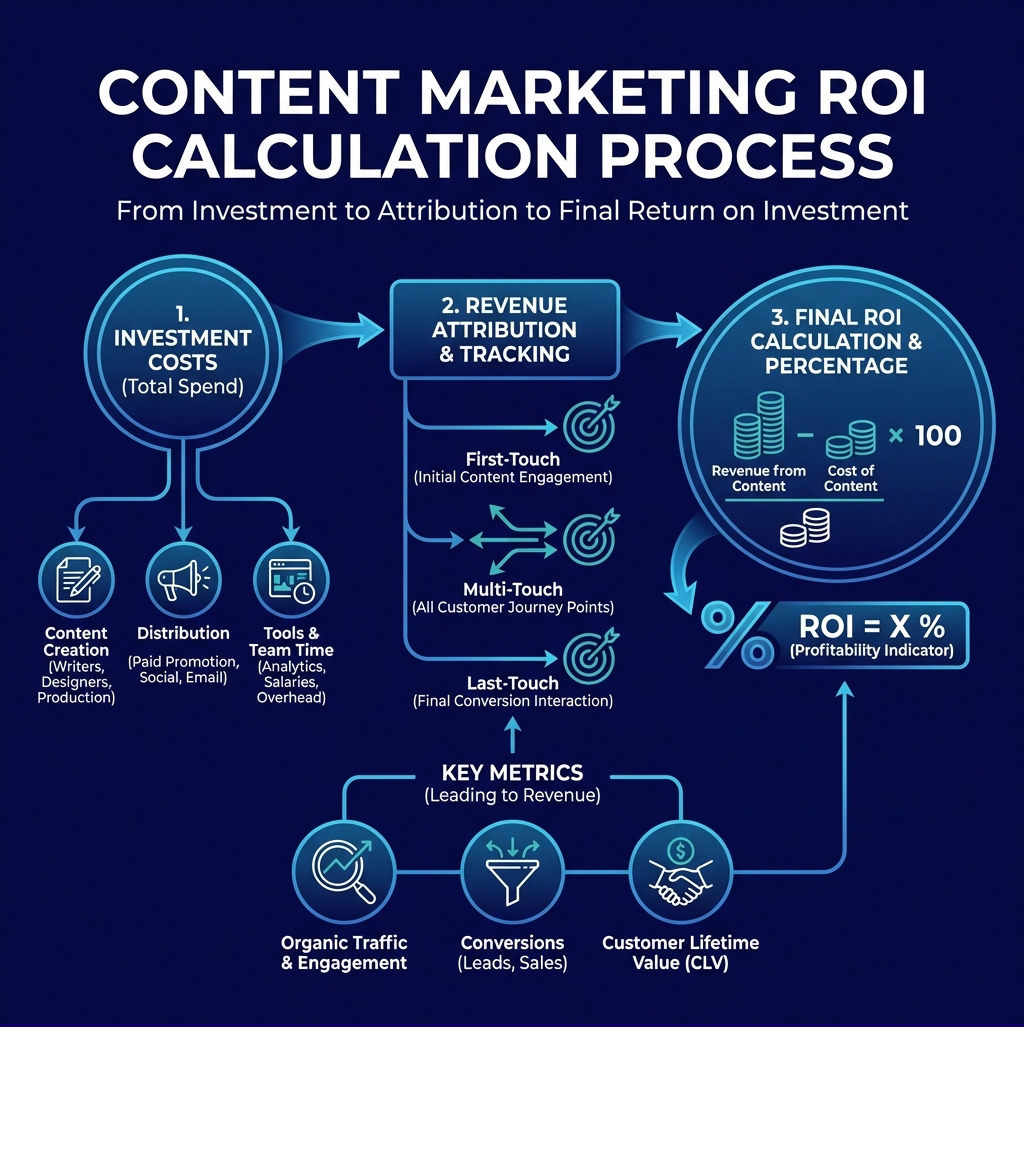
ROI = ((Revenue from Content - Cost of Content) / Cost of Content) × 100
Three Key Steps:
- Calculate Total Costs – Include creation, distribution, tools, and team time
- Measure Revenue Generated – Track conversions, leads, and sales from content
- Apply the Formula – Subtract costs from revenue, divide by costs, multiply by 100
Perhaps the most pressing question that companies have about their marketing efforts is: What’s our actual return on investment? If that question made your stomach drop, you’re not alone. Research shows that 78% of CMOs struggle to prove the return on investment of their content marketing programs.
Here’s the dirty secret in content marketing that nobody wants to talk about: Only around 41% of marketers are sure that their content marketing efforts are working or if they’re even producing a measurable return.
That’s not just sad—it’s dangerous for your business.
Without clear ROI measurement, you’re marketing blind. You can’t optimize what you don’t measure. You can’t justify budgets. You can’t make strategic decisions about where to invest next. And when leadership asks “what’s working?”, you’re left with vague answers about engagement and traffic instead of hard numbers tied to revenue.
But here’s the good news: Content marketing delivers strong returns when measured correctly. Studies show businesses earn an average of $42 for every $1 spent on content marketing—far better than the $1.80 return from paid advertising. Companies achieve an average content marketing ROI of 2:1 to 3:1, with top performers reaching 5:1 or higher.
The challenge isn’t that content marketing doesn’t work. The challenge is that measuring it requires a different approach than traditional advertising. Content influences multiple touchpoints. It builds over time. And its value extends beyond immediate conversions to include brand awareness, customer retention, and reduced acquisition costs.
This guide will show you exactly how to calculate your content marketing ROI without the complexity and confusion. We’ll break down the formulas, identify what costs and returns to track, explain attribution models, and give you practical steps to prove your content’s value to stakeholders.
The Fundamental Formula: How to Calculate ROI on Content Marketing Investment
At its heart, ROI is a financial metric used to evaluate the profitability of a project. It helps you decide if an investment was worth the “squeeze.” While there are advanced ways to slice the data, understanding how to calculate ROI on content marketing investment starts with two primary methods: Simple ROI and Campaign-Attributable ROI.
Simple ROI Formula
This is the “napkin math” version. It’s perfect for a quick pulse check on your strategy.
- Formula: (Sales Growth – Marketing Cost) / Marketing Cost = ROI.
- Example: If your content efforts generated $10,000 in sales and cost $2,000 to produce, your ROI is 400%.
Campaign-Attributable ROI
In the real world, your business likely has “organic” sales—revenue that would have happened even if you didn’t publish a single blog post. To be truly accurate, you must account for this.
- Formula: (Sales Growth – Organic Sales Growth – Marketing Cost) / Marketing Cost = ROI.
- Example: If sales grew by $15,000, but your average organic growth is $600 per month, and the campaign cost $10,000, your true ROI is 44%.

By utilizing data-driven marketing, businesses can move past “gut feelings” and rely on hard numbers. For those looking to dive deeper into the academic side of these numbers, industry-standard resources offer a great foundation.
| Feature | Simple ROI | Campaign-Attributable ROI |
|---|---|---|
| Best For | Quick snapshots | Executive reporting |
| Accuracy | Moderate | High |
| Considers Organic Growth? | No | Yes |
| Difficulty to Calculate | Easy | Moderate |
Accounting for the True Cost of Your Content Investment
Here’s a painful truth: most marketers are lying to themselves about content costs. Not intentionally—but if you’re only counting what you paid your freelance writer, you’re missing about 60% of your actual investment. And that inflated ROI number? Your CFO will spot it from a mile away.
To really understand how to calculate ROI on content marketing investment, you need to get brutally honest about every dollar (and every hour) that goes into your content engine.
Direct Costs
Let’s start with the easy ones—the expenses that actually hit your credit card. These include payments to freelancers and agencies for SEO Copywriting Services, video production, graphic design, and photography. Don’t forget your paid promotion budget—the money you spend on social media ads, sponsored content, or PPC campaigns to actually get eyeballs on what you’ve created.
Internal Resources (The “Hidden” Costs)
This is where things get uncomfortable. Your internal team’s time costs money—even if you’re not cutting them a separate check for each blog post.
Think about your management time. Those two hours your marketing manager spent editing a draft? That’s a cost. The 30-minute strategy meeting where your VP reviewed the content calendar? Also a cost. The time your sales team spent providing input for a case study? You guessed it—cost.
Then there’s the internal labor that makes content happen: uploading posts to your CMS, scheduling social media, coordinating with designers, conducting internal reviews, and optimizing old content. All of this requires human hours, and human hours have a price tag.
To calculate this accurately, multiply each person’s hourly rate (salary divided by 2,080 work hours per year) by the time they spend on content activities. Yes, it’s tedious. Yes, it matters.
Software and Tools
Your content doesn’t magically appear on the internet. You need tools to research it, create it, distribute it, and track its performance.
Include your SEO research tools—those monthly subscriptions add up. Factor in your creative software subscriptions for design and video editing. Don’t forget your CMS and hosting costs, email marketing platform, social media scheduling tools, and analytics software.
Pro tip: If multiple departments share these tools, calculate the percentage your content team uses and allocate that portion to your content costs.
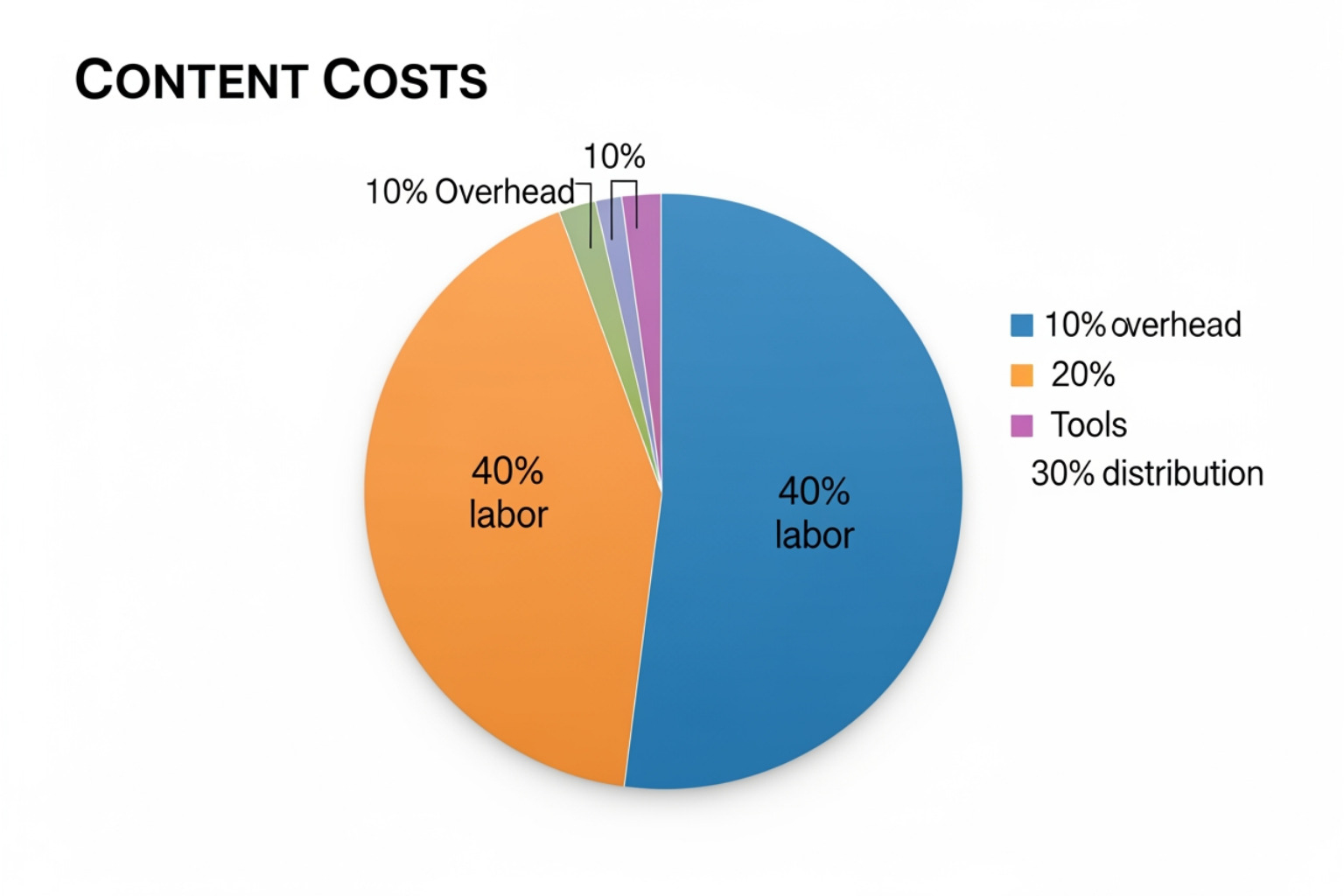
The graphic above shows a typical breakdown—and notice that labor often represents the biggest slice. That’s why ignoring internal time creates such wildly inaccurate ROI calculations. When you account for the true cost of your content investment, you might see your ROI drop initially. But here’s the thing: you’re not making it worse by measuring it honestly. You’re just finally seeing reality. And reality is what lets you make smarter decisions about where to invest next.
Measuring Revenue and Choosing the Right Attribution Model
Determining exactly which piece of content led to a sale is the “holy grail” of marketing. In B2B, a buyer typically engages with 11.4 pieces of content before making a purchase. If they read a blog, watch a video, and then click an ad, which one gets the credit?
Attribution Models Explained
- First-Touch: Gives 100% of the credit to the first piece of content the user ever saw. Great for measuring brand awareness.
- Last-Touch: Gives 100% of the credit to the last interaction before the sale. This is the default for many tools but often undervalues top-of-funnel content.
- Linear Model: Spreads credit equally across every touchpoint.
- U-Shaped Model: Gives 40% credit to the first touch, 40% to the last touch, and splits the remaining 20% among the middle interactions.
To track this journey, you need integrated tools. Connecting Google Analytics with a CRM allows you to trace a customer’s path from their first anonymous visit to a “closed-won” deal.
Determining Value in a Complex Journey: How to Calculate ROI on Content Marketing Investment
Not every conversion is a sale. Sometimes the “gain” is a lead. To value these, use Lead Valuation. If you know your historical conversion rate is 10% and your Average Customer Value (ACV) is $2,000, then every lead is worth $200.
For agencies or busy firms, using White Label Content Creation can help scale these efforts while keeping costs predictable, making the “investment” side of the equation much easier to track in your sales pipeline.
Tracking Success: Leading vs. Lagging Indicators
Content marketing is a compound interest strategy. You won’t see a massive revenue spike on day one. Instead, you need to track “smoke signals” (leading indicators) that tell you the “fire” (revenue) is coming.
Leading Indicators (The Early Wins)
These show that your content is gaining traction.
- Organic Traffic: Are more people finding you through search?
- Keyword Rankings: Is your content moving up the search results? Utilizing Results-Driven SEO ensures these rankings are for high-value terms.
- Engagement: Time on page and social shares.
Lagging Indicators (The Bottom Line)
These are the metrics your stakeholders care about.
- MQLs & SQLs: Marketing and Sales Qualified Leads.
- Closed-Won Deals: Actual revenue in the bank.
- Customer Lifetime Value (CLV): The total revenue a customer generates over their entire relationship with you.
If you are new to interpreting these numbers, the Google Analytics Academy is an excellent place to learn how to interpret behavior data to track ROI.
Key Metrics for How to Calculate ROI on Content Marketing Investment
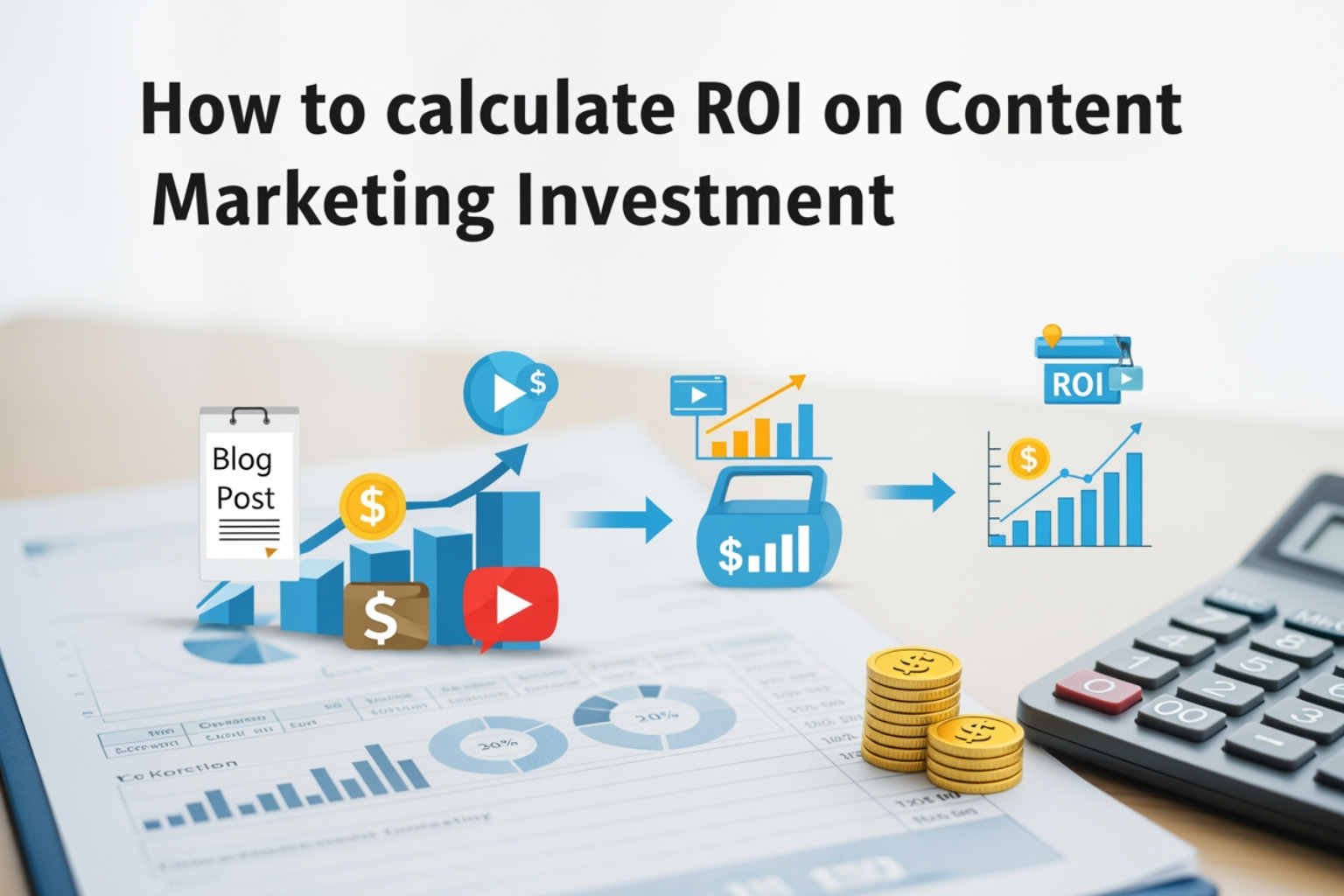
Beyond the basic formula, keep an eye on:
- Cost Per Acquisition (CPA): Content marketing often delivers a 40-60% lower CPA than paid channels.
- Newsletter Sign-ups: A growing list is a valuable business asset.
- Demo Requests: The ultimate signal of high-intent interest.
Overcoming Common Measurement Challenges
The road to perfect data is full of potholes. Long sales cycles (especially in B2B) mean a blog post written today might not pay off for six months. Soft metrics like brand awareness are “squishy,” but they matter.
Furthermore, content obsolescence—where old posts lose their ranking—can drain your ROI if you don’t refresh them. A Performance Marketing Company can help bridge these gaps by treating content as a measurable, high-performance asset.
Strategies to Improve and Report Your Content ROI
Once you know your numbers, the goal is to make them bigger. Here’s how to squeeze more juice out of your investment:
- Content Repurposing: Don’t just publish a blog and forget it. Turn it into a video, a podcast episode, and five social posts. This lowers your “cost per asset.”
- Focus on Evergreen Content: Write about topics that will be relevant three years from now. This creates a “snowball effect” where old content continues to drive leads with zero additional spend.
- Automated Content Marketing: Use tools to handle distribution and scheduling. Automated Content Marketing reduces the labor hours required to keep the engine running.
- Conversion Rate Optimization (CRO): Sometimes you don’t need more traffic; you just need your current traffic to click “Buy” more often. Ensure every piece of content has a clear call to action.
When it comes time to report to the board, use Executive Dashboards. Don’t show them bounce rates; show them Influenced Revenue. Connect your Copywriting for Businesses directly to the sales pipeline to demonstrate that content is a growth engine, not a cost center.
Frequently Asked Questions about Content Marketing ROI
How long does it typically take to see a positive ROI?
Leading indicators like traffic usually appear in 3 to 6 months. However, measurable, revenue-positive ROI typically takes 6 to 12 months. Content marketing is a long game; it rewards patience and punishes short-term thinking. SEO-driven content strategies often see their most significant returns in years two and three.
What is considered a “good” ROI for content marketing?
A 5:1 ROI is considered strong in most industries. A 10:1 ROI is exceptional. If you are seeing a 2:1 return, you are likely covering your costs, but there is room for optimization. B2B SaaS companies often see an average ROI of 702% over a three-year period from SEO-driven content.
What are the most common mistakes when calculating ROI?
The biggest mistakes are:
- Incomplete Cost Accounting: Forgetting to include internal team time and software subscriptions.
- Relying on Last-Click Attribution: This ignores the top-of-funnel content that started the relationship.
- Focusing on Vanity Metrics: Tracking “likes” instead of “leads.”
- Short-Term Thinking: Quitting after three months because the revenue hasn’t spiked yet.
Conclusion
Measuring the success of your strategy doesn’t have to be a headache. By understanding how to calculate ROI on content marketing investment, you move from guessing to knowing. You transform your content from a creative hobby into a documented business asset that drives sustainable, compounding growth.
At MDM Marketing, we specialize in this transition. Our methodology combines rigorous discovery and analysis with precise implementation to help businesses achieve an average 280% ROI increase. We don’t just create content; we build data-driven engines that focus on measurable outcomes and transparent reporting.
Whether you’re looking to scale your organic presence or refine your current strategy, our team in Canton, OH, is ready to help you turn data into action.
Ready to stop guessing and start growing? Connect with our team today to see how we can help you maximize your marketing investment.
About Jay McCullough
This author hasn't written a bio yet.