
What is Copywriting and Why Every Business Needs It
Copywriting for businesses is the craft of writing words that persuade people to take a specific action–whether that’s making a purchase, signing up, or clicking a link. It’s not just writing about your business; it’s writing for your business to connect with your audience and drive results.
Why copywriting matters:
- Drives conversions – Turns visitors into customers.
- Builds brand voice – Creates a consistent, memorable identity.
- Improves SEO – Helps your business rank higher in search results.
- Saves time – Clear messaging reduces customer support needs.
- Increases revenue – Well-crafted copy directly impacts your bottom line.
The reality is that 80% of readers never make it past the headline. If your copy doesn’t grab attention immediately, you’ve lost most of your audience. While content writing informs and educates, copywriting persuades and sells. Both are vital, but they serve different marketing purposes.
Many businesses struggle to communicate their value. They focus on features (“our software has 15 modules”) instead of benefits (“save 20 minutes on every client email”). They use jargon instead of plain English. Good copywriting fixes this by speaking directly to your customer’s needs in their language, guiding them to act. It’s not about being clever–it’s about being clear, compelling, and conversion-focused.
The Anatomy of Irresistible Copy
What turns ordinary words into copywriting for businesses that drives results? It’s not magic–it’s a few fundamental elements working together.
Clarity is non-negotiable. If your reader has to work to understand you, they’ll leave. Use short sentences, avoid jargon, and get to the point. You’re writing to connect, not to impress.
But clarity alone isn’t enough; you need emotion. People make decisions based on feelings and justify them with logic. Effective copy taps into your audience’s hopes and frustrations. When you describe their problem better than they can, they trust you have the solution.
This leads to a key principle: focus on benefits, not features. Customers care about what your product does for them. Instead of “Our software includes automated reporting,” try “Get weekly reports delivered automatically, so you can focus on strategy, not spreadsheets.”
Using the active voice makes your copy more direct and engaging. “The system generates instant reports” is punchier than “Reports are generated instantly by the system.”
A sobering fact: 80% of readers never make it past the headline. Your headline is everything. It must grab attention and promise value to pull readers into your message.
To build trust, use social proof. With 97% of consumers saying online reviews influence their buying decisions, testimonials and case studies are essential signals that tell potential customers, “Others like you were glad they took this step.”
Finally, every piece of copy needs a clear Call to Action (CTA). Don’t make readers guess what to do next. Whether it’s “Get Started Today” or “Download the Free Guide,” your CTA must be impossible to miss.
Essential Types of Copywriting for Businesses
Different marketing channels require different approaches.

Website copy is your digital storefront. Your homepage, about page, and service pages must clearly communicate what you do, who you help, and why someone should choose you.
SEO copywriting integrates keywords into high-quality content that both search engines and humans love. It’s about creating helpful content that answers questions while using terms people are searching for. MDM Marketing specializes in this, combining technical SEO with emotion-driven content. Learn more about our strategic marketing services.
Email marketing copy fights for attention in crowded inboxes. Your subject line is the first hurdle, and the email body must get to the point quickly with a clear CTA.
Social media copy must adapt to the platform. What works on LinkedIn won’t work on Instagram. Know the platform’s culture and grab attention fast.
Ad copy has one job: drive immediate action. With limited space, your copy must highlight what makes you different and include a compelling reason to click now.
Product descriptions are a chance to paint a picture of how a product improves someone’s life. Transform features into benefits to boost conversions.
Common Mistakes to Avoid
Recognizing these common copywriting mistakes can save you from losing sales.
- Focusing on features instead of benefits: Always translate technical specs into tangible benefits for your customer.
- Vague language and jargon: Buzzwords like “synergize” or “leverage” are empty. Be specific and use the language your audience uses. Clarity beats cleverness.
- Missing or weak calls to action: Your audience should know exactly what to do next. Every piece of copy needs a clear next step.
- Ignoring your audience: Writing for everyone means writing for no one. Understand your audience’s pain points, desires, and language.
- Inconsistent brand voice: Your brand voice should be recognizable across all platforms, creating trust and a cohesive identity.
- Grammatical errors and typos: These mistakes damage your credibility. Always proofread your copy before it goes live.
- Keyword stuffing: This outdated SEO tactic hurts your rankings and makes your copy unreadable. Focus on quality content that naturally incorporates keywords.
The Strategic Role of Copywriting for Businesses
Think of copywriting for businesses as the secret sauce that makes your marketing strategy work. It’s the connective tissue holding your brand together and driving measurable results.
Marketing strategy integration means your copy is consistent across all touchpoints–email, social media, your website, and ads. It should all speak with one voice and work toward the same goals, creating a seamless customer journey. For a comprehensive approach, see our guide on Mastering Effective Web Marketing Strategies for Modern Needs.
Your copy is also crucial for brand building. Every word you publish defines your business personality–are you the friendly expert or the innovative disruptor? Consistent, authentic copy builds trust and helps people remember you.
Great copywriting is your best tool for lead generation. A compelling headline or a well-crafted call-to-action can turn a casual reader into a lead by sparking curiosity and addressing their pain points.
In sales funnels, different stages require different copy. Top-of-funnel content educates and builds trust, while bottom-of-funnel copy uses direct, persuasive language to close the sale. Strategic copywriting guides people through this journey naturally.

Identifying and Targeting Your Ideal Audience
The most brilliant copy fails if it’s aimed at the wrong people. The magic of copywriting for businesses happens when you know exactly who you’re talking to.
- Create a customer persona: Go beyond demographics. Understand your ideal customer’s frustrations, problems, and desires. When you can articulate their problems, you can write copy that feels like you’re reading their mind.
- Conduct market research: Listen to your audience where they hang out online–forums, social media groups, and Reddit. The language they use and the complaints they voice are copywriting gold.
- Use voice of customer data: Borrow the exact words and phrases your customers use. This creates an instant connection and shows you “get it.”
- A/B test your copy: Don’t guess what works–know what works. Test different headlines, CTAs, and benefit explanations to see what resonates most with your audience.
Measuring the ROI of Copywriting for Businesses
Tracking the return on investment for copywriting for businesses is essential to understanding what’s working. Focus on these Key Performance Indicators (KPIs):
- Conversion rates: The ultimate measure of success. This tracks how many people took your desired action, like making a purchase or signing up.
- Click-through rates (CTR): Shows how effective your headlines and hooks are at capturing attention and sparking curiosity.
- Bounce rate: A high bounce rate can mean a disconnect between what your copy promises and what your page delivers.
- Time on page: More time spent reading your content is a sign that it’s engaging and valuable.
- Lead quality: Good copy doesn’t just attract more leads; it attracts better leads who are a good fit for your business.
At MDM Marketing, we use data-driven SEO and copywriting to drive these metrics. Understanding how copy and SEO work together is crucial, as explained in our post on Insights on How to Build Quality Backlinks for SEO Growth.
DIY vs. Hiring a Pro: Making the Right Choice
Deciding whether to handle copywriting for businesses yourself or hire a professional depends on your resources, goals, and current business stage.
| Feature | DIY Copywriting | Hiring a Professional Copywriter |
|---|---|---|
| Cost | Lower direct financial outlay (your time is the cost) | Higher direct financial investment |
| Brand Knowledge | Deep, inherent understanding of your business | Requires briefing, but fresh perspective is valuable |
| Time Investment | Significant time required for learning and writing | Frees up your time for core business activities |
| Quality/Expertise | Varies; requires continuous learning | High, specialized skill; conversion-focused |
| Speed | Slower due to learning curve and other duties | Faster turnaround with efficient workflows |
| ROI Potential | Can be good if done well, but often inconsistent | Higher potential for measurable conversions |
| Consistency | Challenging to maintain uniform quality and voice | Ensures consistent brand voice and messaging |
When to DIY
If you’re a startup or small company, writing your own copy can be a smart move. It’s ideal when you have more time than money and are still clarifying your message and value proposition. The process of writing forces you to sharpen your business clarity. DIY also offers the flexibility to iterate quickly. Think of it as building a skill that will serve your business long-term.
When to Hire
As your business prepares to scale, a professional copywriter becomes essential for growth. MDM Marketing in North Canton, OH, understands this transition; expert copywriting for businesses can significantly boost online visibility when the timing is right.
Hire a pro when you’re ready to grow, your DIY efforts aren’t converting, or you lack the time and expertise. An expert brings a fresh perspective and the persuasive power to hit major goals. For high-stakes projects like a product launch or a critical sales page, you can’t afford to guess. This is where you can Streamline Your SEO Efforts Using Outsourced Services and get back to what you do best.
What to Look for When Hiring a Copywriter
When you invest in a professional, choosing the right partner is crucial.

- Portfolio and Experience: Review their work. Does it grab your attention and communicate benefits clearly? Industry experience is a plus, but a versatile writer with strong fundamentals can also bring a fresh perspective.
- Testimonials and Results: Look for testimonials that highlight actual results, such as increased conversions or measurable growth.
- Marketing Understanding: A great copywriter is a marketer first. They should understand your overall strategy, SEO principles, and how their copy fits your business goals.
- Professionalism: Look for strong communication skills, a collaborative attitude, and clear, professional proposals and contracts that outline the scope of work, timelines, and pricing. This protects your investment.
Frequently Asked Questions about Business Copywriting
Let’s tackle a few common questions about copywriting for businesses.
How much does it cost to hire a copywriter?
This is like asking, “How much does a car cost?” Rates for copywriting for businesses vary widely based on experience and project scope. Pricing models include hourly rates, project-based fees, and monthly retainers.
Newer copywriters may charge less, while seasoned professionals with proven track records of driving sales command higher rates. You’re not just paying for words; you’re investing in strategy, psychology, and results. A cheap copywriter who delivers poor results is more expensive in the long run than a skilled professional who increases your revenue. Focus on value versus cost.
How is copywriting different from content writing?
This is a common point of confusion. While both are important, they have different goals.
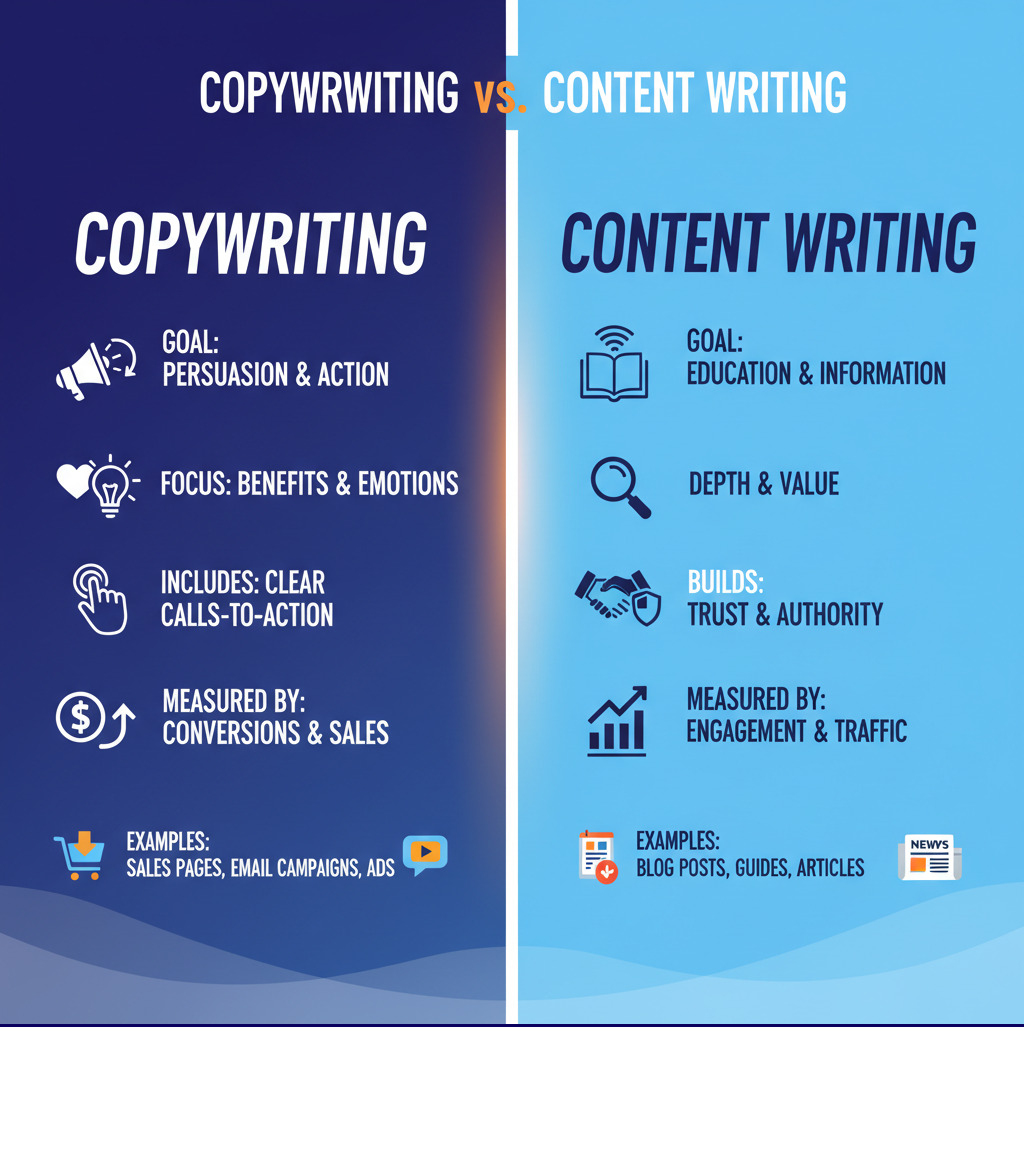
Copywriting persuades and sells. Its purpose is to drive immediate action. Think sales pages, ad copy, and emails designed to convert. It focuses on benefits, taps into emotion, and always has a clear call to action.
Content writing informs and educates. Its goal is to provide value, build trust, and establish expertise over time. Think blog posts, how-to guides, and industry reports.
A great marketing strategy uses both. Content writing builds the relationship, and copywriting closes the deal. MDM Marketing combines both, using data-driven SEO and engaging content to attract and convert customers.
Can I just use AI to write my business copy?
AI writing tools can be helpful, but they are only as good as the person using them.
AI is a good tool for brainstorming ideas, creating outlines, or overcoming writer’s block. It can significantly speed up the initial drafting process.
However, AI lacks human emotion and strategic insight. It can’t truly understand your audience’s pain points, your brand’s unique voice, or how a piece of copy fits into your larger marketing strategy. AI-generated content often sounds generic and forgettable, which doesn’t work in a crowded marketplace.
The best approach is to use AI for first drafts, then have a human copywriter add the strategy, emotion, and authenticity that drives results. At MDM Marketing, we know that effective copywriting for businesses requires a human touch to create a genuine connection–something AI alone can’t replicate.
Conclusion: Turn Your Words into Growth
In today’s business world, your words are doing the heavy lifting. Copywriting for businesses is the strategic force that turns visitors into customers and browsers into brand advocates.
We’ve covered the fundamentals: the power of clarity, emotion, and focusing on benefits. We’ve explored the different types of copy your business needs and the common mistakes to avoid. We also looked at when to DIY versus when to hire a professional to scale your growth.
It all comes down to measurable impact: higher conversion rates, more qualified leads, and increased revenue. This isn’t abstract theory–it’s about using the right words to grow your business in tangible ways.
At MDM Marketing in North Canton, OH, we’ve seen the power of combining strategic copywriting with data-driven SEO. We craft messages that connect emotionally while being optimized for search engines, ensuring your ideal customers can find you and feel compelled to choose you.
Is your copy working as hard as it could be? If you’re ready to turn your words into your most powerful growth engine, let’s talk.
Contact us for expert copywriting and SEO services and let’s turn your message into momentum.
About Jay McCullough
This author hasn't written a bio yet.