
The AI Revolution Meets Reality: Understanding the Pitfalls of Automated SEO
As businesses adopt AI for digital marketing, the limitations of automated SEO content optimization tools are becoming clear. These platforms promise efficiency but also come with drawbacks that owners should weigh before full adoption.
Key limitations:
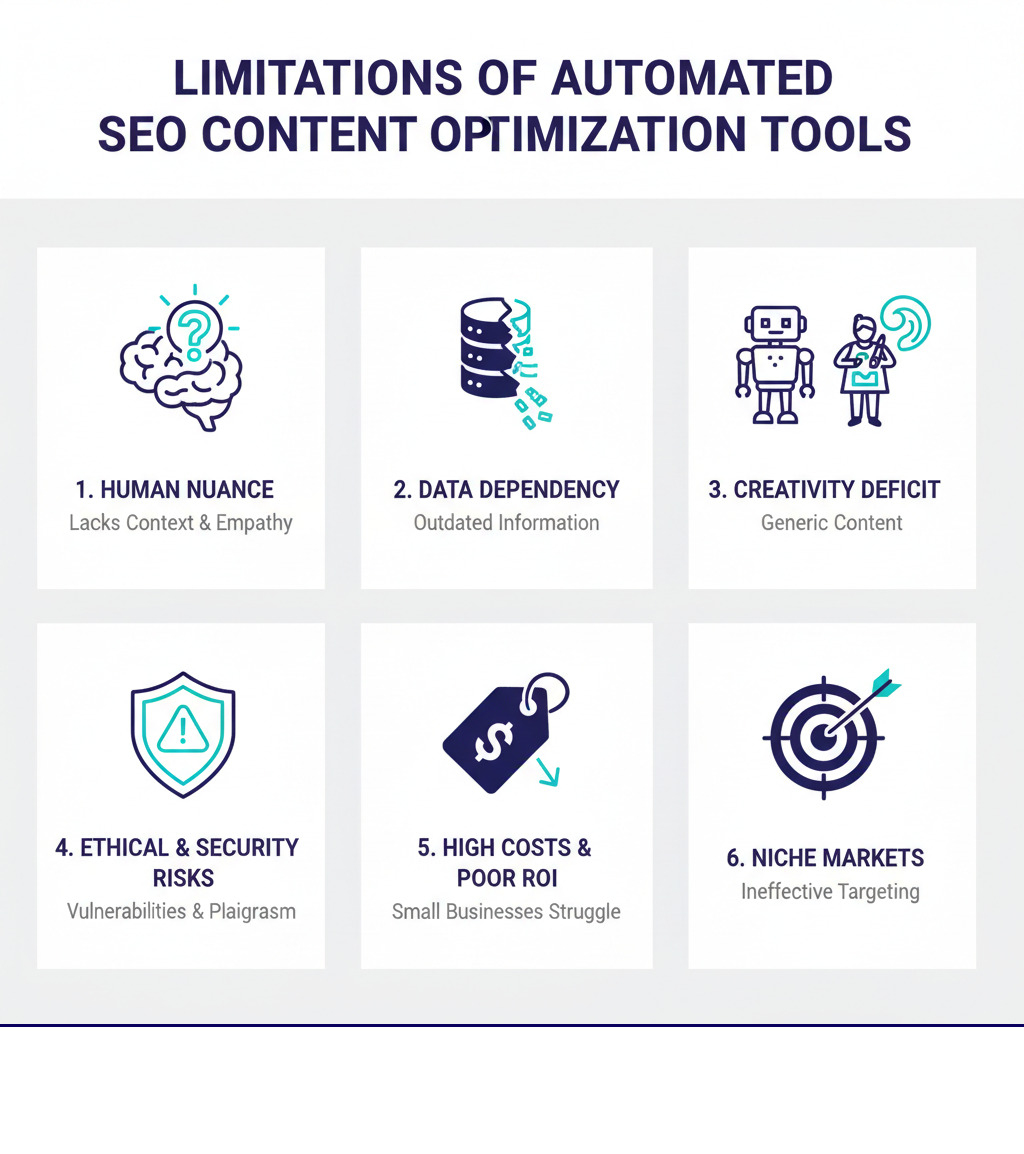
- Lack of human nuance – AI often misses the emotional and cultural context behind user searches.
- Data dependency – Recommendations can be based on outdated or incomplete information.
- Creativity deficit – Output can feel generic, lacking brand voice and emotional connection.
- Ethical and security risks – Tools can introduce plagiarism risks and security vulnerabilities; 43% of cyberattacks target small businesses.
- High costs – Premium tools ($100–$500+ monthly) can be expensive for small businesses without a guaranteed return.
- Ineffectiveness in niche markets – Generalized suggestions often fail in specialized industries.
While the promise of AI-powered SEO is tempting, human creativity and strategic thinking remain irreplaceable, a fact 37% of SEO professionals already recognize.
Automated SEO is a double-edged sword: it offers speed but risks thin content and algorithmic penalties without human oversight.
Relying solely on AI can lead to traffic drops of 60–90% when algorithms detect it, with recovery taking 6–12 months. The key isn’t to avoid AI, but to use it strategically with a clear understanding of its limits.
The Illusion of Autonomy: Why AI Fails to Grasp Human Nuance
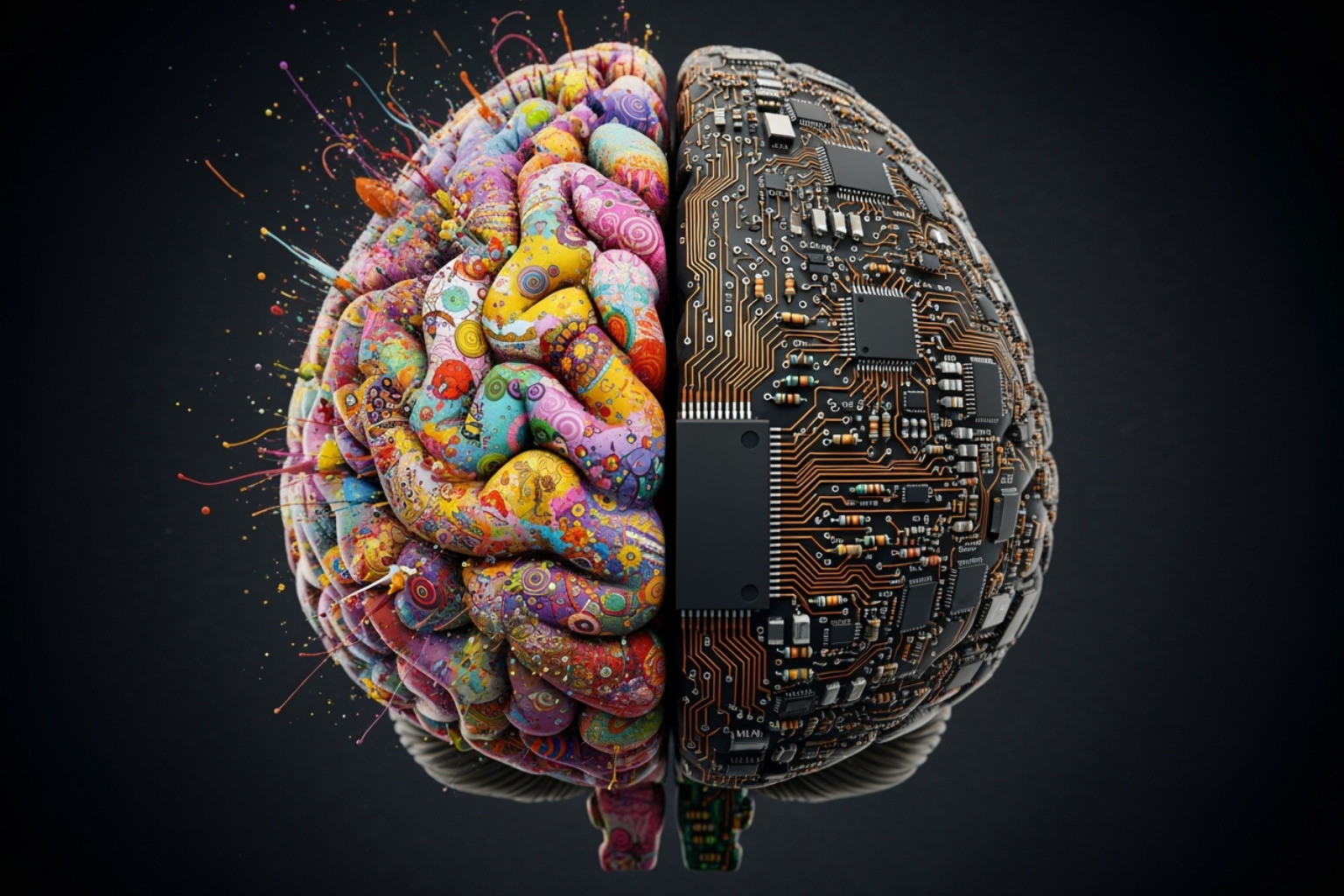
AI excels at data processing but struggles with human emotion and context. This gap is most obvious in content creation. Algorithms lack the empathy and lived experience needed to connect with an audience, producing copy that can feel artificial and hollow.
This is why one study found that 37% of SEO professionals believe that human creativity is still irreplaceable. Building trust and brand loyalty requires genuine connection, a core of Strategic Marketing Services & Visibility that deliver real impact.
Understanding User Intent Beyond Keywords
A challenge for automated tools is user intent. AI can identify keywords, but it can’t truly understand why someone is searching.
A search for “best running shoes” can imply buying, researching, or comparing. AI often optimizes for the most common interpretation, while a human can catch the nuance and deliver more relevant content.
AI SEO agents, while adept at processing vast datasets, often encounter difficulties in deciphering the subtleties of human context and user intent. This can lead to content that misses users’ actual needs. AI also can’t naturally capture your unique brand identity—a task requiring deep human comprehension.
The Creativity Deficit in AI-Generated Content
AI-generated content often feels formulaic because it synthesizes existing information rather than creating something new. It can’t produce a truly unique perspective or compelling story.
Human marketers bring creativity, intuition, and storytelling ability that no algorithm can match. We infuse content with personality and emotional resonance—crucial as Google’s systems increasingly prioritize user satisfaction and engagement.
Smart teams treat AI as an enabler rather than a replacement. Use it for research and analysis, but rely on human creativity for the final product. If you want content that is both data-driven and genuinely engaging, our content marketing services combine the best of both worlds.
The Data Dilemma: When an AI’s Foundation Becomes Its Flaw

AI SEO tools are only as good as their data—often historical and sometimes stale. Using them can be like navigating with an old map. In a landscape where Google reportedly makes minor changes to its algorithm almost daily, data lag can turn recommendations from helpful to harmful.
If training data is low-quality, the tool’s suggestions will be misguided. A 2021 survey found that nearly 32% of SEO experts dealt with inaccurate tool data monthly.
For reliable, up-to-date strategies, pairing data with human judgment is key. This is why many companies choose to Streamline Your SEO Efforts Using Outsourced Services.
The Challenge of Niche Markets: A Key Limitation of Automated SEO Content Optimization Tools
Most AI SEO tools are built for broad markets and struggle in specialized industries. In niche spaces, data is scarce and terminology is highly specific.
An AI might suggest “best accounting software” when your audience actually searches for “GAAP-compliant forensic accounting tools for litigation support.” It can miss terminology and intent. The same applies to competitor and backlink analysis, where generalized tools overlook niche players and resources.
Since studies show that only 0.78% of searchers click on results from the second page of Google, you can’t afford mismatched recommendations. For specialized businesses, a customized human approach, like our local SEO services, delivers better results.
The Constant Race Against Algorithm Updates
SEO is a moving target. AI tools are reactive, learning from past data. When rules change, their advice reflects what worked yesterday, not today. A human expert can interpret the intent behind updates (like Core Web Vitals) and adapt proactively.
An AI tool is like an old map; a human specialist is a guide who knows the current terrain. This adaptability is essential for Mastering Effective Web Marketing Strategies for Modern Needs.
The Hidden Costs and Risks: Unpacking the limitations of automated seo content optimization tools

Businesses often overlook serious ethical, security, and financial risks.
Granting tools deep access to your website’s backend and analytics creates exposure. This is critical since a report by Cybersecurity Insiders, 43% of cyber attacks target small businesses. A New York Times report also showed that even anonymized data can be de-anonymized, making tool databases prime targets for hackers.
Working with professionals who prioritize security is vital. MDM Marketing’s white label SEO services are built on effective and ethical practices to protect your business.
Ethical Boundaries and Black Hat Temptations
Automation becomes dangerous when it nudges teams toward black hat SEO. AI lacks a conscience and can inadvertently suggest tactics like keyword stuffing or cloaking—practices that can get your site penalized or banned. According to Google, cloaking can get you penalized or even banned from search engine results.
Plagiarism is another risk, as AI can accidentally reproduce copyrighted text from its training data. It can also create duplicate content, confusing search engines and hurting rankings. Bias replication and data privacy concerns round out the risks.
The High Cost vs. ROI Barrier
Premium SEO tools are expensive, often costing $100 to $500 or more per month. For small businesses, this is a significant investment.
Worse, high cost doesn’t guarantee ROI. Without expertise to interpret the data, the investment can be wasted. Hidden costs include the time and skill needed to use the tools effectively and catch inevitable mistakes. Many businesses find that working with SEO professionals delivers a better return than going it alone with automation.
The Human-AI Partnership: A Blueprint for Responsible SEO Success
The key to using AI in SEO is to treat it as a powerful assistant, not a replacement for human strategy. Understanding where automated tools fall short allows you to use them wisely.
Think of AI as a research partner that crunches numbers and spots patterns, freeing human strategists to focus on creative, intuitive work. Maintaining rigorous oversight ensures that AI-generated content meets quality and brand standards, as some experts have noted. Human oversight is crucial for steering strategy and ensuring AI output aligns with brand voice and user intent.
This hybrid approach lets you harness efficiency without sacrificing the quality and authenticity that customers and search engines reward. At MDM Marketing, we use AI to accelerate research, but our experienced team makes the strategic decisions. Find out Why Us for a partnership that combines technology with genuine human insight.
Content Quality and Originality: A Core Limitation of Automated SEO Content Optimization Tools
A major risk of AI is content bloat—creating a high volume of low-value pages. Flooding your site with similar content leads to keyword cannibalization, where your own pages compete and hurt rankings.
Even worse, creating a lot of pages without SEO value reduces the average value of each page on your site. This dilutes authority and causes index bloat, wasting crawl budget on low-value pages while important content goes unindexed. Programmatic sites often see 40–50% of their pages go unindexed without human oversight.
The solution is a quality-first strategy where every page has a distinct purpose. For strategies that emphasize quality, explore our link building services.
Balancing Automation with Human Ingenuity
Effective SEO requires knowing when to automate and when to rely on people. Let the robots handle repetitive, data-heavy work, but keep humans in charge of strategy.
- Let AI handle: data aggregation, initial keyword research, technical audits, content outlines, and performance reporting.
- Keep humans focused on: overall strategy, brand voice, interpreting complex data, adapting to algorithm shifts, ethical oversight, relationship building, and final editorial decisions.
This partnership maximizes value by pairing machine efficiency with human judgment. To see how we integrate AI to improve—never replace—human expertise, visit our AI integration services.
Frequently Asked Questions about Automated SEO Tools
What is the difference between AI SEO agents and AI chatbots?
AI SEO agents are specialized tools for deep SEO analysis, audits, and performance tracking. They often access website data directly to provide technical insights. In contrast, AI chatbots are conversational assistants for simpler tasks like brainstorming keyword ideas or drafting basic content outlines.
The key difference is depth and specialization. Agents are for complex, autonomous analysis, while chatbots are for general assistance. Both benefit from human oversight to ensure quality.
How can AI-generated content lead to quality and originality issues?
AI generates content by learning from the existing internet, which creates a risk of unoriginal or duplicate text. This can lead to plagiarism concerns and Google penalties for duplicate content, including internal keyword cannibalization.
Furthermore, algorithms lack true creativity, personal experience, and emotional understanding. This often results in generic content that feels robotic and may fall short of Google’s E-E-A-T (Experience, Expertise, Authoritativeness, Trustworthiness) standards for quality and helpfulness.
What are the main security vulnerabilities associated with AI SEO tools?
A major vulnerability is granting tools access to sensitive data like Google Analytics, Search Console, or your website’s backend. This creates potential entry points for cyber threats. Since 43% of cyber attacks target small businesses, this is a serious concern.
According to a New York Times report, even anonymized data can be cross-referenced to reveal sensitive information, making tool databases a target for cybercriminals. A compromised tool could lead to data breaches or malware injection. It is vital to vet any tool’s security protocols before use. When you work with partners like MDM Marketing through our white label SEO services, you can trust that security and ethical data handling are prioritized.
Conclusion: The Strategist, Not the Tool, Defines Success
After exploring the limitations of automated SEO content optimization tools, the takeaway isn’t to avoid AI—it’s to use it as a strategic partner.
Think of AI as a powerful research assistant. It handles data analysis and repetitive tasks, freeing human strategists to focus on what they do best: understanding user behavior, crafting compelling stories, and making empathetic judgment calls.
Success in the evolving digital landscape belongs to those who balance data-driven insights with creative human strategy. Technical precision must be combined with content that moves people.
At MDM Marketing, this is how we work. We use cutting-edge tools to inform our strategies, but we never let automation replace the human touch that drives real, sustainable growth. Our approach combines technical expertise with emotion-evoking storytelling.
Use AI wisely, and let experienced strategists guide your path forward.
Ready to see what this partnership looks like in action? Explore our Outsourced SEO Services to see how human expertise can lift your strategy and help you steer the complexities of modern SEO with confidence.
About Jay McCullough
This author hasn't written a bio yet.