
Why a Digital Campaign Strategy is Critical for Business Growth
A digital campaign strategy is your blueprint for achieving measurable marketing goals through online channels. It defines who you’re targeting, which platforms you’ll use, what messages will resonate, and how you’ll measure success. Without one, you’re essentially throwing money at tactics and hoping something sticks.
Key components of an effective digital campaign strategy:
- Clear SMART objectives – Specific, measurable goals tied to business outcomes
- Target audience definition – Detailed buyer personas and customer journey mapping
- Channel selection – Choosing platforms where your audience actually engages
- Content and messaging plan – Value-driven communication aligned with customer needs
- Budget allocation – Strategic resource distribution across channels
- Performance metrics – KPIs that track progress toward your goals
- Optimization framework – Continuous testing and refinement processes
Here’s the hard truth: 47% of companies don’t have a planned digital marketing strategy, according to Smart Insights research. That means nearly half of businesses are winging it, chasing trends, and wondering why their marketing dollars aren’t delivering results.
The difference between companies that succeed online and those that struggle comes down to one thing: strategic clarity before tactical execution. A great digital strategy adopts a directional approach—it sets a clear path forward while remaining flexible enough to adapt based on market response and performance data.
Think of your digital campaign strategy as the difference between planning and doing. Strategy answers the “why”—why you’re targeting specific audiences, why certain channels matter, why particular messages will resonate. Tactics answer the “how”—how you’ll execute campaigns, how you’ll create content, how you’ll track results.
The research is clear: businesses with documented strategies see increased sales, decreased marketing costs, higher customer lifetime value, and improved team productivity. But strategy isn’t just for enterprise brands with massive budgets. Whether you’re a local service business, an e-commerce brand, or a B2B company, a structured approach ensures every marketing dollar supports your business objectives.
The Foundations of a Digital Campaign Strategy
Success in the digital landscape does not happen by accident. It requires a solid foundation built on data, research, and clear intent. A digital campaign strategy acts as the execution plan that demystifies a marketer’s actions. It provides a 10,000-foot view of the business goals while grounding daily tasks in reality.
For businesses in Canton, OH, and beyond, establishing this foundation is the first step toward Strategic Marketing Services Visibility. Without a defined plan, organizations often waste resources chasing popular trends that may not even reach their actual target audience.

Defining Measurable SMART Goals
The most common mistake in digital marketing is setting vague goals. “I want more sales” is a wish, not a strategy. A robust digital campaign strategy relies on SMART objectives:
- Specific: Clearly define what is to be achieved (e.g., increase website traffic).
- Measurable: Attach a number (e.g., increase traffic by 20%).
- Achievable: Ensure the goal is realistic based on current resources and market conditions.
- Relevant: Align the goal with high-level business missions.
- Time-bound: Set a deadline (e.g., in the next six months).
By using this framework, a business can transition from abstract hopes to concrete targets. For example, a high-level goal might be to “become the go-to place for ordering flowers online,” while the corresponding SMART KPI would be “increase direct-to-consumer sales by 40% within 18 months.”
Understanding Your Target Audience
Arguably the most important step in building any strategy is defining who the business is talking to. Digital marketing offers the freedom to reach consumers in nearly unlimited ways, but trying to target everyone often results in targeting no one.
Effective strategies use buyer personas—detailed profiles of ideal customers based on demographics (age, location, income) and psychographics (goals, challenges, fears). For instance, a craft coffee company might target “Steve,” a 35-year-old professional earning $80,000 who values sustainability and convenience.
Gathering this information can be done through:
- Direct Surveys: Using tools like Google Surveys or Typeform to ask customers about their pain points.
- Social Listening: Checking Reddit communities to understand the conversations happening in a specific niche.
- Analytics: Reviewing Facebook Audience Insights tool to see where potential customers spend their time.
Structuring Success with Proven Frameworks
Once the goals and audience are defined, the next step is choosing a structure. Frameworks prevent a digital campaign strategy from becoming a disorganized list of tasks. They provide a repeatable model that can be adapted for different markets or product launches.
The Customer Value Journey
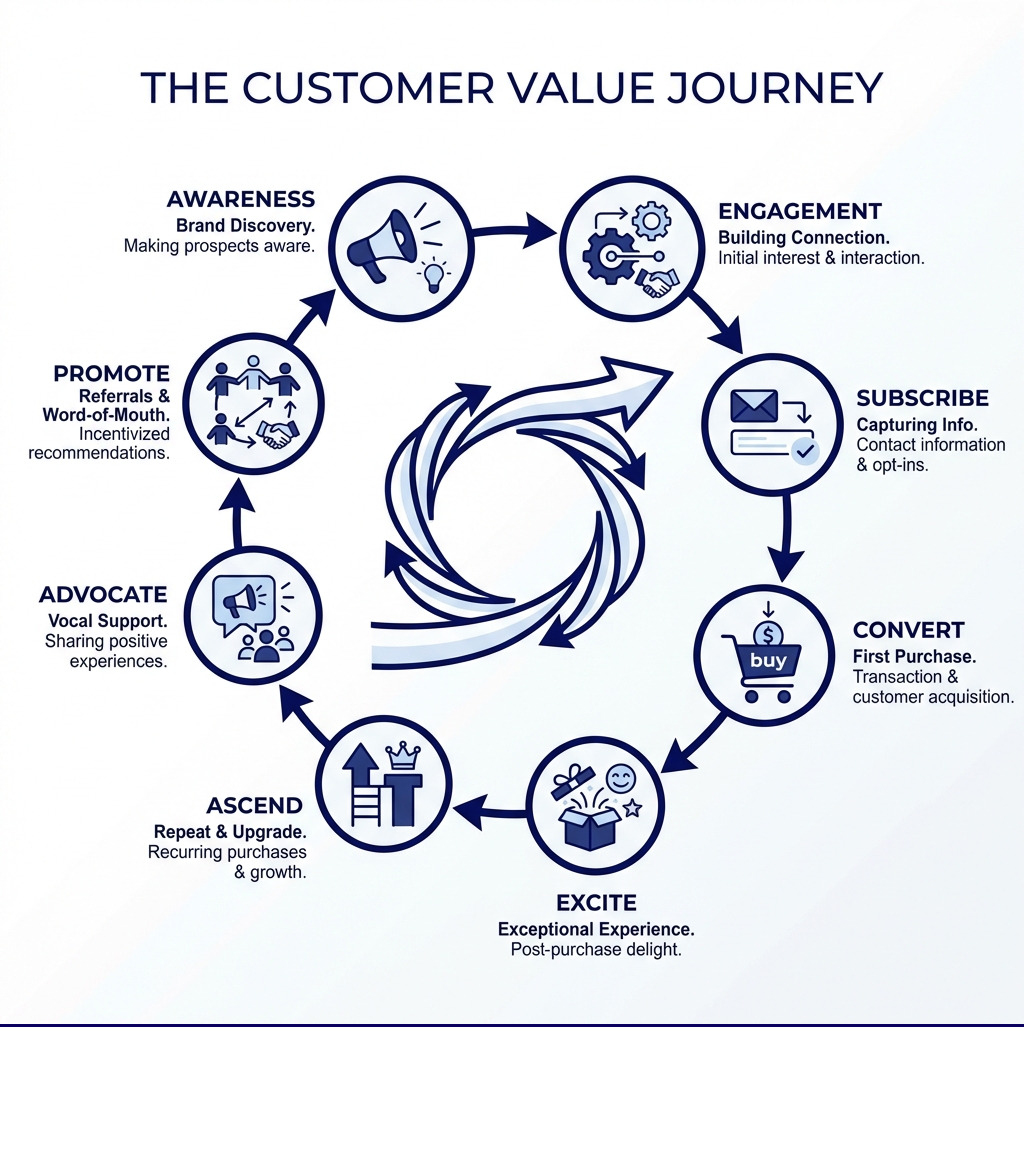
The Customer Value Journey (CVJ) is a strategic map that moves prospects through eight stages of relationship-building. Marketing is not a one-step process; it is a subtle progression:
- Awareness: The prospect sees an ad or a social post.
- Engagement: They watch a video or read a blog post.
- Subscribe: They provide an email address in exchange for value.
- Convert: They make a small, low-risk purchase (the “entry-point offer”).
- Excite: The business delivers a “wow” moment post-purchase.
- Ascend: The customer buys the core product or an upgrade.
- Advocate: The customer provides a testimonial or review.
- Promote: The customer actively refers new business.
MDM Marketing emphasizes that the job of marketing is to move people through these stages seamlessly. You can download a writeable copy of the Customer Value Journey here to begin mapping your own business.
The RACE OSA Improvement Process
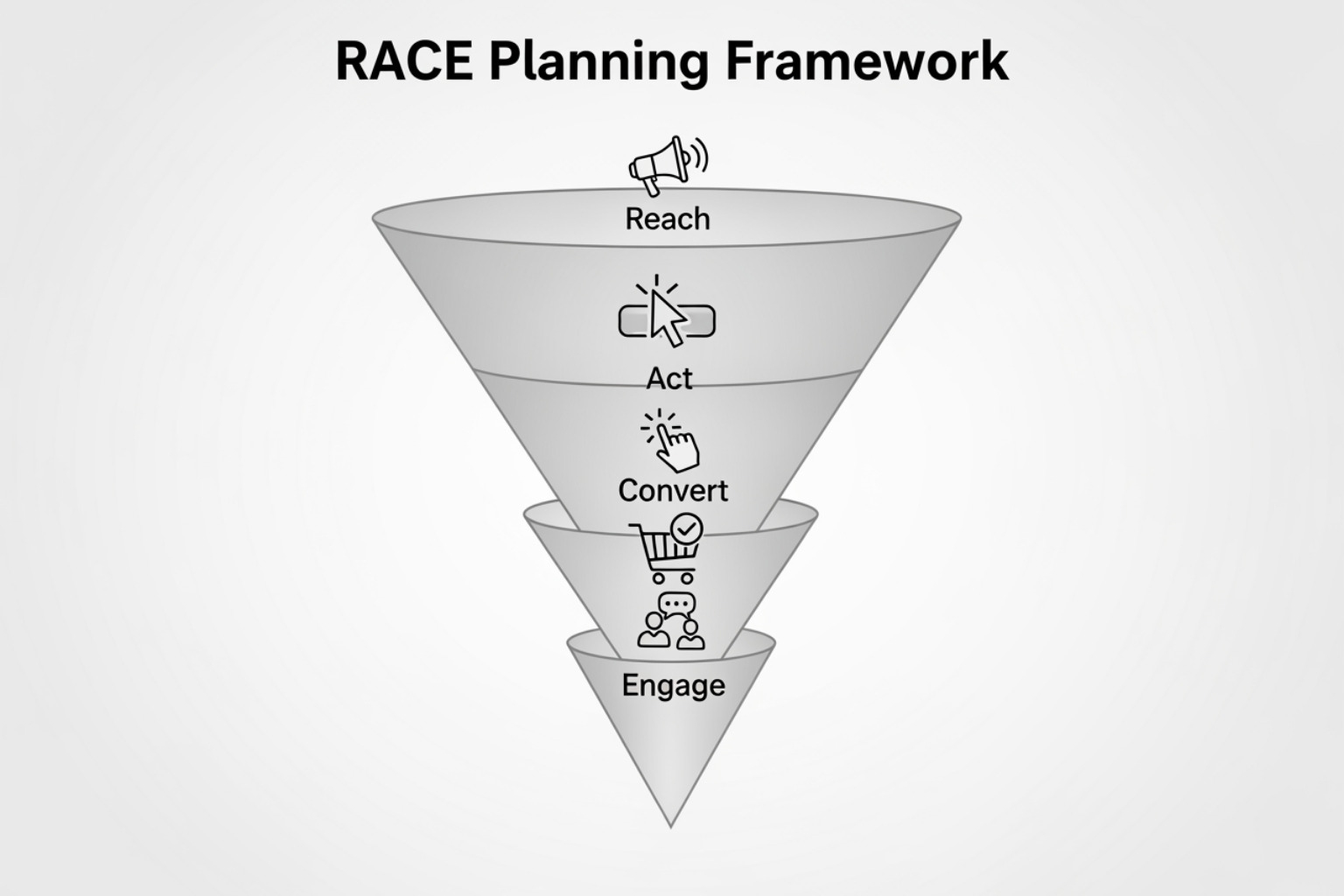
The RACE framework (Reach, Act, Convert, Engage) is another powerful tool for structuring a digital campaign strategy. It focuses on the full customer lifecycle and integrates Data-Driven Marketing at every touchpoint.
- Reach: Building awareness on other websites and social media to drive traffic to your web properties.
- Act: Encouraging interactions on your website or social media to generate leads.
- Convert: Using retargeting, lead nurturing, and CRO to turn leads into paying customers.
- Engage: Building long-term loyalty to encourage repeat purchases.
To implement this, businesses often use the RACE OSA process:
- Opportunity: Audit current performance and review the marketplace.
- Strategy: Define the directional plan and set SMART goals.
- Action: Implement 90-day plans to achieve specific wins.
Building Your Step-by-Step Roadmap
With a framework in place, it is time to build the roadmap. This involves deep market research, a SWOT analysis (Strengths, Weaknesses, Opportunities, Threats), and a clear content calendar. A results-oriented roadmap ensures that every piece of content serves a purpose in the larger Results-Driven SEO ecosystem.
Selecting the Right Channels for Your Digital Campaign Strategy
A common mistake is trying to be everywhere at once. A “quick way to fail is to try to do everything while doing nothing in particular very well.” Instead, businesses should prioritize channels where their audience is most active.
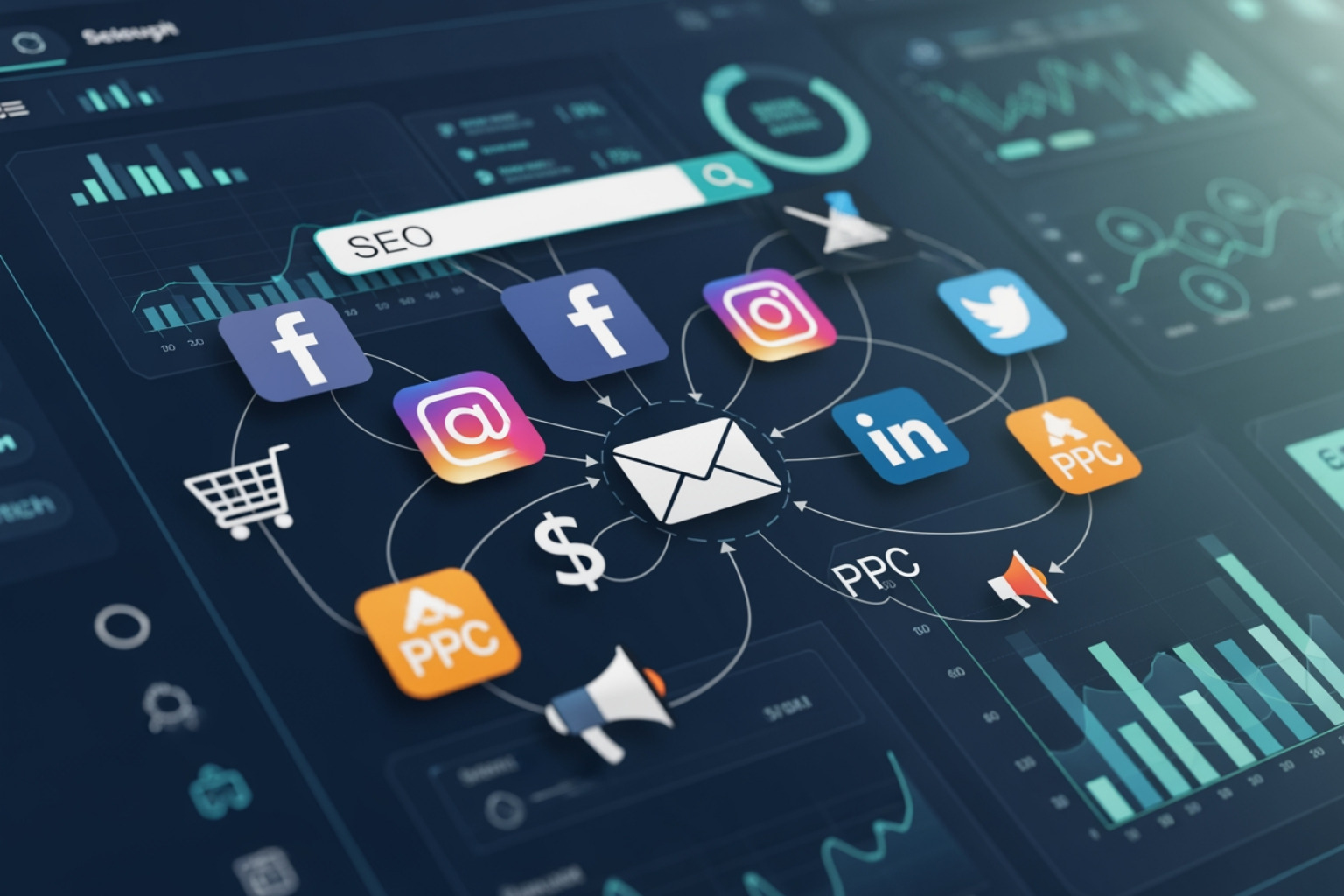
- Search Marketing (SEO & PPC): Essential for capturing high-intent users who are actively looking for a solution.
- Social Media: Great for brand awareness and community building.
- Email Marketing: Offers some of the highest ROI for B2C brands by building direct relationships.
- Content Marketing: The foundation of all digital efforts. Automated Content Marketing can help maintain consistency across these channels.
Insights from the 2025 Contentsquare Digital Experience Benchmarks show that website interactions are becoming more complex. Businesses must ensure their “operational backbone”—their website and core data systems—is strong enough to handle this traffic.
Integrating AI into Your Digital Campaign Strategy
AI is no longer a futuristic concept; it is a current necessity. Generative AI tools like ChatGPT support strategy creation, copywriting, and even Automated SEO Optimization.
Modern strategies use AI for:
- Predictive Analytics: Forecasting customer behavior and campaign outcomes.
- Personalization: Turning user data into tailored experiences, similar to how music streaming services create year-end summaries.
- Efficiency: Using AI agents to automate repetitive tasks like appointment scheduling or initial customer service inquiries.
Budget Allocation and ROI Management
Setting a budget requires a calculated approach. Marketers must consider revenue goals, profit margins, and ad spend. A helpful rule of thumb is to look at the lifetime value of a customer. If it costs $50 to acquire a customer who spends $500 over two years, that is a successful investment.
Resource efficiency is key. By focusing on high-performing channels and using toolkits and resources to structure campaigns, businesses can decrease marketing costs while increasing sales.
Measuring, Optimizing, and Scaling for ROI
A digital campaign strategy is not a “set it and forget it” project. It is an ongoing process of refinement. Continuous optimization puts a business in the top 10% of performers.
Tracking Key Performance Indicators
To know if a strategy is working, one must track the right metrics.
- Website Traffic: The number of people visiting your site.
- Conversion Rate: The percentage of visitors who take a desired action. This is the focus of Conversion Rate Optimization SEO.
- Return on Ad Spend (ROAS): How much revenue is generated for every dollar spent on ads.
- Customer Lifetime Value (CLV): The total revenue a business can expect from a single customer account.
By partnering with a Performance Marketing Company, businesses can use advanced attribution modeling to see exactly which touchpoints led to a sale.
Continuous Optimization and Testing
A/B testing is a simple yet powerful way to improve results. By varying one factor—such as the headline of an email or the color of a “Buy Now” button—marketers can see which version performs better.
User experience (UX) and mobile responsiveness are non-negotiable. In Canada, for example, while 56% of people use desktops, a significant 34% use mobile devices. If a site is slow or hard to navigate on a phone, those potential customers will leave.
| Feature | SEO (Organic) | PPC (Paid) |
|---|---|---|
| Cost | High upfront time/effort | Immediate spend required |
| Speed of Results | Slow (months) | Immediate (hours) |
| Long-term ROI | Very High (compounds over time) | Low (stops when budget stops) |
| Sustainability | High | Low |
| Best For | Authority & long-term growth | Quick wins & testing |
Frequently Asked Questions
What is the difference between a digital strategy and a campaign?
A digital campaign strategy is the overarching “why” and the long-term plan. It aligns with business objectives and defines the target audience. A campaign is the tactical “how”—a specific initiative with a start and end date designed to move people through one stage of the value journey.
How do you adapt a strategy for international markets?
Localization is key. It is often better to focus on a particular city or suburb when entering a new market to test the approach. Cultural nuances, local customs, and even the choice of social platforms (e.g., using X for customer service in some regions vs. WhatsApp in others) can make or break a strategy.
Why is a customer journey map essential for campaigns?
A journey map ensures you aren’t asking for a “marriage” (a big sale) on the “first date” (the first interaction). It helps identify where prospects might be getting stuck and allows for the creation of targeted content to nudge them toward the next stage.
Conclusion
Mastering a digital campaign strategy is the most effective way to ensure sustainable business growth. By moving away from random acts of marketing and toward a structured, data-driven framework, businesses can achieve predictable results.
MDM Marketing helps brands transform their online presence through custom strategy development and precise implementation. With a 93% client retention rate and an average 280% ROI increase, the team focuses on measurable outcomes that matter. Whether you are looking to scale paid acquisition or strengthen your organic presence in Canton, OH, a dedicated strategy is the key to your success.
Contact MDM Marketing for a Strategy Consultation today to start building your roadmap to growth.
About Jay McCullough
This author hasn't written a bio yet.