
Why an SEO Audit is the Blueprint for Your Digital Growth
An SEO audit for construction businesses is a systematic evaluation of your website that identifies technical issues, content gaps, and missed opportunities preventing you from ranking in search results and attracting qualified leads.
What an SEO Audit Reveals:
- Technical problems like slow page speed, mobile issues, or crawl errors that block Google from indexing your site
- On-page weaknesses including missing title tags, poor keyword targeting, or thin service page content
- Local SEO gaps such as incomplete Google Business Profile or inconsistent citations
- Content opportunities where competitors rank but you don’t
- Backlink profile health showing toxic links or missed link-building opportunities
- User experience issues that increase bounce rates and hurt conversions
If you’re struggling with low online visibility despite having quality workmanship and satisfied clients, the problem isn’t your business – it’s likely your website. Studies show that 53% of all site traffic is organic, making search visibility crucial for construction firms competing for high-value projects.
Most construction companies build impressive structures but their websites sit buried on page three of Google. Potential clients searching for “construction companies near me” (searched nearly 100,000 times monthly) never find them. An SEO audit for construction businesses acts as your digital blueprint, systematically uncovering why you’re invisible online and providing a clear action plan to fix it.
The construction industry is deeply rooted in tradition, but ignoring digital marketing is like building without a foundation – costly and ultimately ineffective. Unlike paid advertising that stops working the moment you stop paying, SEO builds long-term authority that compounds over time. However, you can’t fix what you don’t measure.
A professional audit examines every ranking factor Google uses, from technical issues like broken links and slow mobile performance to strategic elements like keyword targeting and local citations. For construction businesses specifically, this means evaluating how well you appear for location-based searches, whether your project portfolio pages are optimized, and if your service pages clearly communicate what you build and where.
The good news? Most construction websites have basic SEO errors that, once fixed, can lead to significant improvements. Technical SEO audits have helped businesses achieve results like a 2,002% boost in organic traffic by fixing critical crawling and indexing issues, or a 76% reduction in cart abandonment through page speed improvements.
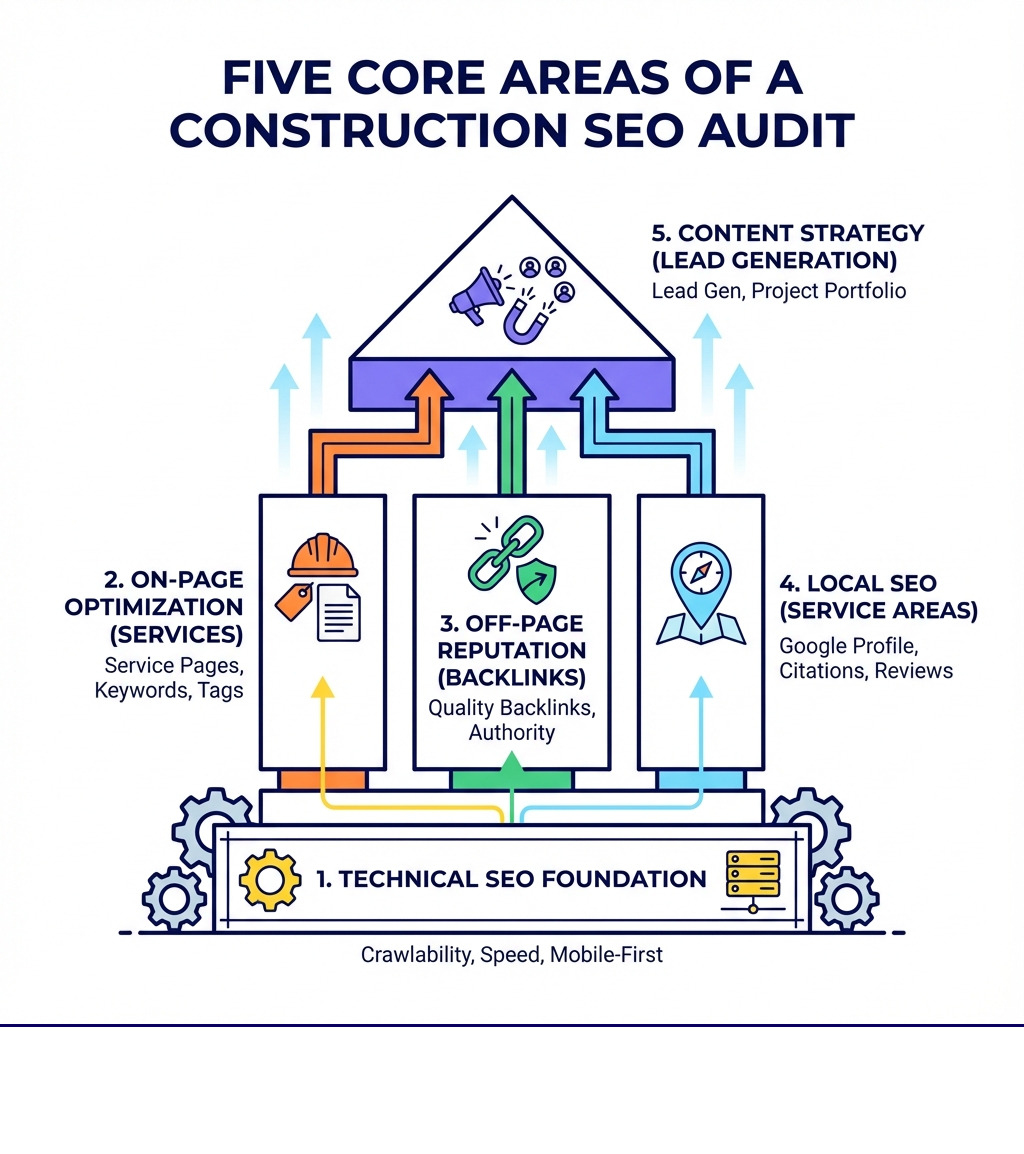
An SEO audit for construction businesses is crucial because it directly impacts your visibility and lead generation. It helps you understand how ideal clients search for your services and ensures your messaging targets them effectively. By building visibility, credibility, and a consistent pipeline of qualified project inquiries, an audit sets the stage for sustainable growth. It’s about getting your construction business to the top of search results to bring in more qualified leads and bigger projects.
Related content about seo audit for construction businesses:
The Core Components of an SEO Audit for Construction Businesses
A thorough SEO audit for construction businesses examines every factor that influences your search engine ranking. For a construction company, this means a specialized focus on local visibility, project showcases, and service-specific keywords. MDM Marketing breaks it down into five critical areas that form the framework of any successful SEO strategy.
Technical SEO: The Foundation of Your Website
Think of technical SEO as the very foundation of your website – the plumbing, electrical, and structural integrity. If there are cracks here, no matter how beautiful the interior design (your content), the building won’t stand strong. Technical issues are the unseen problems that can prevent Google from crawling and indexing your site properly, directly impacting user experience and search rankings. This is especially critical for construction clients who might be browsing on mobile devices from a job site.
Key elements of a technical SEO audit include:
- Site Speed: Your page load time is crucial not only for SEO but also for your potential customer’s experience. Google will promote sites with a faster page load speed if it improves the user’s experience. Slow-loading pages can negatively impact user engagement, leading potential clients to abandon your site for quicker alternatives. You can check your site with PageSpeed Insights to identify and fix performance issues. Aim for a good Largest Contentful Paint (LCP) score under 2.5 seconds and an Interaction to Next Paint (INP) under 200 milliseconds.
- Mobile-Friendliness: With Google’s mobile-first indexing, your website must be mobile-friendly. More than 60% of all website traffic comes from mobile devices. If your site isn’t responsive, easy to steer on a small screen, and fast-loading on mobile networks, you’re missing out on a huge segment of your audience and signaling to Google that your site isn’t user-friendly.
- Crawlability & Indexability: Can search engines easily find, crawl, and index all your important pages? An audit checks for issues like
robots.txtblocking important content,noindextags where they shouldn’t be, or complex JavaScript that prevents Google from rendering your pages correctly. If Google can’t “read” your site, it can’t rank it. - Site Architecture: A clear and logical site structure helps both users and search engines understand your website’s hierarchy and find what they’re looking for. A well-organized site ensures that important service pages and project galleries are easily accessible within a few clicks.
- HTTPS Security: Google uses HTTPS encryption as a ranking signal, and for good reason – it protects user data. Ensuring your site is secure builds trust with visitors and meets a fundamental SEO requirement.
- Broken Links: Both internal and external broken links create a poor user experience and can waste Google’s crawl budget. An audit identifies these dead ends, allowing you to fix them and improve site quality.
How do technical SEO issues impact a construction company? Imagine a potential client searching for “commercial builder North Canton, OH.” If your site is slow, not mobile-friendly, or has crawl errors, they’ll likely bounce to a competitor before even seeing your impressive portfolio. A technical SEO audit identifies these foundational weaknesses, much like a structural engineer inspects a building for hidden flaws.
On-Page SEO: Framing Your Services for Search Engines
Once the foundation is solid, it’s time to make your website’s content shine. On-page SEO involves optimizing the content and HTML source code of your pages. For construction firms, this means ensuring your service pages, project galleries, and blog posts are clearly structured to tell both users and search engines exactly what you do and where you do it.
Key aspects of on-page SEO in an audit include:
- Title Tags & Meta Descriptions: These are your website’s storefront window in search results. A compelling title tag (under ~60 characters) and a descriptive meta description (under ~155 characters) should include relevant keywords and entice users to click. Missing or poorly optimized meta elements mean missed opportunities to grab attention.
- Header Tags (H1, H2, H3): Proper use of header tags creates a logical content flow, making your pages easy to read for both humans and search engines. Your H1 should be unique and accurately describe the page’s main topic, while H2s and H3s break down sub-topics, especially useful for showcasing different services or project phases. A surprising 36% of top construction companies are missing a basic H1 tag on their homepages, a fundamental error.
- Image Optimization (Alt Text): Construction websites rely heavily on images to showcase projects. Optimizing these images with descriptive alt text helps search engines understand their content, improving visibility in image search and accessibility for users with visual impairments. It’s also crucial for page speed, as large image files can significantly slow down your site.
- Internal Linking Strategy: Strategic internal links guide users and search engines through your site, distributing “link equity” and reinforcing the relevance of related pages. Linking from a blog post about “choosing a general contractor” to your “commercial construction services” page is a powerful way to connect content.
- URL Structure: Clean, short, and keyword-rich URLs are more user-friendly and can provide a slight SEO advantage. For example,
yourcompany.com/commercial-construction/office-buildingsis better thanyourcompany.com/services?id=123. - User Experience (UX): A great UX keeps visitors engaged, encourages action, and signals to search engines that your site is valuable. This includes clear navigation, readable fonts, and a logical layout. If visitors find your site frustrating, they’ll leave, increasing your bounce rate and hurting your rankings.
- Readability: Construction content can be technical, but it doesn’t have to be dense. An audit checks for clear, concise writing, appropriate paragraph breaks, and easy-to-understand language. This is especially important when explaining complex services or project details to potential clients.
On-page SEO ensures that when a potential client searches for a specific construction service, your website clearly communicates that you offer exactly what they need. Learn about our SEO services to help you frame your construction business for success.
Off-Page SEO: Building Your Digital Reputation
While on-page SEO focuses on what happens on your website, off-page SEO refers to actions taken outside of your own website to impact your rankings. Primarily, this involves building high-quality backlinks, which act as votes of confidence from other reputable sites, signaling to Google that you are a trusted authority in the construction industry.
Key aspects of off-page SEO in an audit include:
- Backlink Profile Analysis: This involves examining the quantity and quality of links pointing to your site. Are they from reputable industry sources, local businesses, or spammy directories? A strong backlink profile is a powerful ranking factor.
- Link Quality vs. Quantity: It’s not just about how many links you have, but where they come from. A few high-quality links from authoritative construction industry publications or local government sites are far more valuable than hundreds of low-quality, spammy links.
- Local Business Directories: Listing your construction business in relevant local directories (like Yelp, Yellow Pages, or industry-specific directories) not only provides valuable backlinks but also helps with local SEO by ensuring consistent Name, Address, and Phone (NAP) information across the web.
- Industry Association Links: Being listed on the websites of construction industry associations, chambers of commerce, or professional organizations can provide highly authoritative and relevant backlinks.
- Guest Posting Opportunities: Contributing valuable content to other reputable construction blogs or industry websites can earn you high-quality backlinks and expose your brand to a new audience.
- Brand Mentions: Even mentions of your company name without a direct link can contribute to your online authority, especially if they come from respected sources.
Off-page SEO helps establish your construction business as a credible and authoritative player in the industry, building a digital reputation that Google recognizes and rewards. For deeper insights, explore our guide on Insights on How to Build Quality Backlinks for SEO Growth.
Local SEO: Winning Projects in Your Service Area

For most construction businesses, success is inherently local. Whether you’re a residential builder in North Canton, OH, or a commercial contractor serving the surrounding areas, your clients are typically searching for services “near me.” A local SEO audit is critical for ensuring you appear in the “Map Pack” and for local search queries like “construction companies near me,” which is searched nearly 100,000 times a month on Google.
A local SEO audit focuses on:
- Google Business Profile (GBP) Optimization: Your GBP listing is often the first interaction a local customer has with your business. An audit ensures your profile is fully optimized with accurate information, services, photos, hours, and customer reviews. An optimized GBP is vital for enhancing local reach and reputation management. Explore our GMB Optimization Services.
- NAP Consistency (Name, Address, Phone): Inconsistent NAP information across different online directories is a common local SEO issue. An audit verifies that your business name, address, and phone number are identical everywhere they appear online, which builds trust with Google and prevents confusion.
- Customer Reviews: Positive customer reviews are a huge factor in local search rankings and building credibility. An audit assesses your current review strategy and identifies opportunities to encourage more positive feedback and manage any negative reviews.
- Service Area Pages: For construction companies serving multiple locations, dedicated service area pages can significantly boost local visibility. These pages are optimized for specific cities or neighborhoods, detailing your services in those areas.
- Localized Content: Creating content that speaks directly to the needs and concerns of your local community, perhaps featuring local projects or addressing local building codes, can greatly improve your local SEO efforts.
- Schema Markup for Local Business: Implementing specific schema markup for local businesses helps search engines understand critical information about your company, such as your location, services, and contact details, making it easier to display your business prominently in local search results.
Local SEO is how construction businesses ensure they are found by the clients who matter most: those in their immediate service area.
Content Strategy: Showcasing Your Expertise and Projects
Beyond the technical and structural elements, an SEO audit for construction businesses analyzes your most valuable asset: your content. It identifies whether your website effectively communicates your expertise, answers potential client questions, and targets the keywords that lead to profitable projects.
This part of the audit digs into:
- Keyword Research: This is the bedrock of any content strategy. An audit uses tools like Google Keyword Planner to identify the exact terms potential clients are using to find construction services. It goes beyond obvious keywords to uncover long-tail queries and user intent (e.g., “cost to build a custom home in North Canton, OH”).
- Content Gap Analysis: Are there questions your target audience is asking that your website isn’t answering? A content gap analysis compares your content to competitors’ and identifies topics where you can create valuable, authoritative content to attract more traffic.
- Thin or Duplicate Content: Google prioritizes unique, high-quality content. An audit will flag pages with very little text (thin content) or content copied from other parts of your site or external sources (duplicate content), which can dilute your SEO efforts.
- Project Case Studies: For construction, a picture is worth a thousand words – and a well-documented case study is worth a million. An audit assesses how effectively your project galleries and case studies are optimized to showcase your work, highlight your expertise, and attract new clients.
- Service Page Quality: Each of your service pages (e.g., residential remodeling, commercial build-outs, specialized concrete work) should be comprehensive, keyword-targeted, and clearly articulate the value you provide. An audit ensures these pages are designed to convert visitors into leads.
- Blog & FAQ Content: A blog can be a powerful tool for attracting organic traffic by answering common client questions and demonstrating your industry expertise. However, many construction companies use their blogs for PR rather than SEO. An audit helps pivot your blog strategy to target user intent and build topical authority.
Effective content strategy ensures that when potential clients are researching construction projects or looking for solutions, your website provides the answers and builds trust, positioning you as the go-to expert. See our Content Marketing services to learn more.
From Audit to Action: Implementing Your SEO Blueprint
An audit is only valuable if you act on its findings. The next step is to create a prioritized action plan. Address the most critical issues first – the ones that offer the highest impact with reasonable effort – to start seeing results quickly. This is where the blueprint transforms into a construction schedule.
MDM Marketing approaches this with a clear methodology:
- Prioritizing Fixes: Not all issues are created equal. Some technical errors might be blocking your entire site from being indexed, while a minor on-page adjustment might have less immediate impact. We categorize findings based on:
- Impact vs. Effort: What fixes will give you the most “bang for your buck” (high impact, low effort)? These are your quick wins.
- Technical Dependencies: Some changes need to happen before others. For example, you can’t optimize content on pages that aren’t even being crawled.
- Cost: While we don’t discuss pricing here, the cost-effectiveness of implementing a solution is always considered in a real-world scenario.
- Creating a Roadmap: A detailed roadmap outlines each task, its priority level, the resources required, and the expected outcome. This ensures a systematic approach to optimizing your online presence.
- Assigning Tasks: Clear ownership of each task is crucial, whether it’s assigned to an internal team member or an external SEO partner like MDM Marketing.
- Setting Deadlines: Establishing realistic deadlines for each task keeps the project moving forward and ensures accountability.
An SEO audit for construction businesses is not a one-time task. It’s an ongoing process, much like maintaining a building. Consistently updating and monitoring your SEO strategy helps you build an even stronger, longer-lasting presence. For businesses looking to streamline this process, consider how Streamline Your SEO Efforts Using Outsourced Services can provide the expertise and resources needed.
Measuring the ROI and Timeline for Results

After implementing changes from your SEO audit for construction businesses, tracking your performance is key to proving ROI. While some technical fixes can yield quick improvements, a comprehensive SEO strategy is a long-term investment. Building authority and trust with search engines takes time.
Here’s what to expect and how to measure success:
- Key Performance Indicators (KPIs): These are the metrics that matter most. We focus on:
- Organic Traffic Growth: The number of visitors coming to your site from search engines.
- Keyword Ranking Improvements: Where your target keywords appear in search results.
- Conversion Rate: The percentage of visitors who complete a desired action (e.g., filling out a contact form, making a phone call).
- Leads Generated: The actual number of qualified inquiries your website produces.
- Typical Result Timelines: SEO is a marathon, not a sprint. High-quality results build steadily, compounding over months.
Business Type Typical Timeline to See Noticeable Results Brand New Construction Businesses 6-12 months to see noticeable results Established Construction Businesses (new to SEO) 3-6 months to start seeing significant progress Construction Businesses with Previous Poor SEO Results 4-8 months for initial cleanup and re-strategizing
These timelines reflect the nature of SEO – it takes time for search engines to recognize a site as trustworthy and authoritative. However, once results begin, consistent and significant growth can be observed.
MDM Marketing uses tools like Google Analytics and Google Search Console to monitor these KPIs, providing transparent reporting and continuous strategy refinement. This ensures that every optimization contributes to your business goals. Learn about our Analytics services to see how we track your progress.
Frequently Asked Questions about SEO Audits for Construction
Navigating SEO can bring up many questions, especially for construction businesses focused on their craft. Here are some common inquiries about SEO audits for construction businesses.
How often should a construction company perform an SEO audit?
A comprehensive SEO audit for construction businesses is recommended annually. This deep dive ensures that your strategy remains aligned with the latest search engine algorithms and industry trends. Between these annual audits, smaller, more focused quarterly check-ups are highly beneficial. These regular reviews can monitor technical health, track keyword performance, and quickly identify any new issues or content gaps. This proactive approach helps you stay ahead of algorithm changes and your competitors.
Can I perform an SEO audit myself?
While basic checks can be done with free tools like Google Search Console or PageSpeed Insights, a truly professional SEO audit for construction businesses goes much deeper. It uses advanced software and requires specialized expertise to uncover subtle technical issues, analyze complex backlink profiles, and identify nuanced strategic opportunities that a DIY approach might miss. Relying solely on a self-audit could mean overlooking critical errors that are holding your site back, costing you valuable leads and projects. For optimal results, partnering with SEO specialists is often the most effective route.
What is the single biggest mistake construction websites make with SEO?
The most common and impactful mistake construction websites make with SEO is neglecting local SEO. Many firms have a great-looking website but fail to fully optimize their Google Business Profile (GBP) or build consistent local citations across the web. This makes them virtually invisible to nearby customers actively searching for their services. For construction businesses, the phrase “construction companies near me” is searched nearly 100,000 times a month, highlighting the immense opportunity missed by ignoring local search signals. Without a strong local SEO strategy, a construction company is essentially a hidden gem in plain sight, unable to connect with its most promising clients.
Build Your Business on a Solid Digital Foundation
An SEO audit for construction businesses isn’t just a technical check-up; it’s a strategic investment in the future growth of your company. By identifying weaknesses and capitalizing on opportunities, you can build a powerful online presence that consistently attracts the right clients and fills your project pipeline. It ensures your quality workmanship is matched by your online visibility, helping you stand out in a competitive market.
Ready to lay the groundwork for sustainable growth? The expert team at MDM Marketing, based in North Canton, OH, combines data-driven analysis with custom strategies to help you dominate your local market. We understand that trust and credibility are everything in construction, and our custom SEO solutions are designed to build both for your digital presence.
Contact us for a free consultation and start building a stronger digital foundation today.
About Jay McCullough
This author hasn't written a bio yet.