
Why Your Trade Show Booth Is Invisible Online (And How to Fix It)
A Trade show traffic SEO guide gives exhibitors a step-by-step system to attract more booth visitors and qualified leads through organic search — before, during, and after the event.
Here’s the quick version of how it works:
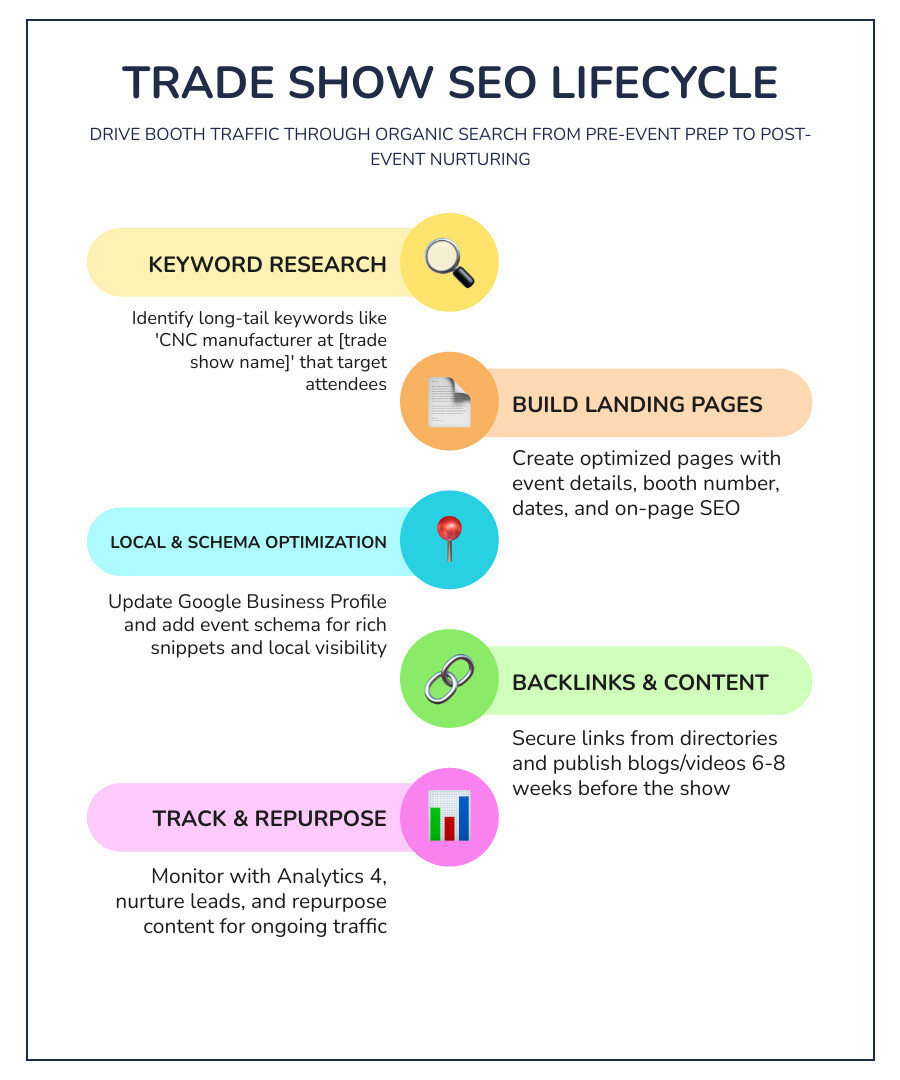
- Research keywords your target attendees are actually searching (e.g., “CNC manufacturer at [trade show name]”)
- Build an optimized landing page for the event with location, dates, and your booth number
- Add schema markup so search engines display your event details as rich snippets
- Optimize your Google Business Profile with trade show details for local search visibility
- Build pre-show backlinks through sponsors, directories, and partner sites
- Publish supporting content (blog posts, videos, social posts) 6-8 weeks before the show
- Track results with Google Analytics 4 and Search Console during and after the event
- Repurpose content post-event to keep driving organic traffic long after the show closes
Think about this for a second.
Over 90% of online experiences begin with a search engine. That means the attendees you want at your booth — buyers, procurement managers, engineers, CMOs — are almost certainly Googling before they walk the floor.
But most exhibitors skip search entirely.
They spend months on booth design, travel logistics, and giveaway swag. Then they show up and wonder why foot traffic feels random. The hard truth? If your booth isn’t findable online before the event, you’re already behind.
SEO isn’t just for blogs and e-commerce stores. It’s one of the most underused levers in trade show marketing — and for small and mid-sized businesses, it’s a cost-effective way to compete with much bigger exhibitors.
This guide covers everything: keyword research, on-page optimization, local SEO, backlink building, email timing, and post-event analytics. Whether you’re a B2B marketing leader or a first-time exhibitor, you’ll leave with a clear, actionable plan.
The Foundation of a Trade Show Traffic SEO Guide
To master trade show visibility, one must first understand that attendee behavior has shifted. In the past, people wandered the aisles to discover new products. Today, B2B buyers conduct roughly 12 searches before ever engaging with a brand. If a company isn’t appearing in those dozen searches, it essentially doesn’t exist to that prospect.
Building a solid foundation starts with more info about SEO strategy that prioritizes buyer personas. Who is the ideal visitor? Is it a plant manager looking for “industrial automation solutions in Ohio” or a contractor searching for “new construction technology at [Event Name]”? By mapping search intent to these personas, exhibitors can create content that answers specific questions long before the show doors open.
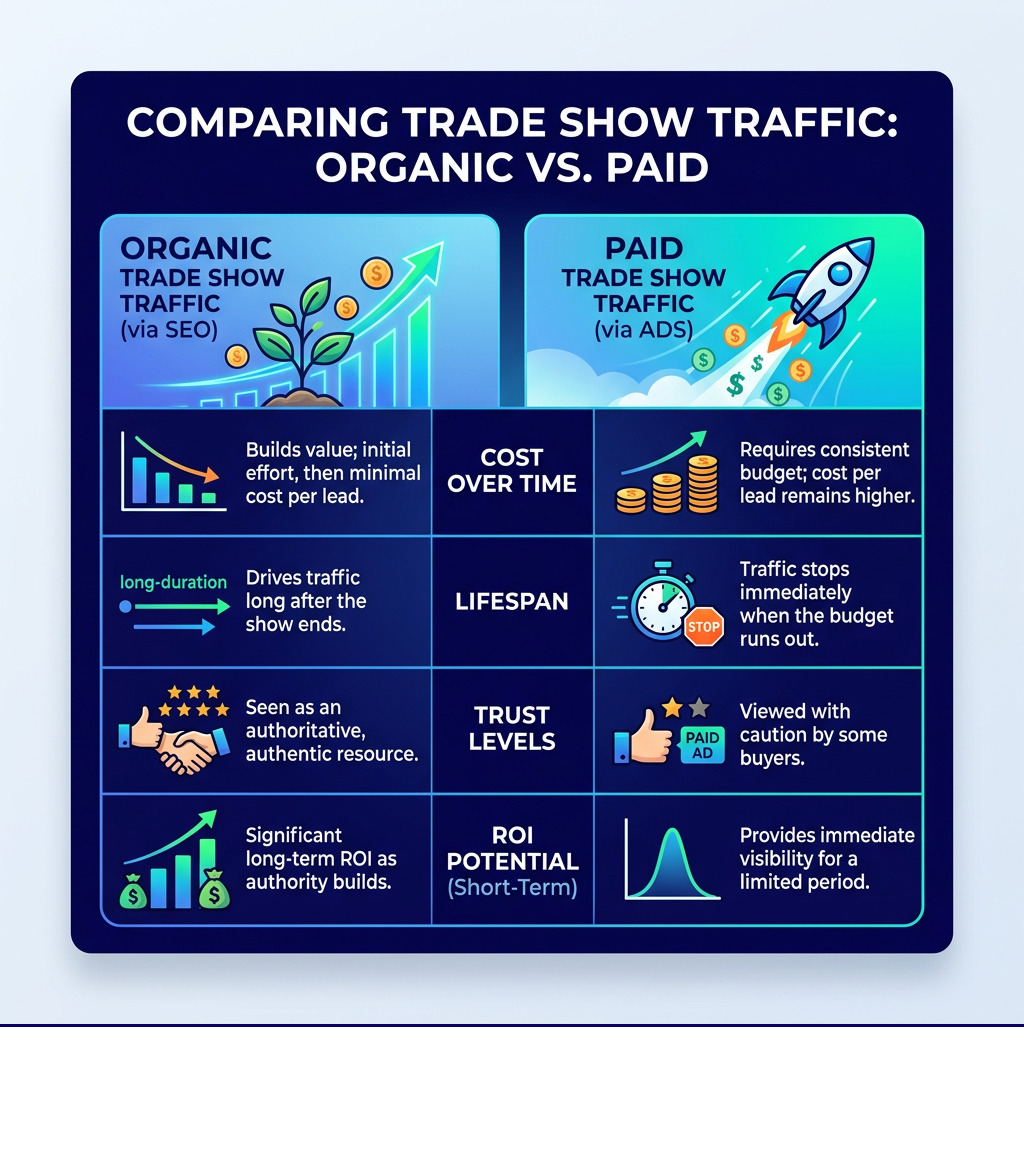
Organic search is often more powerful than paid listings. Research indicates that 70% of searchers skip over paid ads to click on organic results. While paid traffic stops the moment the budget runs out, organic traffic continues to build authority and drive leads for months.
Pre-Show Content and Technical Optimization
Preparation is the secret sauce of any successful Trade show traffic SEO guide. Search engines need time to crawl and index new information, so optimization should begin at least six to eight weeks before the event.
The centerpiece of this effort is a dedicated event landing page. This page shouldn’t just list the booth number; it should be a resource hub. It needs to include SEO On-Page Optimization Techniques such as optimized meta tags and title tags that include the trade show name, the year, and the city.
Technical health is equally vital. With 60% of searches happening on mobile devices, a landing page that loads slowly will lose visitors. According to Google’s PageSpeed Insights, mobile users often abandon a site if it takes more than 10 seconds to load. Large images and unoptimized code are common culprits that can sink a trade show page’s ranking.
Furthermore, implementing event structured data (schema markup) tells Google exactly what the page is about. This can result in a “rich snippet” in search results, showing the event date and location directly on the search page, which significantly boosts click-through rates.

Utilizing a Trade show traffic SEO guide for Keyword Research
Keyword research for trade shows requires a mix of broad industry terms and hyper-specific “long-tail” phrases. While “manufacturing equipment” might be too competitive to rank for quickly, a term like “best industrial mixers at [Trade Show Name] 2025” is much easier to capture.
Exhibitors should look for competitor gaps. What are other companies in the niche ignoring? By using tools like Google Keyword Planner, marketers can identify the specific questions attendees are asking. This is where more info about content marketing comes into play—creating blog posts or “know before you go” guides that target these intents can position a brand as an industry leader before the first badge is scanned.
Optimizing On-Page Elements for Event Visibility
On-page SEO is about making the website readable for both humans and search robots. This involves using header tags (H1, H2, H3) to structure the content logically. For instance, an H2 could be “Visit Our Booth for Live Demos,” making it clear to Google what the section offers.
Don’t ignore image alt text. If a page features a photo of a new product, the alt text should read “New [Product Name] being showcased at [Trade Show Name].” This helps the image appear in Google Image searches. Effective On-Page SEO for Website also includes internal linking—connecting the event page to existing product pages—to pass “link equity” throughout the site and keep users engaged longer.
Local SEO, Backlinks, and Social Synergy
Trade shows are physical events tied to a specific geography, making local SEO a critical component of a Trade show traffic SEO guide. Even if a business is headquartered in Canton, OH, it can leverage local SEO for a show happening in a different city.
The first step is ensuring NAP (Name, Address, Phone) consistency. If a company’s details are different on their website than they are on an event directory, search engines may get confused, which hurts rankings. Local SEO Marketing Services often focus on claiming and updating a Google Business Profile. For the duration of the show, exhibitors can add “updates” to their profile, mentioning their temporary presence at the convention center and offering “local” promotions to attendees searching “near me.”
Implementing a Trade show traffic SEO guide for Local Visibility
Geographic targeting involves using location-specific keywords like “best tech exhibitors in [City Name].” This helps the brand appear in the “Map Pack” when attendees search for vendors while they are in town.
Review management is another pillar of a Local SEO Optimization Guide. Encouraging booth visitors to leave a Google review in real-time can provide a massive boost to local search visibility. Since proximity is a major ranking factor, being physically present at the venue gives exhibitors a unique window to dominate local search results for those few days.
Building Authority Through Link Building and Partnerships
Backlinks—links from other websites to yours—act as votes of confidence in the eyes of search engines. For trade shows, exhibitors should seek links from the official event website, industry associations, and local news outlets.
Link Building 2025 strategies also include guest posting on industry blogs or collaborating with influencers who will be at the show. When an influencer links to an exhibitor’s landing page, it passes significant domain authority. For more insights on how to build quality backlinks for SEO growth, companies should focus on creating “linkable assets,” such as original industry reports or high-quality infographics that others want to share.
Social media also plays a role. While social links aren’t direct ranking factors, the traffic they drive signals to Google that the content is relevant. Consider the Facebook statistics: with 1.84 billion daily users, the potential for “social signals” to amplify SEO efforts is massive. Sharing booth glimpses or “behind the scenes” videos can create a buzz that translates into search volume.
Post-Event Nurturing and Analytics
The trade show might end on Friday, but the SEO work continues long after the booth is packed away. In fact, SEO ranking as the third most invested in marketing activity in 2023 highlights how valuable long-term search visibility is for ROI.
Post-event SEO focuses on lead nurturing and content repurposing. For example, a company might take the videos recorded at the booth and turn them into a series of blog posts. This strategy is highly effective for SEO for Construction Companies and other industrial sectors where the buying cycle is long and prospects need continuous education.
Measuring Success with Data-Driven Insights
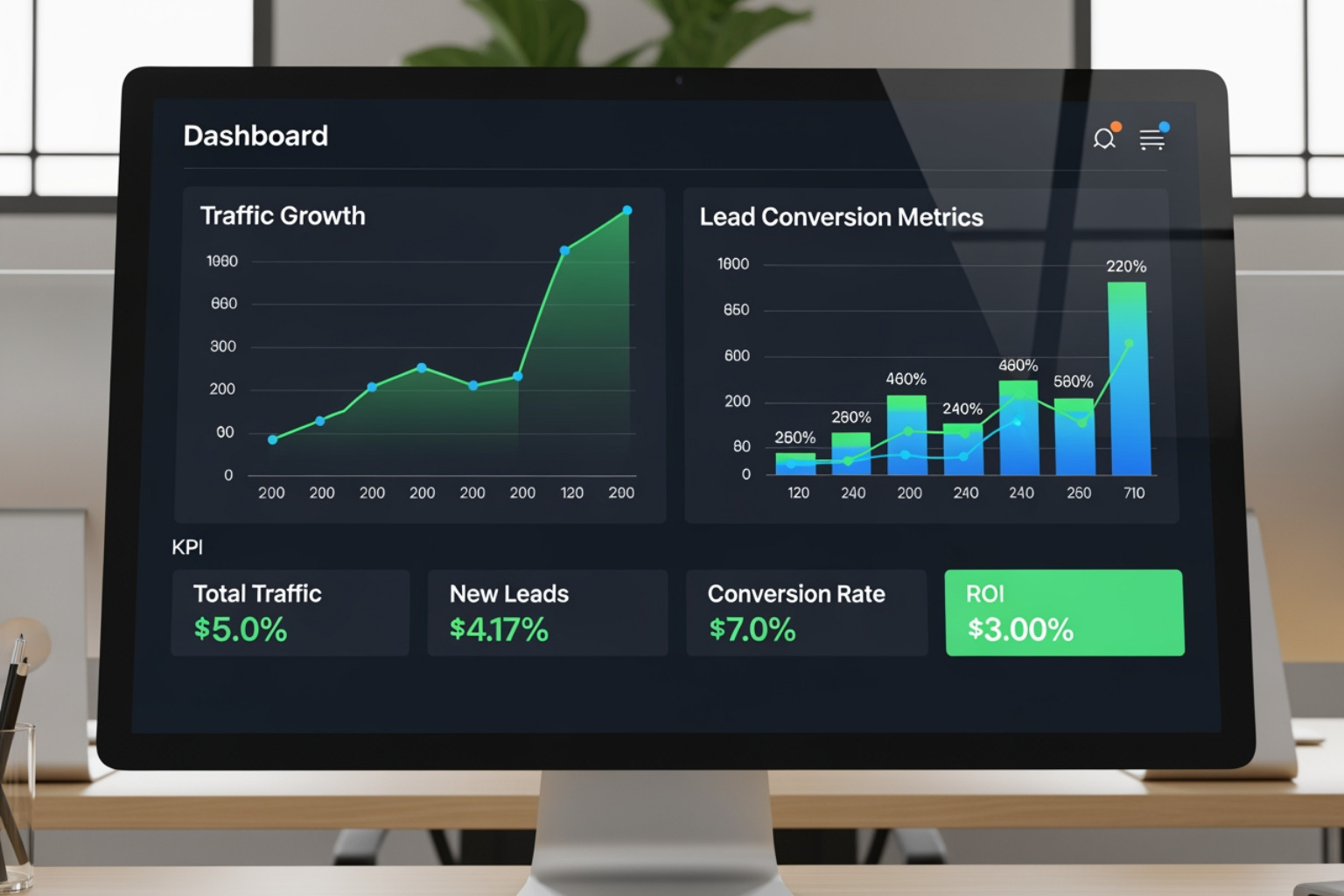
To know if the Trade show traffic SEO guide worked, one must dive into the data. Google Analytics 4 (GA4) is the gold standard for tracking how many people landed on the event page and what they did afterward.
Key metrics to monitor include:
- Organic Traffic: How many people found the site via search?
- Bounce Rate: Did visitors find the content relevant, or did they leave immediately?
- Conversion Tracking: How many visitors filled out a “schedule a meeting” form or downloaded a brochure?
By getting more info about analytics services, exhibitors can tie specific booth visits back to the original search terms, proving the ROI of their SEO efforts.
Long-Term Lead Nurturing and Content Repurposing
Email marketing is the “secret weapon” for post-show follow-up. Segmented emails drive 30% more opens and 50% more click-throughs than generic blasts. By sending personalized content—like a recap of the demo they saw at the booth—exhibitors can keep the conversation going.
Repurposing content is also a smart way to maintain evergreen visibility. A live “trivia contest” from the booth can become a fun social media video, and a speaker’s presentation can be turned into a downloadable whitepaper. This keeps the website fresh and signals to search engines that the brand is a consistent authority in its field.
Conclusion
Mastering trade show traffic isn’t about luck; it’s about a strategic, data-driven approach to search engine optimization. By moving away from “hide and seek” and embracing a comprehensive Trade show traffic SEO guide, exhibitors can ensure their booth is the busiest spot on the floor.
MDM Marketing helps businesses transform their online presence through end-to-end services. From local SEO and link building to advanced analytics and content marketing, the team focuses on measurable outcomes and sustainable growth. With a 93% client retention rate and an average 280% ROI increase, MDM Marketing knows how to turn search visibility into real-world revenue.
Ready to dominate your next event? Contact MDM Marketing for a Custom SEO Plan and stop leaving your booth traffic to chance.
What is the most common SEO mistake exhibitors make?
The biggest blunder is keyword stuffing—cramming the trade show name into every sentence. This makes the content unreadable and can lead to search engine penalties. Other common errors include ignoring mobile users (who are searching while walking the show floor) and failing to follow up with post-event content that keeps the organic momentum alive.
How early should I start my trade show SEO campaign?
Exhibitors should ideally start six to eight weeks before the event. This allows enough time for search engines to index new landing pages and for pre-show content to start ranking. Starting early also helps build “buzz” and allows for a more natural accumulation of backlinks from partners and directories.
Can local SEO help if I don’t have a permanent office in the event city?
Absolutely. Local SEO isn’t just for permanent storefronts. By creating location-specific landing pages and updating a Google Business Profile with “Event Posts,” a company can signal its temporary presence in a city. Using local citations and targeting keywords like “exhibitors in [City Name]” allows even national companies to capture local search traffic during the window of the trade show.
About admin
This author hasn't written a bio yet.