
What Does Creating a Digital Marketing Campaign Actually Involve?
Creating a digital marketing campaign is the process of planning and executing a coordinated set of actions across digital channels — like search, social, email, and paid ads — to hit a specific business goal within a defined timeframe.
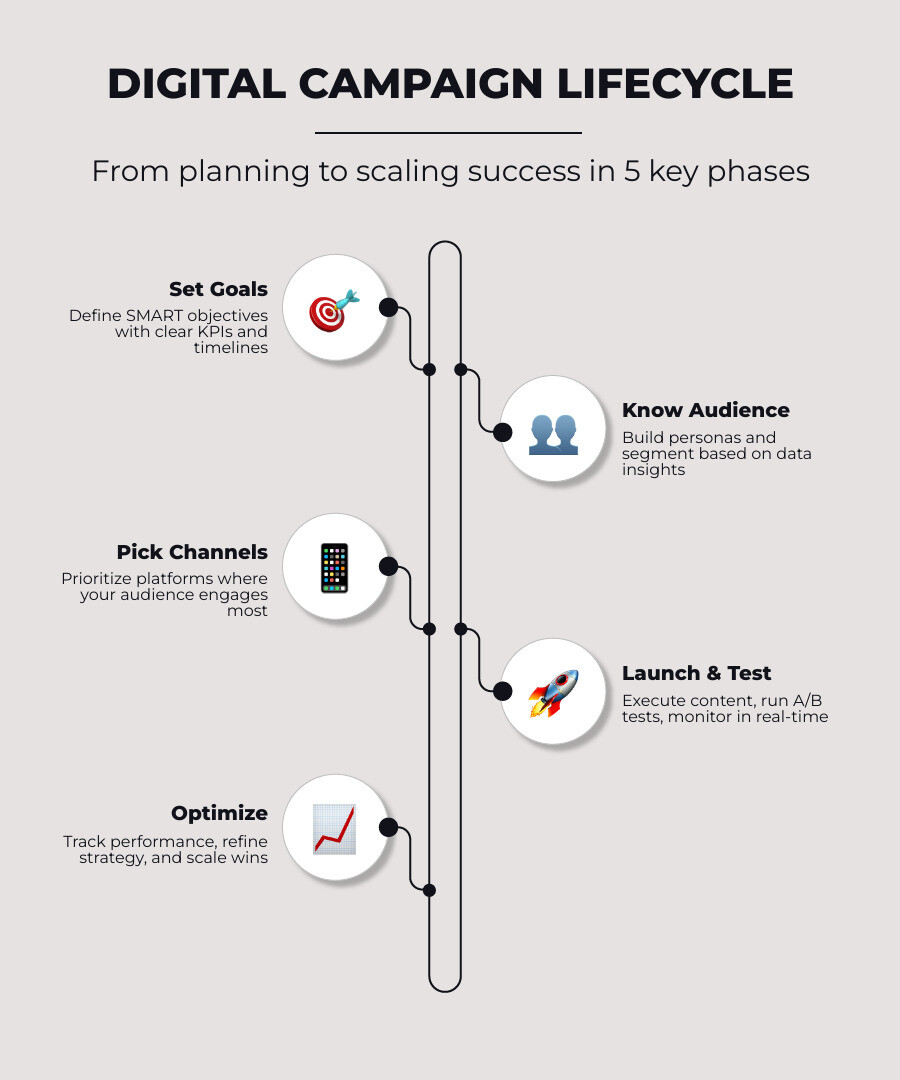
Here’s a quick overview of the core steps:
- Set SMART goals — define exactly what you want to achieve and by when
- Identify your target audience — build buyer personas based on real data
- Analyze competitors — find gaps and opportunities in the market
- Choose your channels — focus on where your audience actually spends time
- Set your budget — allocate spend across channels, testing, and tools
- Create your content strategy — plan what you’ll say, where, and how often
- Build a project plan — assign tasks, set milestones, and lock in timelines
- Launch and test — start lean, then scale what works
- Monitor and optimize — track KPIs and adjust in real time
Despite how essential this process is, the numbers tell a sobering story. Research from Smart Insights found that almost half of all companies (47%) have no planned digital marketing strategy at all — and only 17% clearly define theirs.
That’s a massive missed opportunity.
Whether you’re a local service business trying to show up on Google, an e-commerce brand chasing better ROI, or a B2B marketing leader who needs a repeatable system — a well-structured campaign is the difference between guessing and growing.
The good news? You don’t need a massive team or budget to do this well. You need a clear process.
This guide walks you through every step.
Handy creating a digital marketing campaign terms:
The Essential Steps for Creating a Digital Marketing Campaign
To build a campaign that actually moves the needle, it helps to use a proven structure. One of the most effective frameworks is the RACE planning system (Reach, Act, Convert, Engage). This model helps marketers look at the entire customer journey rather than just focusing on a single ad.
The journey begins with an “Opportunity” phase where the marketplace is analyzed, followed by “Strategy” where the approach is defined, and finally “Action” where the plan is executed. This is often referred to as the OSA process (Opportunity, Strategy, Action). According to a Smart Insights report on strategy definition, having this kind of defined structure is what separates high-performing companies from the 47% who are “aiming in the dark.”
When creating a digital marketing campaign, the focus should always be on your Strategic Marketing Services Visibility. This means ensuring your brand is seen by the right people at the right time. To do this, you must define your value proposition: why should someone choose you over a competitor? If you can’t answer that in one sentence, your campaign will likely struggle to resonate.
Setting SMART Goals for Creating a Digital Marketing Campaign
You wouldn’t start a road trip without a destination, and you shouldn’t start a campaign without a goal. However, “getting more sales” is too vague. Experts recommend using the SMART framework to ensure your objectives are:
- Specific: Instead of “increase traffic,” try “increase organic website traffic from Canton, OH residents.”
- Measurable: Attach a number, like “by 20%.”
- Achievable: Ensure the goal is realistic based on your current resources.
- Relevant: The goal should align with your broader business objectives, like Business Scaling Solutions.
- Time-bound: Set a deadline, such as “by the end of Q3.”
For example, a SMART goal might be: “Generate 500 new qualified email subscribers in 30 days through a targeted lead magnet.” To help keep these terms straight, you can refer to this Marketing Terms Cheat Sheet provided by Harvard Business Online.
Defining Your Campaign Timeline and Resources
Once the goals are set, it’s time to build the roadmap. Creating a digital marketing campaign involves many moving parts—designers, writers, and ad managers all need to be on the same page.
Start by using milestones to call out key dates like launch days, content deadlines, or mid-campaign reviews. Before you assign a mountain of work, it is vital to check team availability to ensure no one is overloaded.
Organization is key. You can stay granular by using subgroups to break down activities by channel (e.g., SEO tasks in one group, Social Media in another). This prevents the project plan from becoming a giant, confusing list of tasks and makes it easier to track progress.
Researching Your Audience and Competitors
The most expensive mistake in marketing is talking to the wrong person. Before spending a dime, you must define your buyer personas. These are semi-fictional representations of your ideal customers based on data and research.
Think beyond basic demographics. While age and location are important, psychographics—like their fears, motivations, and hobbies—are what drive actual buying decisions. Effective audience segmentation allows you to tailor your message so it feels personal to the recipient.
This is where Data-Driven Marketing becomes your best friend. By looking at your existing Google Analytics data, you can see what your current customers actually do on your site, which informs how you should target new ones. Finally, perform a SWOT analysis (Strengths, Weaknesses, Opportunities, Threats) to see where your business stands in the current marketplace.
Leveraging Tools for Market Insights
You don’t have to guess what people are searching for. Tools like Answer the Public allow you to see the exact questions people are asking online about your industry. This is a goldmine for creating content that actually provides value.
Don’t forget to look at what your neighbors are doing. You can use the Facebook Ads Library and the Google Ads Library to see exactly what ads your competitors are running.
- What is their messaging?
- What kind of imagery are they using?
- What are people saying in their comments?
Competitive benchmarking isn’t about copying; it’s about finding what they missed so you can fill that gap.
Choosing Channels and Budgeting
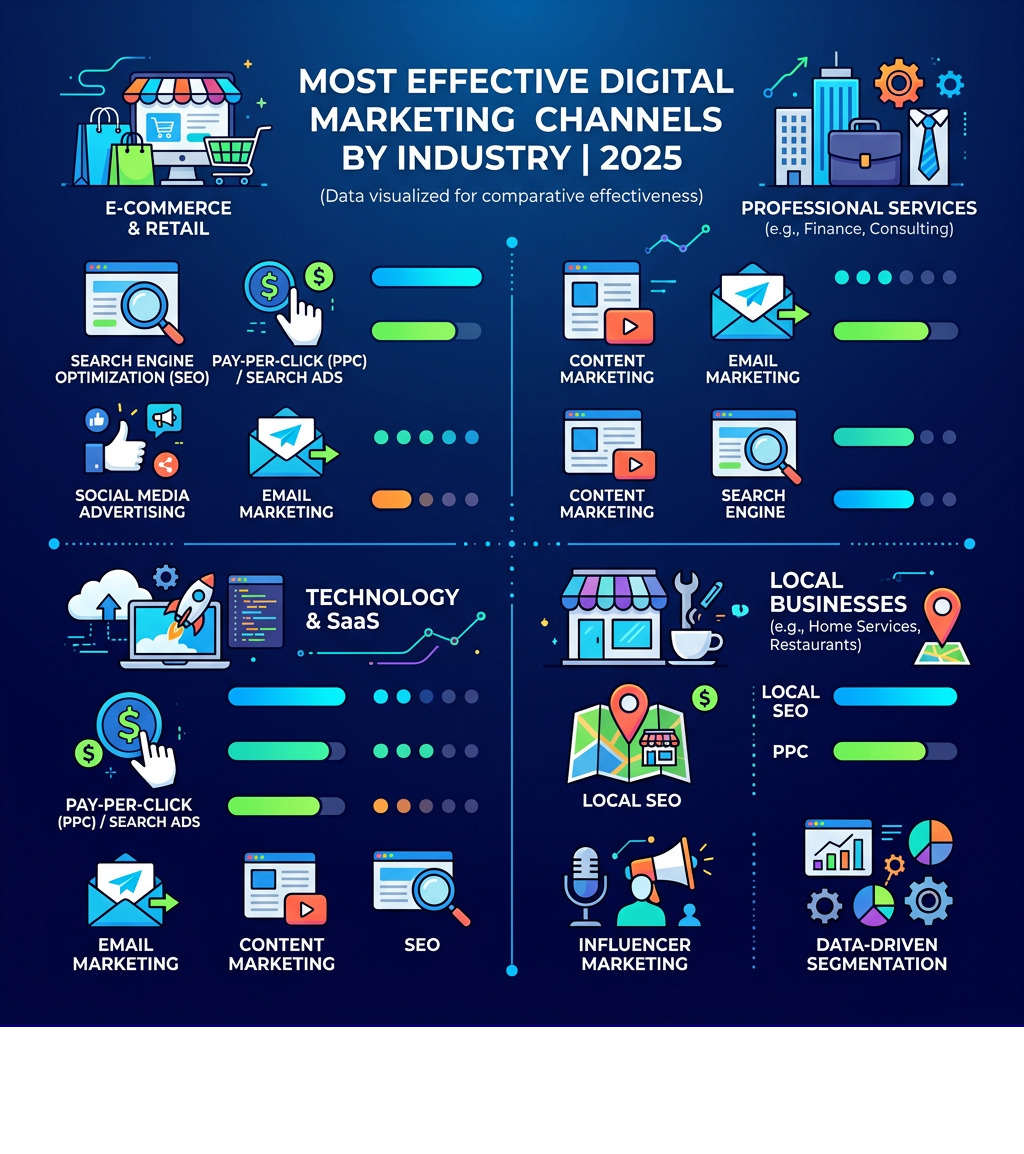
Not every business needs to be on every platform. In fact, trying to be everywhere usually leads to being nowhere. If you are a plumber in Canton, OH, you might find more success with Search Engine Marketing Ohio because people search for your services when they have an emergency. If you sell trendy apparel, social media might be your primary driver.
According to the 2025 Contentsquare Digital Experience Benchmarks, which analyzed billions of sessions, user behavior is shifting toward higher expectations for mobile speed and personalization. This means whichever channel you choose—SEO, PPC, Social, or Email—the experience must be seamless.
Allocating Your Campaign Budget
How much should you spend? A good rule of thumb is to work backward from your revenue goal. If you want to make $10,000 and your product margin is $100, you need 100 sales. If your conversion rate is 2%, you need 5,000 visitors. Your budget should be enough to buy those 5,000 visitors.
A Microsoft study on digital ROI found that digital marketing consistently outperforms traditional media like TV or print in terms of return on investment. To maximize this, many businesses partner with a Performance Marketing Company to ensure their spend is optimized.
Your budget should include:
- Paid Media Spend: The actual cost of ads on Google or Facebook.
- Software Costs: Tools for email, analytics, and project management.
- Testing Reserves: Always keep about 10-20% of your budget for testing new creatives or audiences. This “testing buffer” prevents you from blowing your whole budget on an unproven idea.
Launching and Optimizing Your Campaign
The “Launch” isn’t the end—it’s just the beginning. When creating a digital marketing campaign, you should start with a lower budget to let the algorithms (like Google’s or Meta’s) learn who is most likely to click.
Content is the heart of the campaign. By Mastering Effective Web Marketing Strategies for Modern Needs, you can create assets that are both helpful to the user and optimized for search engines. Use A/B testing to compare two different headlines or images to see which performs better.
The landscape is changing fast. Gartner predicts that by 2025, 80% of marketers will be using AI for personalization and content production. Using AI to help with brainstorming or data analysis can save your team hours of manual work.

Common Mistakes to Avoid When Creating a Digital Marketing Campaign
Even the best-laid plans can go awry. Here are the most common pitfalls to watch out for:
- Fragmented Messaging: If your Facebook ad says one thing and your landing page says another, users will get confused and leave.
- Ignoring the Data: Don’t stick to a failing strategy just because you like the creative. If the data says it’s not working, pivot.
- Poor Attribution: If you don’t know which channel actually caused the sale, you won’t know where to invest more.
- Losing Track of Time: It’s easy for projects to bloat. Use tools to see how tracked time compares to your plan so you can catch overages early.
- Overlooking Mobile: If your site takes 10 seconds to load on a phone, you’ve already lost the customer.
Monitoring KPIs and Scaling Success
As your campaign runs, you need to keep a close eye on your Key Performance Indicators (KPIs). The most important ones are usually your conversion rate and your Customer Acquisition Cost (CAC).
If you find a specific audience or ad that is performing exceptionally well, it’s time for Business Scaling Solutions. This involves gradually increasing the budget for winning ads while cutting the spend on underperformers.
One of the most effective ways to boost ROI is through retargeting. This involves showing ads to people who have already visited your site but didn’t buy. It often takes 7 to 13 “touches” before a customer feels comfortable making a purchase. For more help on how to handle these technical aspects, you can find More info about digital marketing services on our main service page.
Frequently Asked Questions about Digital Campaigns
What is the difference between a digital marketing strategy and a campaign?
Think of a strategy as the long-term “map” for your business. It defines your overall goals, brand voice, and target market for the year. A campaign is a specific “trip” on that map. It is time-bound (e.g., a “Back to School Sale”) and has a very specific goal within the larger strategy.
How do I identify the best channels for my target audience?
Start by looking at where your current customers come from. Use Google Analytics to see your top referral sources. You can also research platform demographics; for example, B2B services often thrive on LinkedIn, while visual consumer products do better on Instagram or Pinterest.
How has AI changed campaign creation in 2025?
AI has moved from a “fun tool” to a necessity. It is now used for hyper-personalization, where ads change in real-time based on a user’s behavior. Generative AI also helps teams produce hundreds of variations of ad copy and images in seconds, allowing for much more extensive A/B testing than was ever possible manually.
Conclusion
Creating a digital marketing campaign doesn’t have to be an overwhelming task. By breaking it down into manageable steps—setting SMART goals, researching your audience, choosing the right channels, and continuously optimizing—you can build a system that generates consistent growth for your business.
At MDM Marketing, we specialize in taking the guesswork out of the process. Whether you are looking for localized SEO in Canton, OH, or a global PPC strategy, our data-driven methodology ensures that every dollar you spend is working toward a measurable outcome.
The digital landscape is always evolving. The most successful marketers are those who stay curious, keep testing, and aren’t afraid to adjust their course based on what the data is telling them.
Ready to stop guessing and start growing? Contact our team for a custom strategy today and let’s build a campaign that actually delivers.
About Jay McCullough
This author hasn't written a bio yet.