
Why a Digital-First Campaign Is No Longer Optional for Modern Brands
A digital first campaign is a marketing strategy built from the ground up for digital channels — not adapted from print or TV, but designed natively for the platforms where your audience actually spends time.
Quick answer: What is a digital-first campaign?
- Built for digital, not borrowed from traditional — content and messaging are created specifically for online channels
- Data-driven — decisions are guided by real-time analytics, not gut feel
- Two-way — it invites interaction, not just broadcasting a message
- Omnichannel — it delivers a consistent experience across social, search, email, and mobile
- Measurable — every touchpoint can be tracked, tested, and optimized
The numbers make a strong case. CeraVe’s digital-first approach generated over 32 billion earned impressions and drove its highest-ever week of moisturizer sales. Brands with a strong online presence can increase revenue by up to 20%, according to industry research. And 75% of credit card applications in Q1 2023 were completed on digital channels — a signal that consumer behavior has fundamentally shifted.
Yet many brands are still running digital campaigns the old way: repurposing a TV spot for Instagram, or treating social media as an afterthought. That approach leaves real growth on the table.
The shift isn’t just about where you advertise. It’s about how you think about your audience, your content, and your entire marketing operation. Brands that embrace a true digital-first mindset move faster, spend smarter, and build stronger relationships with customers.
This guide breaks down exactly how to do that — from strategy and AI tools to measurement and real-world examples.
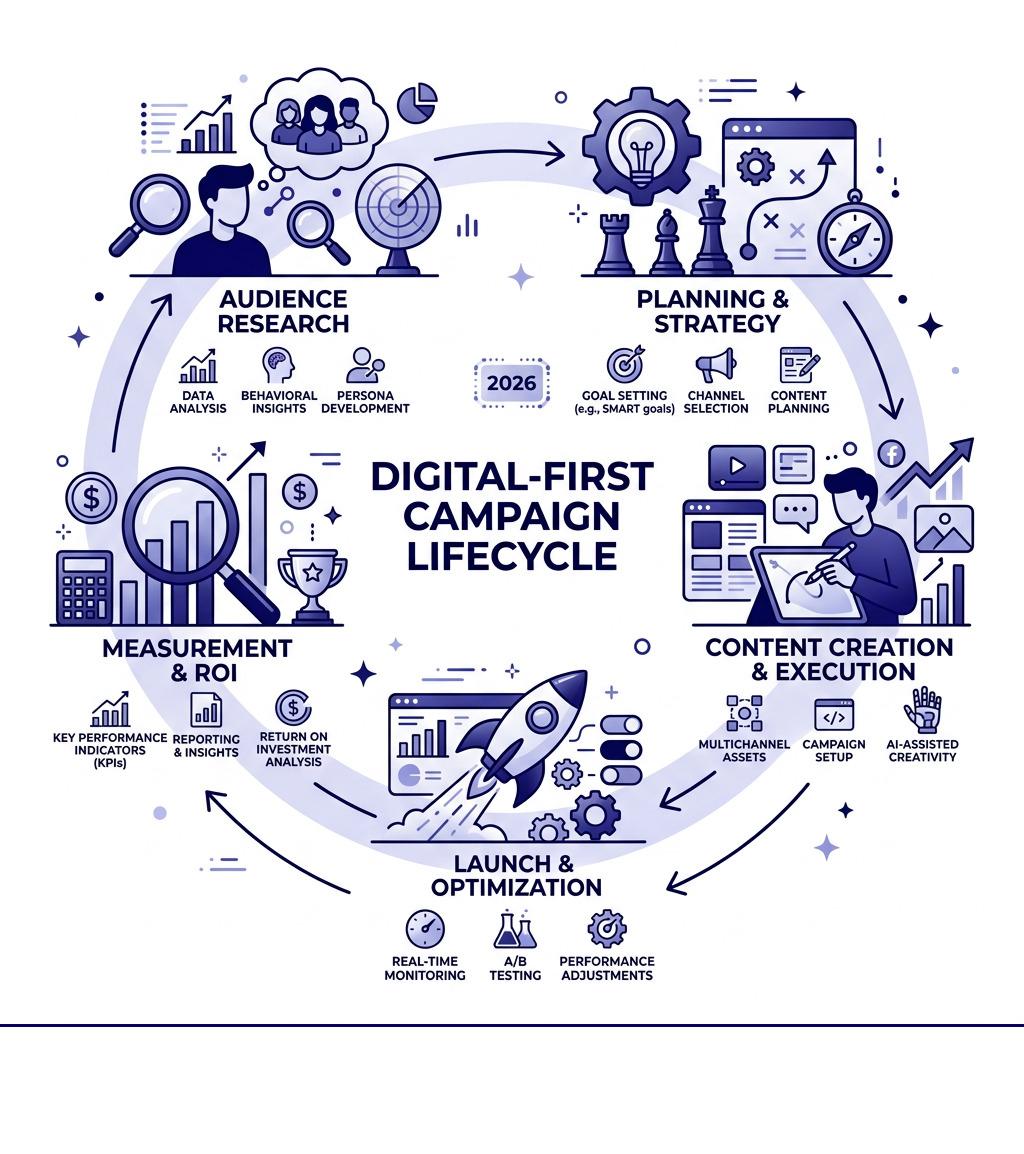
Important digital first campaign terms:
Defining the digital first campaign: A Modern Marketing Necessity

In the era of Mad Men, marketing was a monologue. A brand bought a billboard or a 30-second TV slot, shouted its message, and hoped for the best. Today, the monologue has become a dialogue. A digital first campaign recognizes that the medium is the message. When a brand creates content specifically for TikTok, it uses different pacing, humor, and visuals than it would for a LinkedIn thought-leadership piece.
Digital-native strategies focus on the user experience first. According to industry data, 94% of consumers have researched products online in the last year, and 40% will walk away from a business that fails to provide a high-quality digital experience. This means that for a brand in Canton, OH, or anywhere else, being “online” isn’t enough; the brand must be digitally fluent.
This fluency allows for real-time engagement. If a customer tweets a question, a digital-first brand responds in minutes, not days. This level of responsiveness builds trust and authority. To truly excel, marketers must focus on Mastering the Art of Digital Campaign Planning to ensure every digital touchpoint serves a specific purpose in the buyer’s journey.
| Feature | Traditional Marketing | Digital-First Campaign |
|---|---|---|
| Communication | One-way (Broadcast) | Two-way (Interactive) |
| Targeting | Broad / Demographic | Precise / Behavioral |
| Flexibility | Static (Hard to change) | Dynamic (Real-time pivots) |
| Measurement | Estimated reach | Exact conversions & ROI |
| Cost | High entry barrier | Scalable & Accessible |
The Core Benefits of a digital first campaign
The most immediate benefit of a digital first campaign is the sheer efficiency it offers. Traditional media often requires months of lead time and massive budgets. In contrast, digital campaigns can be launched in days and scaled based on performance.
- Cost Efficiency: Digital channels allow brands to reach more people for less money. Research shows that digital advertising is often the most affordable way to grow a business, especially for startups.
- Production Speed: Tools like AI have slashed the time it takes to create campaign assets. What used to take weeks now takes hours.
- Scalability: Once a brand finds a winning ad or piece of content, it can increase the budget instantly to reach a wider audience.
The financial impact is undeniable. Research shows that brands with a strong online presence can see an increase in their revenue by up to 20%. This isn’t just about selling more products; it’s about building a brand that survives in a landscape where consumer attention is the most valuable currency.
Transitioning from Multichannel to Omnichannel
Many brands think they are digital-first because they have a Facebook page and a website. However, there is a big difference between being “multichannel” (having many channels) and “omnichannel” (having all channels work together).
In a multichannel setup, the social media team might not talk to the email marketing team. This leads to a disjointed customer journey. In an omnichannel digital first campaign, the experience is seamless. A customer might see an ad on Instagram, visit the website, leave a cart behind, and then receive a personalized email reminder that references the exact item they were looking at.
To understand how to weave these threads together, brands should ask: What is Digital Strategy Anyway?. It is the roadmap that ensures the brand voice remains consistent whether the customer is reading a blog post or interacting with an AI chatbot.
The Role of AI in Scaling Digital-First Initiatives
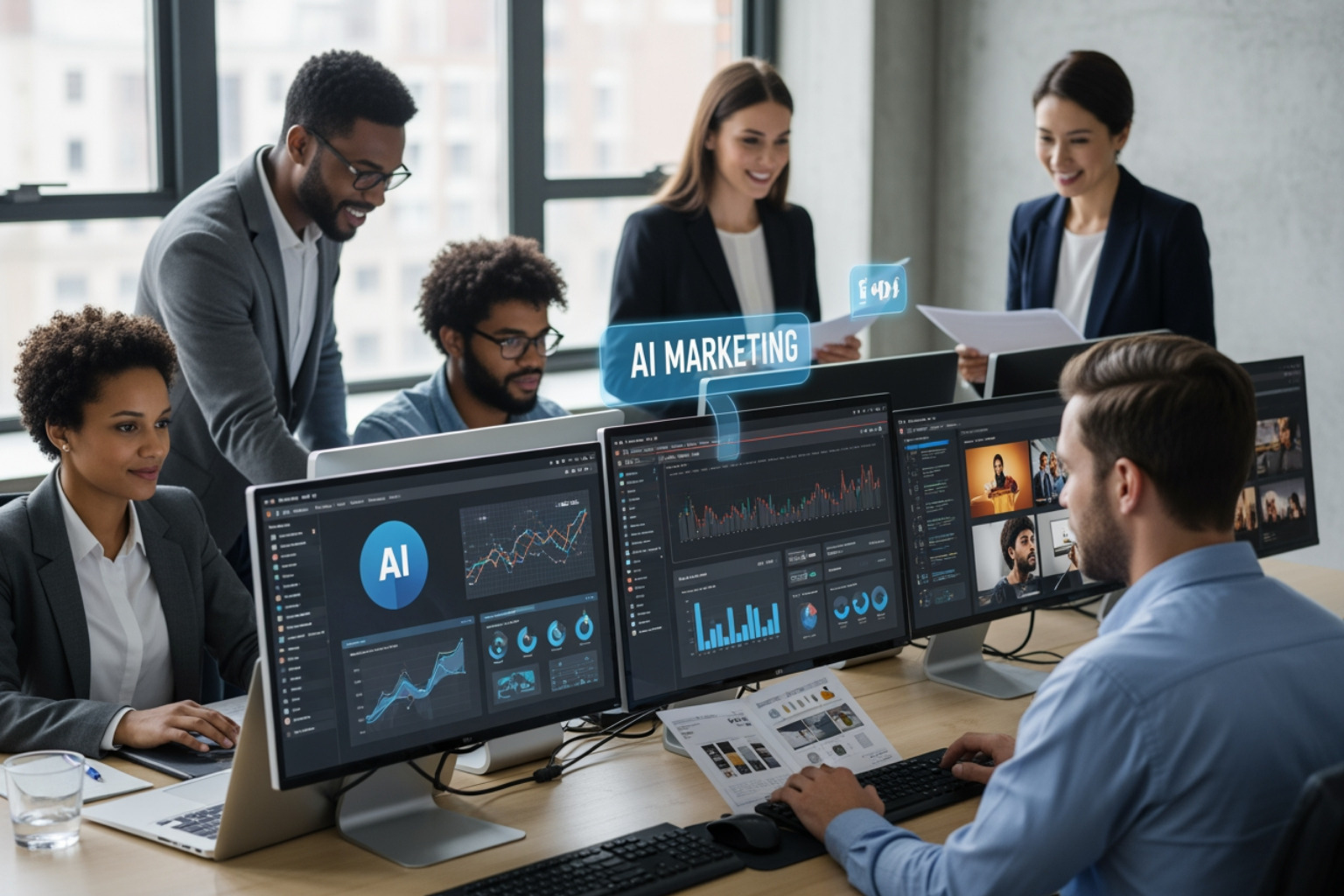
Artificial Intelligence has moved from a futuristic concept to a daily workhorse for marketing teams. In fact, 61.4% of marketers have already used AI in their activities, and over half believe it will significantly enhance their marketing efforts. For a digital first campaign, AI is the engine that allows for rapid variation and hyper-personalization.
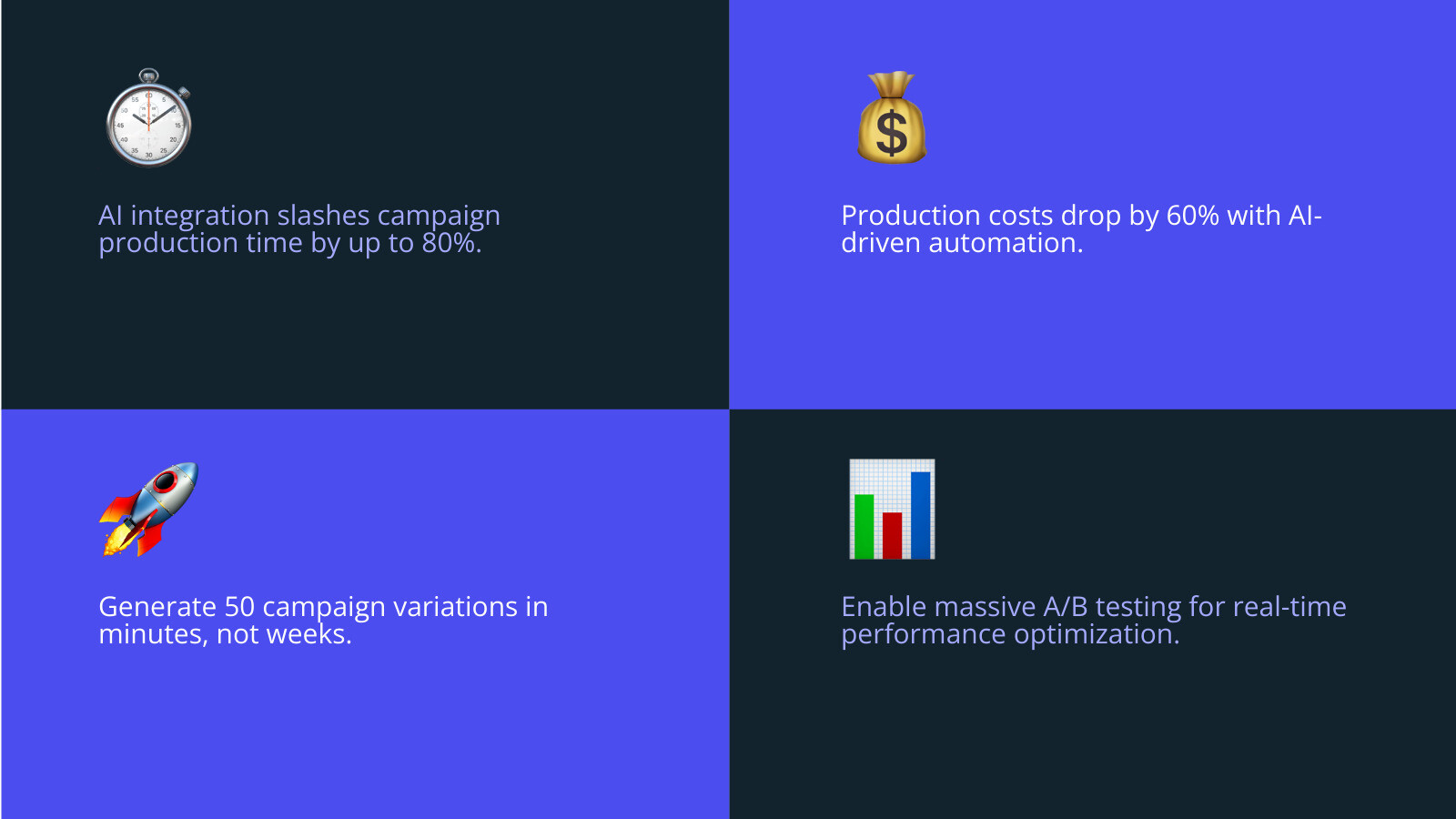
Advanced AI-powered marketing platforms exemplify this shift. By using AI agentic workflows, marketers can generate 50 campaign variations in minutes rather than weeks. This allows for massive A/B testing — seeing which headline, image, or call-to-action resonates best with a specific audience segment in real-time.
Leveraging Specialized AI Agents for Strategy
The true power of AI lies in its specialized agents. These aren’t just generic chatbots; they are tools designed for specific marketing tasks.
- Nuanced Copywriting: AI can analyze a brand’s tone and produce copy that sounds human and persuasive.
- Real-time Research: AI agents can scan the web for competitor intelligence and consumer trends, providing insights that would take a human researcher days to compile.
- Visual Creation: From social media graphics to high-quality images, AI tools enable creators to produce professional visuals at a fraction of the traditional cost.
Marketers can leverage these specialized tools to see how these agents can handle the heavy lifting of research and production. This allows the human team to focus on high-level strategy and creative direction rather than getting bogged down in repetitive tasks.
Slashing Production Costs and Time
Time is money, and in the digital world, speed is a competitive advantage. Brands that can react to a trending topic or a competitor’s move within hours will always outperform those stuck in a three-week approval cycle.
By integrating AI into the workflow, some marketing teams have reported cutting campaign production time by up to 80%. This isn’t just about working faster; it’s about working smarter. It allows a Performance Marketing Company like MDM Marketing to allocate resources where they matter most: driving conversions and maximizing ROI.
7 Steps to Executing a High-Impact Strategy

Building a successful digital first campaign requires a structured approach. You wouldn’t build a house without a blueprint, and you shouldn’t launch a campaign without a documented plan.
- Create SMART Objectives: Goals must be Specific, Measurable, Achievable, Relevant, and Timely. Instead of saying “we want more sales,” say “we want to increase online revenue by 15% in the next quarter.”
- Understand Your Target Audience: Create detailed buyer personas. Think of “Steve,” the 27-year-old marketing pro who loves local craft coffee and uses subscription boxes. What are his fears? Where does he hang out online?
- Audit Competitors: What are others in your industry doing? Identifying gaps in their strategy can help you find your Unique Selling Proposition (USP). Use Strategic Marketing Services Visibility to understand how you stack up against the competition.
- Decide Your Channel Mix: Don’t try to be everywhere. Choose the platforms where your audience is most active. If you are a B2B company, LinkedIn might be your primary focus. If you’re a fashion brand, TikTok and Instagram are non-negotiable.
- Develop Your Message and Visuals: Consistency is key. Your messaging should have a “hook” to grab attention, build interest, and provide a clear call-to-action (CTA).
- Build a Detailed Implementation Plan: Map out exactly when and where content will be published. This includes your email sequences, blog posts, and social media ads.
- Analyze and Optimize: A digital campaign is never “finished.” Use data to see what’s working. If an ad has a low click-through rate, tweak the image or the headline and try again.
Building an Earned-First Narrative
The most successful campaigns often don’t look like ads at all. They look like cultural moments. This is known as an “earned-first” approach.
Take CeraVe’s 2024 campaign featuring actor Michael Cera. By leaning into a “conspiracy theory” that he was the founder, the brand generated 32 billion earned impressions. They didn’t just buy ad space; they created a story that people wanted to share. This is the power of Mastering Effective Web Marketing Strategies — using social proof and user-generated content to amplify your message.
Influencer partnerships are a huge part of this. Pretty Little Thing, for example, achieved $209 million in Media Impact Value (MIV), with 44% of that coming directly from influencers. By partnering with creators who already have the trust of your target audience, you bypass the “ad fatigue” that many consumers feel.
Measuring the Success of Your digital first campaign
One of the biggest pitfalls in marketing is focusing on “vanity metrics” like likes or follows. While these are nice, they don’t always pay the bills. Instead, focus on metrics that tie directly to your business goals.
- Media Impact Value (MIV): A metric that assigns a monetary value to every mention, post, and interaction.
- Conversion Rate: The percentage of people who take the desired action (like buying a product or signing up for a newsletter).
- Return on Investment (ROI): The ultimate proof of success. How much revenue did the campaign generate compared to what was spent?
Data-Driven Marketing is the only way to ensure your budget is being used effectively. Real-world success stories prove this: American Eagle reported a 19% increase in total digital revenue in Q4 2023 by doubling down on their digital-first e-commerce strategy.
Frequently Asked Questions about Digital-First Marketing
What is the difference between a digital-first campaign and a traditional one?
A traditional campaign is often static and one-way. You print a flyer or run a TV ad and wait for results. A digital first campaign is native to the internet. It is designed to be interactive, allowing for two-way conversations between the brand and the consumer. It also uses real-time data to pivot. If a digital ad isn’t performing by Tuesday, it can be changed by Wednesday. You can’t do that with a billboard!
How can small businesses implement digital-first strategies effectively?
Small businesses don’t need a million-dollar budget to be digital-first. Start with cost-effective tools like social media and email marketing. Focus on your local community through Local SEO services to ensure you show up when people in your area search for your services. An incremental rollout — starting with one or two channels and doing them well — is much better than trying to manage five platforms poorly.
What role does AI play in modern digital campaigns?
AI acts as a force multiplier. It helps with content production (writing blogs, creating images), predictive analytics (guessing what customers will want next), and hyper-personalization. For specialized industries, such as PPC Marketing for Contractors, AI can help manage ad bids and targeting to ensure that every dollar spent is reaching a homeowner who actually needs a repair.
Conclusion
The future of marketing is clear: it is digital, it is fast, and it is increasingly driven by AI. We are moving toward a world of hyper-personalization, where every customer receives a message tailored specifically to their needs and behaviors. Voice-centric approaches and AI-driven creative tools will continue to lower the barrier to entry, making it possible for brands of all sizes to compete on a global stage.
However, technology is only part of the equation. A successful digital first campaign still requires a deep understanding of human psychology, a clear brand voice, and a strategic roadmap.
At MDM Marketing, the team specializes in helping brands navigate this complex landscape. Whether you are looking to scale your paid acquisition, strengthen your organic presence, or completely overhaul your digital strategy, the goal remains the same: measurable growth and a high ROI.
Ready to transform your brand’s online presence? Contact our team for a custom proposal and let’s build a strategy that delivers results. You can also Explore our full range of SEO services to see how we help businesses in Canton, OH, and beyond dominate the digital space.
About Jay McCullough
This author hasn't written a bio yet.