
Why an Effective Onboarding Process is Essential for Growth
A client onboarding guide is a structured process that takes a new client from contract signing to fully engaged partner — covering everything from paperwork and kickoff meetings to goal-setting and follow-ups.
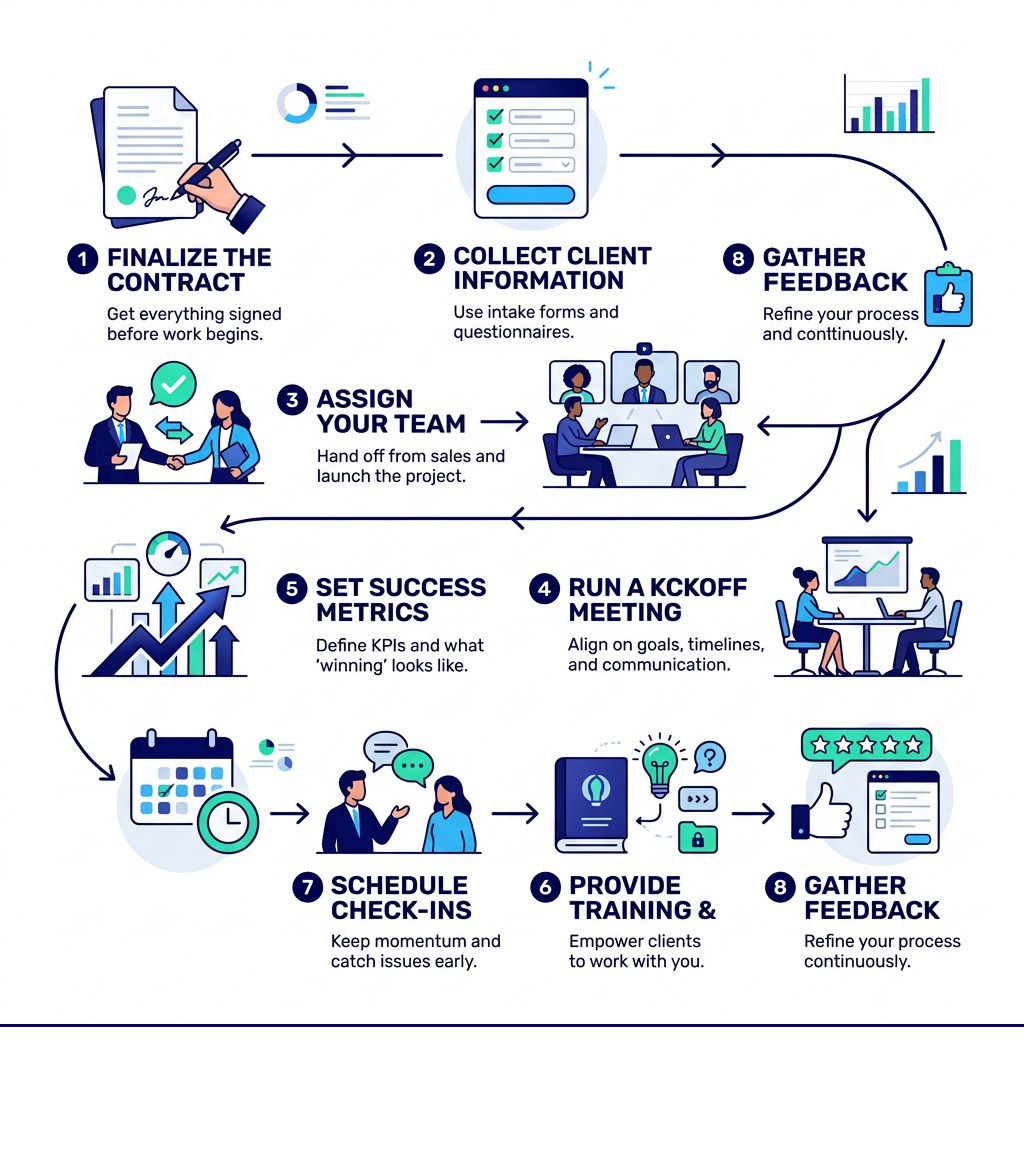
Here’s what a strong client onboarding process covers:
- Finalize the contract — get everything signed before work begins
- Collect client information — use intake forms and questionnaires
- Assign your team — hand off from sales and launch the project
- Run a kickoff meeting — align on goals, timelines, and communication
- Set success metrics — define KPIs and what “winning” looks like
- Provide training and resources — empower clients to work with you
- Schedule check-ins — keep momentum and catch issues early
- Gather feedback — refine your process continuously
First impressions matter more than most businesses realize. A lot more.
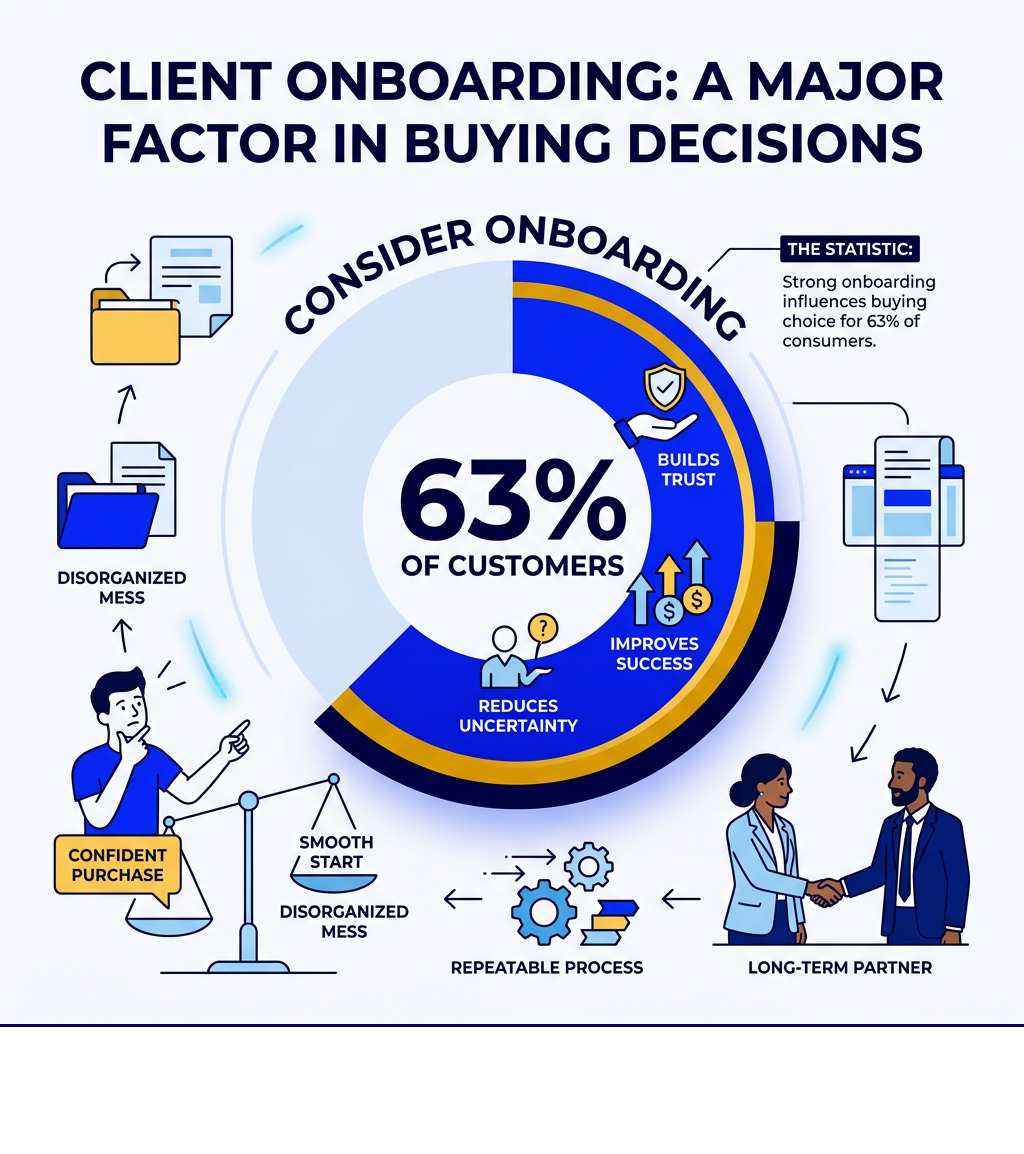
Research shows that 25% of customers will walk away after just one poor interaction. And poor onboarding is cited as the third most common reason clients churn — often within the first 90 days.
For small and mid-sized businesses, agencies, and service providers, that’s a costly problem. You’ve already done the hard work of winning the client. A disorganized start can undo all of it.
The good news? A repeatable, well-structured onboarding process fixes this. It builds trust, sets clear expectations, and turns new clients into long-term partners.
This guide walks you through every step.
Think of client onboarding like a first date. You’ve made a great impression during the sales process, but now you have to prove that you are a reliable, long-term partner. An intentional onboarding process is the bridge between a “closed-won” deal and a successful, profitable project.
When a business lacks a clear client onboarding guide, it often suffers from “buyer’s remorse.” The client is excited when they sign the contract, but if they don’t hear from the team for two weeks or receive a flurry of disorganized emails asking for the same information, that excitement turns into anxiety.
The Benefits of Getting It Right
- Improved Retention: Poor onboarding is the third most common reason for customer churn, right after bad product fit. A smooth start keeps clients engaged and reduces the likelihood of them leaving in the first 90 days.
- Increased Efficiency: By standardizing the process, teams spend less time on administrative “scrambles” and more time delivering results. Research suggests that a structured system can cut setup time by 40-50%.
- Professionalism and Trust: Clients want to work with experts who are prepared and proactive. A clear roadmap builds immediate confidence and boosts your net promoter score (NPS).
- Compliance and Risk Mitigation: For regulated industries, onboarding ensures that all legal and security requirements, such as Know Your Customer (KYC) protocols, are met before any work begins.
B2B Professional Services vs. SaaS Onboarding
It is important to note that onboarding looks different depending on the business model. While SaaS products focus on user adoption and “time to first value,” professional services—like White Label SEO Services—require a more high-touch, relationship-focused approach.
| Feature | B2B Professional Services | SaaS Products |
|---|---|---|
| Primary Goal | Relationship building & goal alignment | Product adoption & feature usage |
| Touchpoints | High-touch (meetings, calls) | Low-touch (automated emails, in-app tours) |
| Complexity | High (tailored strategies) | Medium (standardized setup) |
| Success Metric | Client satisfaction & ROI | Daily active users & churn rate |
The 8-Step Client Onboarding Guide to Repeatable Success
Standardization is the secret to scaling a business. Without a repeatable client onboarding guide, every new client feels like reinventing the wheel. By following these eight steps, businesses can ensure consistency, whether they are onboarding their first client or their fiftieth. This is especially vital for agencies offering White Label Content Creation, where clear communication and asset collection are the lifeblood of the project.
Step 1: Finalize the Contract and Engagement Letter
Never start work without a signed agreement. It sounds simple, but many businesses fall into the trap of “starting early” to show good faith, only to find themselves in a dispute over scope later.
A solid contract protects both parties by defining the scope of work, payment terms, and deadlines. It also sets essential boundaries. For example, if a client expects unlimited revisions, the contract is where you clarify that only two rounds are included. Using proposal and engagement letter templates can automate this step, allowing for remote e-signatures and faster approvals.
Step 2: Deploy a Comprehensive Client Onboarding Guide Questionnaire
To avoid the “average of ten contacts” it often takes to gather data, use a centralized intake form. This is your chance to gather “head” questions (technical data like logins and brand guidelines) and “heart” questions (what excites or frustrates the client about their business).
Digital tools like Typeform create an interactive experience that keeps clients engaged. You can even use this Zap to automatically send the questionnaire the moment a client books their kickoff call.
What to collect in your questionnaire:
- Business goals and success metrics.
- Audience personas and ideal customer profiles.
- Current tools, logins, and historical performance data.
- Brand guidelines and creative assets.
Step 3: Internal Team Handoff and Resource Allocation
The transition from sales to service delivery is often where communication breaks down. Before the client meets the production team, hold an internal kickoff meeting.
During this meeting, the sales lead should brief the account manager on any “unspoken” client needs or sensitivities. Assign roles clearly using project management software like Asana or WorkflowMax. Ensuring the team is aligned internally prevents the client from having to repeat themselves—a major pain point in the onboarding experience.
Step 4: Host a High-Impact Client Kickoff Meeting
The kickoff meeting is the official “launch” of the partnership. This shouldn’t be a generic chat; it needs a structured agenda to demonstrate your value from day one.
Kickoff Meeting Agenda:
- Introductions: Meet the core team and define points of contact.
- Review Questionnaire: Clarify any ambiguous answers from the intake form.
- Timeline & Milestones: Walk through the first 30, 60, and 90 days.
- Communication Protocols: Establish how often you will meet and which channels to use (e.g., Slack vs. Email).
- Scope Review: Reiterate what is included—and what is considered “out-of-scope”—to prevent scope creep.

Step 5: Establish Success Metrics and SMART KPIs
Every client has a different definition of a “win.” For an accounting firm in Canton, OH, success might be a 15% reduction in tax liability. For a marketing agency, it might be a 25% increase in organic traffic.
You must define what success means early on. Work with the client to set SMART goals: Specific, Measurable, Achievable, Relevant, and Time-bound. These goals help clients achieve their aha moments—the point where they realize the true value of your service. Using a White Label SEO Dashboard ensures transparency by giving clients real-time access to these metrics.
Step 6: Provide Necessary Training and Knowledge Resources
Sometimes, a client needs to learn how to use your systems or provide feedback in a specific way. Don’t leave them guessing. Providing a “Welcome Package” or a digital “Business Cheat Sheet” can go a long way.
You can also build a knowledge base with FAQs and short video tutorials. This empowers the client to find answers independently, reducing the burden on your support team and helping the client feel more capable.
Step 7: Schedule Regular Check-ins and Follow-ups
Momentum is easy to lose after the initial excitement of the kickoff. Scheduled follow-ups ensure the project stays on track. A simple check-in call 30 days into the relationship allows you to catch small issues before they become project-ending problems.
Supplement these calls with weekly written updates and White Label SEO Reports to keep the client informed of progress without requiring a full meeting.
Step 8: Refining Your Client Onboarding Guide Through Feedback
Your client onboarding guide should never be static. The best way to improve is to ask for input from the people who just went through it.
Use tools like Retently to send a Net Promoter Score (NPS) survey after the first 30 or 60 days. Ask questions like:
- “Was the onboarding process clear and easy to follow?”
- “Did you feel supported by our team during the setup?”
- “Is there anything we could have done to make the transition smoother?”
Best Practices for Managing Your Client Onboarding Guide
To truly excel, businesses must balance automation with personalization. While 76% of customers choose brands offering personalization, trying to do everything manually is a recipe for burnout.
- Automate the Repetitive: Use tools to streamline repetitive tasks like sending welcome emails, creating project folders, and following up on unsigned contracts.
- Personalize the Experience: Mention specific goals from the discovery call in your welcome message. A personalized video greeting from the CEO or account manager can make a massive impact.
- Set Clear Boundaries: Use your onboarding to manage expectations regarding response times and office hours. This prevents the “midnight email” syndrome.
- Leverage Experts: If you are an agency looking to scale, consider using SEO Reseller Services to handle the heavy lifting while you focus on the client relationship.
Frequently Asked Questions about Client Onboarding
How long should the onboarding process take?
The length of the process depends on the complexity of the service. For simple projects, it might take 14 days. For long-term, high-stakes partnerships, it can take 30 days or more. The goal is not to be fast, but to be thorough. Focus on “speed to value”—how quickly can you show the client a “quick win” that proves they made the right choice?
What is the difference between B2B and SaaS onboarding?
B2B onboarding is generally “high-touch,” involving multiple meetings and a high degree of strategy customization. SaaS onboarding is often “low-touch,” relying on automated tutorials and in-app prompts to help users learn the software. Both aim to teach new customers the value of the product or service.
How do you handle compliance and KYC during onboarding?
In regulated industries like finance or law, you must verify client identities to mitigate risk and follow Anti-Money Laundering (AML) rules. This often involves collecting government IDs, verifying business registration, and performing risk assessments. Using automated ID verification tools can make this process faster and more secure for the client.
Conclusion
A client onboarding guide is more than just a checklist; it is the strategic framework that transforms a new customer into a long-term advocate. By investing in a structured, 8-step process, businesses can eliminate administrative chaos, build immediate trust, and set the stage for sustainable growth.
At MDM Marketing, we understand that every client journey is unique. With our 93% client retention rate and 5+ years of experience, we specialize in creating data-driven strategies that deliver measurable results—from Local SEO to PPC management. We pride ourselves on clear communication and transparent reporting, ensuring that our clients in Canton, OH, and beyond always know exactly how their investment is performing.
Ready to transform your online presence and build a partnership focused on your growth? Explore our full range of services or contact us for a custom proposal today. Let’s start your journey to success the right way.
About Jay McCullough
This author hasn't written a bio yet.