
Why the Best Digital Strategy Separates Thriving Businesses from Struggling Ones
The best digital strategy is an integrated plan that aligns your technology, channels, and data with clear business goals — turning digital activity into measurable growth.
Here’s what the best digital strategies have in common:
- Clear objectives — SMART goals tied directly to business outcomes
- Deep audience understanding — buyer personas built from real data, not guesses
- Right channel mix — prioritizing where your customers actually spend time
- Data-driven decisions — tracking performance and adjusting continuously
- Leadership commitment — visible executive buy-in throughout execution
- Integration across functions — no siloed teams or disconnected campaigns
Here’s a sobering reality: 47% of companies still don’t have a defined digital marketing strategy. And among those that do, only 35% fully achieve their transformation goals — despite trillions spent globally each year.
That gap between intention and result isn’t about effort. It’s usually about precision.
Most businesses launch apps, run ads, post on social media, and call it a “digital strategy.” But without a coherent plan connecting those pieces to real business goals, it’s just expensive noise.
The companies that win — think Nike with 30%+ of sales now coming from online channels — treat digital not as a marketing add-on, but as a core operating model.
This guide breaks down exactly what an effective digital strategy looks like in 2025, how to build one, and how to avoid the mistakes that sink most attempts.
The Core Foundations of the Best Digital Strategy
Creating the best digital strategy isn’t about chasing every new shiny object in the tech world. It’s about building a house on a rock-solid foundation. If the foundation is shaky, the most expensive AI tools in the world won’t save the business.
SMART Goals
Everything starts with goals. But not just “we want to grow” goals. We are talking about SMART goals: Specific, Measurable, Actionable, Relevant, and Timely. Instead of saying “we want more traffic,” a SMART goal would be “we want to increase organic traffic by 25% by the end of Q4 2025 to generate 100 new qualified leads per month.”
Audience Analysis and Buyer Personas
Who is the customer? If a business tries to speak to everyone, it ends up speaking to no one. Effective strategies use both quantitative data (like demographics and location) and qualitative data (like challenges, motivations, and pain points) to build buyer personas.

When organizations understand the Mastering Customer Lifecycle Marketing: Strategies for Every Stage, they can tailor their messaging to meet the customer exactly where they are—whether they are just learning about a problem or are ready to hit the “buy” button.
UX Design and Data Analytics
In 2025, a website is often the “hub” of the entire strategy. If the user experience (UX) is poor—slow loading times, confusing navigation, or non-responsive mobile design—the rest of the strategy will fail. According to recent digital experience benchmarks, user interactions across billions of sessions show that friction in the digital journey is the ultimate conversion killer.
Finally, the best digital strategy is fueled by data. Businesses must move away from “gut feelings” and toward hard numbers. Analytics tools allow teams to track what works and, more importantly, what doesn’t, so they can pivot before wasting too much budget.
Aligning Your Best Digital Strategy with Business Goals
A digital strategy should never exist in a vacuum. It is not a “side project” for the IT department; it is a fundamental driver of business value. To achieve the best digital strategy, an organization must ensure that every digital initiative supports a core business objective.
When digital efforts are fragmented, ROI suffers. Research shows that organizations with strong integration between their digital and business strategies achieve a 10.3x ROI, compared to a mere 3.7x for those with poor integration. This is why Strategic Marketing Services Visibility is so critical—it ensures that digital efforts are seen and supported at the highest levels of the company.
Resource allocation is another hurdle. Successful companies reallocate capital at “digital speed,” meaning they are willing to move budgets away from underperforming traditional areas and toward high-growth digital initiatives. This requires visible leadership engagement; transformations are 65% more likely to succeed when the C-suite is actively involved and championing the change.
The Role of Data Privacy and Personalization
We live in a bit of a paradox. Customers want personalized experiences, but they are also more protective of their privacy than ever before.
- The Stat: 86% of customers welcome some personalized communication.
- The Warning: 55% will stop engaging if that communication feels invasive or “creepy.”
Modern strategies must navigate this by focusing on Data-Driven Marketing that respects boundaries. With the deprecation of third-party cookies, the shift toward first-party data is non-negotiable. This means building consent-based touchpoints—like newsletters, loyalty programs, or high-value gated content—where customers willingly share their information in exchange for value.
By putting the customer in control of their data, brands build the trust necessary for long-term loyalty.
Proven Frameworks for Structuring Your Digital Roadmap
Structure provides clarity. Without a framework, a digital strategy is just a to-do list. One of the most effective ways to organize a plan is the RACE framework.
The RACE Framework
This framework helps businesses plan and manage their digital activities across the entire customer journey:
- Reach: Building awareness of the brand, products, and services on other websites and in offline media to drive traffic to the main web presence.
- Act: Encouraging interactions on websites or social media to help generate leads.
- Convert: Using “always-on” marketing to move leads toward a commercial transaction (sale or lead).
- Engage: Building long-term relationships with first-time buyers to build fan loyalty and repeat sales.

To make RACE actionable, many use the OSA process: Opportunity (auditing performance and setting goals), Strategy (prioritizing initiatives), and Action (executing 90-day plans).
5 Rules for a High-Impact Best Digital Strategy
Traditional companies can beat the odds by following five specific rules for their digital strategy roadmap:
- Assess Strategic Impact: Don’t just look at how digital changes marketing; look at how it changes the economics of the whole industry.
- Set High Ambition: Digital strategies fail more often from too little ambition than too much. Aim for “winner-takes-most” positions.
- Place Big Bets: Stop “letting a thousand flowers bloom.” Focus on the two or three use cases that deliver the most value.
- Build Strategic Muscles: Digital isn’t a one-time project. Companies need to build the internal capability to iterate and innovate constantly.
- Manage Transformation Actively: Use a strong central team to govern the transformation and ensure that short-term wins are funding long-term goals.
High-ROI Channels and Emerging 2025 Trends
Not all digital channels are created equal. The best digital strategy prioritizes channels based on where the target audience lives and which ones offer the best return on investment (ROI).
| Channel | Typical ROI Profile | Best For |
|---|---|---|
| SEO & Content | High (Long-term) | Building authority, organic lead gen |
| Email Marketing | Very High | Nurturing leads, repeat sales |
| Paid Search (PPC) | Moderate to High | Immediate traffic, high-intent buyers |
| Social Media | Moderate | Brand awareness, community building |
| Influencer Marketing | Variable | Reaching niche audiences via trust |
For many businesses, Mastering Effective Web Marketing Strategies for Modern Needs involves an omnichannel approach. This means providing a seamless experience whether the customer is on a mobile app, a website, or a physical storefront.
How AI is Redefining Digital Execution
In 2025, AI is no longer a futuristic concept; it is strategic infrastructure. 78% of companies now use AI in their daily operations, and 68% of CMOs believe AI will be the defining topic of 2026.
AI allows for a level of scale and personalization that was previously impossible. Generative AI can assist in creating vast amounts of high-quality content, while predictive analytics can help businesses anticipate customer needs before the customer even realizes them.
Integrating AI isn’t just about chatbots. It’s about Beyond the Hype: Mastering Data-Driven Advertising for Maximum ROI. By using AI to analyze massive datasets, businesses can optimize their ad spend in real-time, ensuring that every dollar is working as hard as possible.
Learning from Success: Real-World Digital Strategy Examples
Looking at how the “big players” do it can provide inspiration for any business size.
- Nike: Nike has built an incredible digital ecosystem. By integrating its mobile apps (like the Nike Training Club) with its e-commerce platform and social media, the company has seen online sales account for over 30% of total sales. They didn’t just build a store; they built a community.
- Netflix: Their strategy is built entirely on data and personalization. By using a sophisticated recommendation engine, they keep users engaged and reduce churn, disrupting the entire entertainment industry.
- Spotify Wrapped: This is a masterclass in turning data into engagement. Every year, Spotify gives users a personalized summary of their listening habits, which becomes a viral social media event. It turns “boring” data into a shareable brand experience.
- Apple: Apple often uses User-Generated Content (UGC) to build hype. The “Shot on iPhone” campaign didn’t rely on Apple’s professional photographers; it relied on its customers, proving the quality of the product through the eyes of the people who use it.
- Hinge: In a world of apps designed to keep people scrolling, Hinge used “antimarketing” with the slogan “Designed to be deleted.” This clear USP (Unique Selling Proposition) resonated with people tired of endless swiping and helped them stand out in a crowded market.

Frequently Asked Questions about Digital Strategy
Why do 70% of digital transformations fail?
Most failures can be traced back to strategic imprecision. Companies often jump into the “Action” phase without a clear “Opportunity” or “Strategy” phase. Other common reasons include:
- Lack of Leadership: If the bosses aren’t on board, the team won’t be either.
- Siloed Data: When departments don’t share information, the customer experience becomes fragmented.
- Resource Misallocation: Spending too much on the wrong tools or spreading the budget too thin across too many initiatives.
How do I measure the success of my digital initiatives?
Success should be measured against the SMART goals set at the beginning. Key metrics often include:
- Customer Lifetime Value (CLV): How much a customer is worth over the entire relationship.
- Conversion Rate: The percentage of visitors who take a desired action.
- Multi-channel Attribution: Understanding which channels contributed to a sale, rather than just giving credit to the “last click.”
- ROI Monitoring: Regularly checking if the revenue generated exceeds the cost of the digital initiatives.
What is the difference between a strategy and a tactic?
Think of it this way: Strategy is the destination and the route on the map. Tactics are the individual turns you take and the speed you drive.
- Strategy: A guiding policy (e.g., “Become the most trusted local authority in HVAC services via educational content”).
- Tactic: A specific, measurable action (e.g., “Publish two blog posts a week about common furnace repairs”).
Conclusion: Building Your Actionable Roadmap
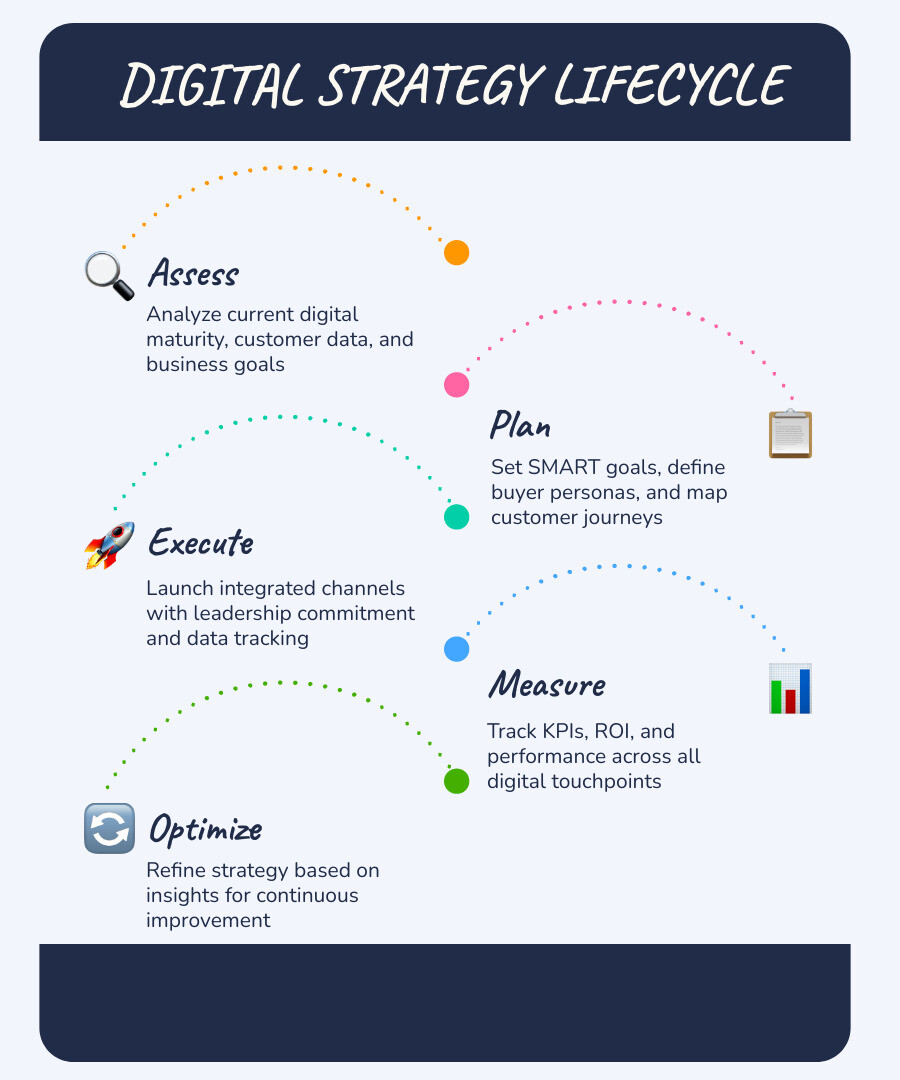
The journey to the best digital strategy begins with an honest assessment of digital maturity. Where is the business now? Where are the gaps in technology, talent, or data?
At MDM Marketing, based in Canton, OH, the team specializes in helping businesses close those gaps. With over 5 years of experience and a 93% client retention rate, MDM Marketing uses a data-driven methodology to deliver an average 280% ROI increase for clients. Their approach isn’t about guessing; it’s about discovery, custom strategy development, and precise implementation across SEO, PPC, and content marketing.
To truly Outsmart the Competition: A Marketer’s Blueprint for Success, organizations must balance short-term wins with a long-term vision. Start by fixing the “leaks” in the current funnel—optimize the website for UX and SEO—and then place “big bets” on emerging technologies like AI integration.
The digital landscape in 2025 is fast-moving and complex, but with a clear roadmap and a commitment to continuous optimization, any business can transform its online presence into a powerful engine for sustainable growth.
About Jay McCullough
This author hasn't written a bio yet.