
Why Most SEO Efforts Stall (And How Iteration Fixes That)
Iterative SEO strategy improvements are the practice of making small, continuous, data-backed changes to your website’s SEO — rather than doing one big optimization push and walking away.
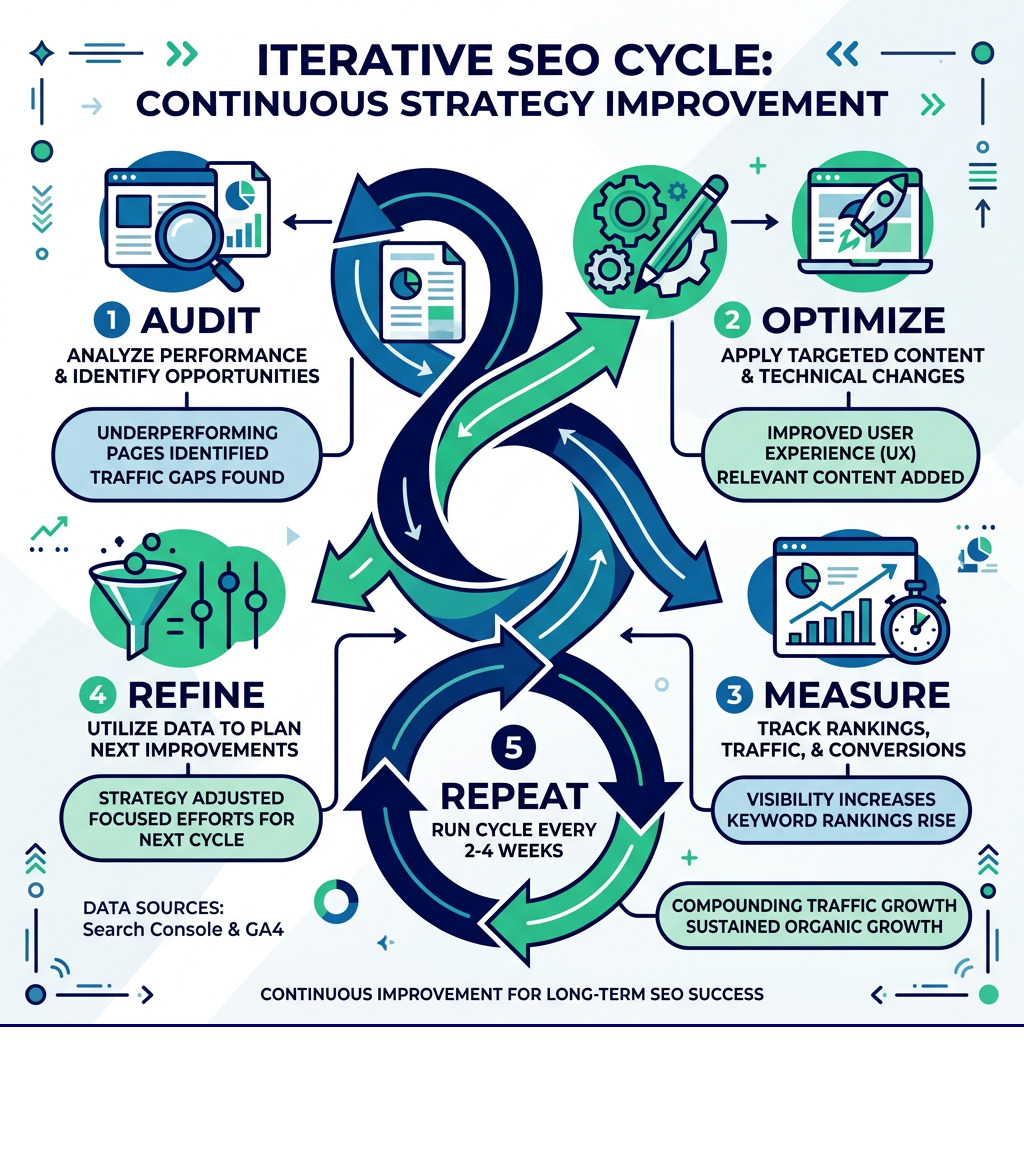
Here’s what an iterative SEO approach looks like in practice:
- Audit – Identify high-impact or underperforming pages using Google Search Console and GA4
- Optimize – Apply targeted changes: update metadata, add content, fix technical issues
- Measure – Track organic traffic, rankings, CTR, and conversions
- Refine – Use what the data tells you to plan the next round of improvements
- Repeat – Run this cycle every two to four weeks, continuously
Think about how many businesses treat SEO like a one-time project. They hire someone, get the site “optimized,” and then move on — expecting the rankings to hold forever.
They don’t.
Google makes hundreds of algorithm updates every year. User behavior shifts. Competitors publish new content. What ranked well six months ago may quietly slip to page two today without anyone noticing.
The businesses that grow consistently in organic search are the ones treating SEO like an ongoing system — not a checkbox.
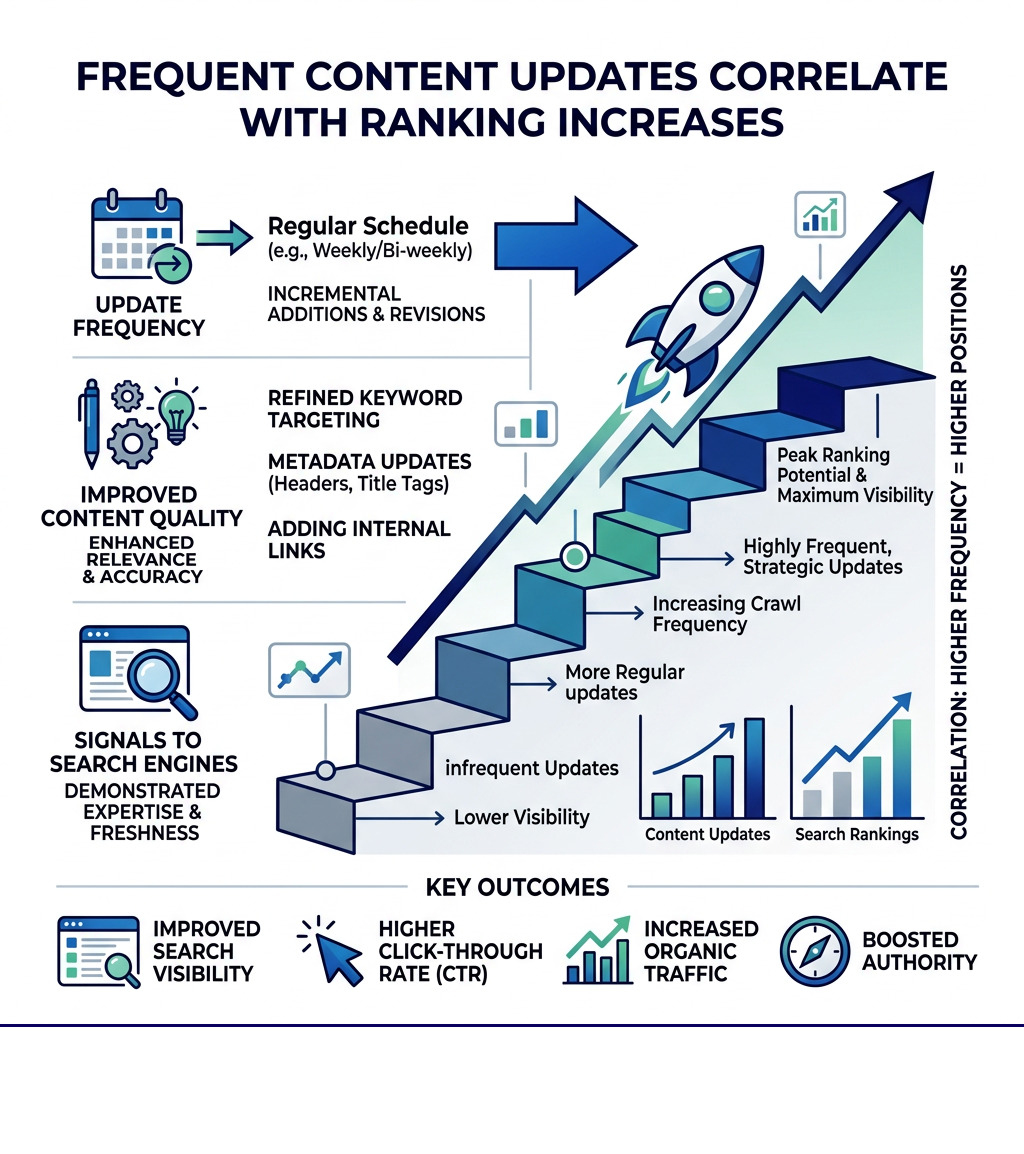
One simple example of this in action: teams that updated their blog content every two weeks saw pages stuck at positions 15–20 jump into the top 5, with traffic doubling in several cases. That’s not a one-time win. That’s what a rhythm of small improvements compounds into over time.
This guide is built for small and mid-sized businesses, local service providers, e-commerce brands, and B2B marketing teams who want a clear, repeatable process for turning SEO into a reliable growth channel.
Why Iterative SEO Strategy Improvements Outperform One-Time Efforts
The most common mistake in digital marketing is viewing a website like a physical building. Once the “construction” of your SEO is finished, you assume the work is done. In reality, a website is much more like a garden. If you plant seeds and never return to pull weeds, water the soil, or prune dead branches, the garden eventually withers.
Search engines are living ecosystems. Google alone accounts for nearly 64% of all traffic referrals, and its ranking criteria evolve constantly. An iterative approach allows a business to adapt to these “seasonal” shifts in the algorithm. By focusing on results-driven SEO, companies move away from vanity metrics and toward compounding growth. Every small tweak to a title tag or internal link acts as a compound interest payment on your digital authority. Over time, these small gains outperform massive, one-time overhauls because they are based on real-time feedback rather than outdated assumptions.

The “Set It and Forget It” Myth in Modern Search
The “set it and forget it” mindset is a relic of 2010. Today’s search landscape is defined by high competitive density and rapidly shifting searcher expectations. When a competitor publishes a more comprehensive guide or a faster-loading page, your “perfectly optimized” content from last year begins to lose its shine.
Furthermore, user behavior is not static. A keyword that used to signal a desire for information might now signal a desire to buy. If you aren’t monitoring these shifts, your content will stop satisfying user intent, leading to a slow slide down the rankings. Iteration ensures you are always aligned with what the searcher actually wants to see today.
Implementing Iterative SEO Strategy Improvements for Long-Term ROI
Iteration isn’t just about better rankings; it’s about smarter business management. By breaking SEO down into phases, companies can achieve:
- Smarter Resource Allocation: Instead of a massive upfront investment that may or may not work, you spread costs over time, investing more in what the data proves is working.
- Reduced Risk: A Minimum Viable Product (MVP) launch allows you to test the waters. If a specific content cluster isn’t gaining traction, you can pivot before wasting months of effort.
- Faster Time-to-Market: You don’t need a 100-page site to start ranking. Launching ten high-quality pages and iterating on them gets you into the search results faster.
- Stakeholder Alignment: Frequent, smaller wins are easier to explain to leadership than waiting six months for a “big reveal” that might underdeliver.
Effective data-driven marketing relies on this feedback loop. It turns SEO from a dark art into a predictable science.
Data-Driven Tactics for Continuous Optimization
To succeed with iterative SEO strategy improvements, you must move from “guessing” to “knowing.” This requires a deep dive into your own data. Tools like Google Search Console (GSC) and GA4 are the heartbeat of this process. They tell you not just where you rank, but how users interact with your site.
| Feature | One-Time SEO | Iterative SEO |
|---|---|---|
| Strategy Basis | Initial Keyword Research | Continuous Performance Data |
| Content Updates | Rare / Annual | Bi-weekly / Monthly |
| Risk Level | High (All-in on one plan) | Low (Constant micro-pivots) |
| Growth Pattern | Linear / Stagnant | Compounding / Exponential |
| Technical Health | Fixed once at launch | Monitored & polished regularly |

By focusing on on-page SEO for website elements—like headers, image alt text, and internal linking—on a regular schedule, you ensure your site remains technically sound and highly relevant.
Targeting Striking Distance Keywords for Quick Wins
One of the fastest ways to see an ROI from iteration is to target “striking distance” keywords. These are terms for which your site currently ranks in positions 11 through 20 (the dreaded page two).
Because you are already on the cusp of page one, you don’t need a total rewrite. Often, simple automated keyword research combined with metadata refinement—such as making your title tags more enticing to click—can provide the nudge needed to jump into the top five.
Quick Win Checklist:
- Identify keywords in GSC with high impressions but positions 11-15.
- Update the page’s H1 and Title tag to better match the specific query.
- Add 2-3 internal links from higher-authority pages on your site.
- Check the “People Also Ask” section for that keyword and add those answers to your page.
Content Gap Analysis and Topic Clustering
Iteration also involves looking outward. A content gap analysis compares your site against your top competitors to see what topics they are ranking for that you’ve missed. This isn’t about copying; it’s about identifying “unmet needs.”
Once gaps are identified, use topic clustering to build authority. This involves creating a “pillar page” (a comprehensive guide) and several “cluster pages” (specific sub-topics) that link back to the pillar. This structure signals to Google that you have deep expertise in a subject. This is one of the most effective insights-on-how-to-build-quality-backlinks-for-seo-growth, as comprehensive clusters naturally attract more organic mentions and shares.
Measuring the Impact of Iterative SEO Strategy Improvements
You cannot improve what you do not measure. In an iterative cycle, you should track:
- Organic Sessions: Is the total number of visitors from search increasing?
- CTR (Click-Through Rate): Are more people clicking your result after seeing it?
- Conversion Rates: Are these visitors actually taking action?
- Bounce Rate: Are they finding what they expected?
Using a white-label-seo-dashboard can help centralize this data, making it easier to spot trends. For instance, if you see that adding FAQ content to a service page increased impressions by 33%, you know to replicate that tactic across other pages.
Advanced Iteration: Pruning, AI, and Agile Workflows
As your site grows, it can become bloated. Iteration isn’t just about adding; it’s also about subtracting. This is known as “content pruning.”
In one striking real-world case, a site deleted more than half of its underperforming blog articles. The result? A 500% increase in traffic over just three weeks. By removing “thin” or irrelevant content, you stop wasting your “crawl budget”—the limited number of pages Google’s bots will look at—on pages that don’t drive value. This forces the search engine to focus on your highest-quality, most relevant pages.
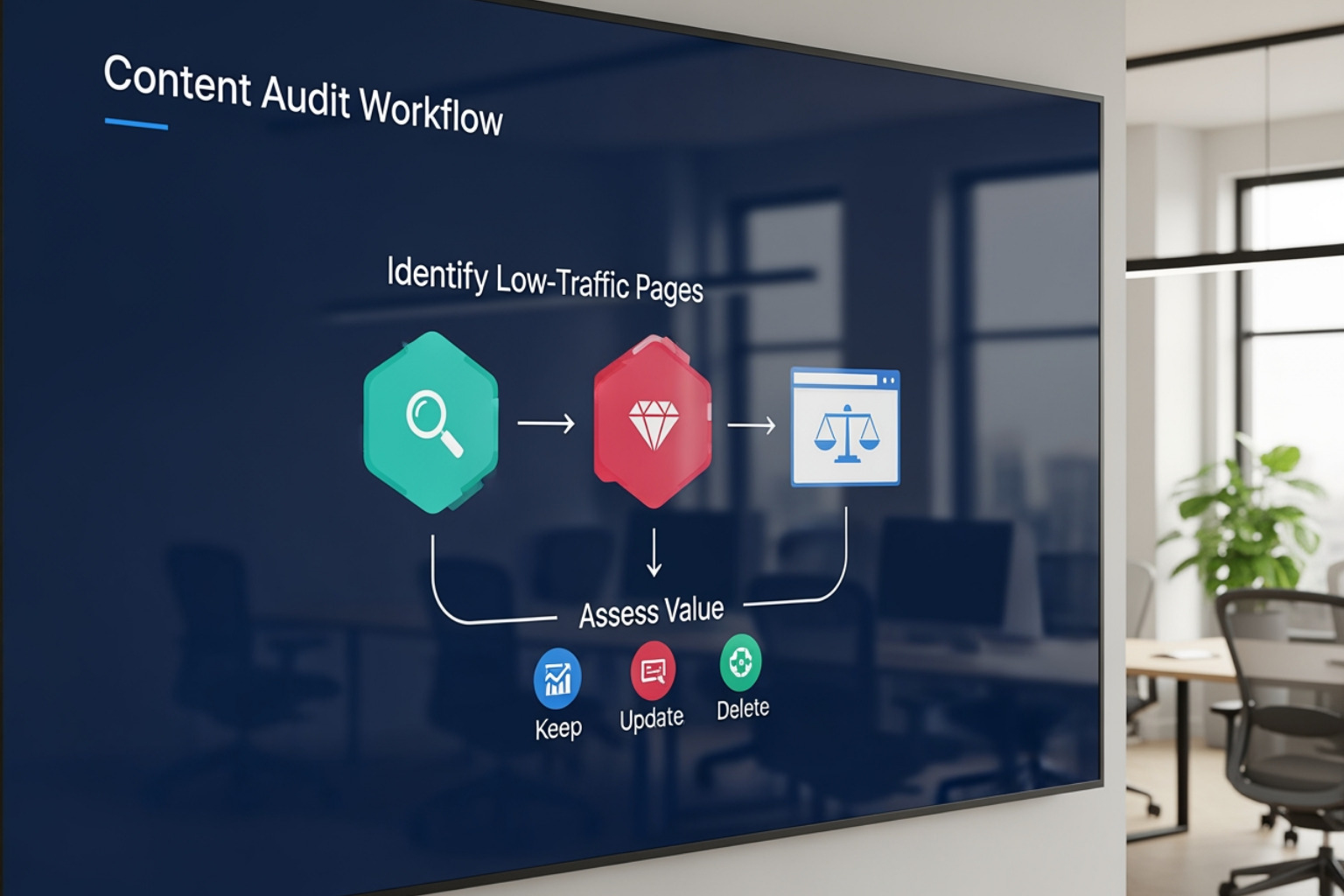
Using automated-seo-solutions can help identify these low-value pages quickly, allowing your team to focus on high-level strategy.
Leveraging AI and Internal Search Data for 2025
The future of iterative SEO is heavily influenced by Artificial Intelligence. An AI-first SEO approach focuses on how Large Language Models (LLMs) and AI Overviews summarize information. To stay ahead, businesses should:
- Address Customer Hesitations: Analyze internal site search data. If people are searching “is [Product] safe for kids?” and you don’t have a page answering that, you are losing sales. One page addressing a specific customer hesitation once converted 4 buyers from just 18 visitors—a massive ROI.
- Embed FAQs: Use FAQ-style content on core service pages. This helps AI engines “clip” your content for featured snippets.
- Utilize AI for Structure: While AI shouldn’t write your entire blog, it is excellent at identifying automated-seo-services like schema markup generation and content outlining.
Following a modern AI SEO Strategy Framework ensures your site is ready for the “recommendation engines” of 2025 and beyond.
Structuring Agile Iterations for Technical SEO Success
Technical SEO often requires help from developers. To prevent SEO tasks from getting buried in the dev backlog, use an agile “sprint” structure. Instead of sending a 50-page audit, slice the work into small, actionable tickets.
Sample Agile SEO Sprint Tasks:
- Week 1-2: Fix 404 errors and broken internal links.
- Week 3-4: Optimize Core Web Vitals (LCP and CLS) for top-performing mobile pages.
- Week 5-6: Implement Schema markup for all product or service pages.
This release cadence ensures steady progress. For example, one iterative migration to a modern framework like Next.js resulted in a 100% improvement in “Good URLs” in GSC after just 25 days.
Frequently Asked Questions about Iterative SEO
How often should I perform SEO optimizations to stay competitive?
For most businesses, a bi-weekly or monthly update cycle is ideal. While massive changes aren’t always necessary, micro-adjustments—like updating a date on evergreen content or adding a new internal link—signal to Google that the site is active and maintained. Monitoring for algorithm updates should happen weekly, while deep-dive audits can occur quarterly.
What are the most common mistakes to avoid in an iterative approach?
The biggest pitfall is creating “disconnected clusters”—publishing content that doesn’t link back to a main goal. Another mistake is ignoring comparisons; if your competitors are all using video or calculators on their pages and you aren’t, no amount of keyword tweaking will save your rankings. Finally, avoid “over-automation.” While tools are helpful, the “Helpful Content” era of Google requires a human touch for E-E-A-T (Experience, Expertise, Authoritativeness, and Trustworthiness).
How does user intent analysis inform content refreshes?
User intent analysis is the process of asking, “What does the searcher actually want?” If a page has high impressions but a high bounce rate, the content likely doesn’t match the intent. You might need to change the layout (e.g., moving a CTA higher) or the format (e.g., turning a long block of text into a bulleted list). Refreshing content to align with shifting intent is the “watering” part of the SEO garden.
Conclusion
The journey to the top of the search results isn’t a sprint; it’s a series of well-planned steps. By embracing iterative SEO strategy improvements, your business moves away from the “hope and pray” method of marketing and toward a sustainable, data-driven growth model.
At MDM Marketing, we specialize in this continuous refinement process. Our methodology combines deep discovery with precise implementation across all channels—from Local SEO and link building to AI-integrated content strategies. With a 93% client retention rate and an average 280% ROI increase, we focus on measurable outcomes that help brands in Canton, OH, and beyond transform their online presence.
Stop treating your SEO like a one-time project. Start treating it like the growth engine it is.
Ready to see what iterative growth looks like for your business? Contact MDM Marketing today to schedule your custom strategy session and start your journey toward sustainable organic traffic.
About Jay McCullough
This author hasn't written a bio yet.