
Why Measuring Content Marketing ROI Matters
A content marketing roi calculator helps you determine whether your content investments are paying off. Here’s what you need to know:
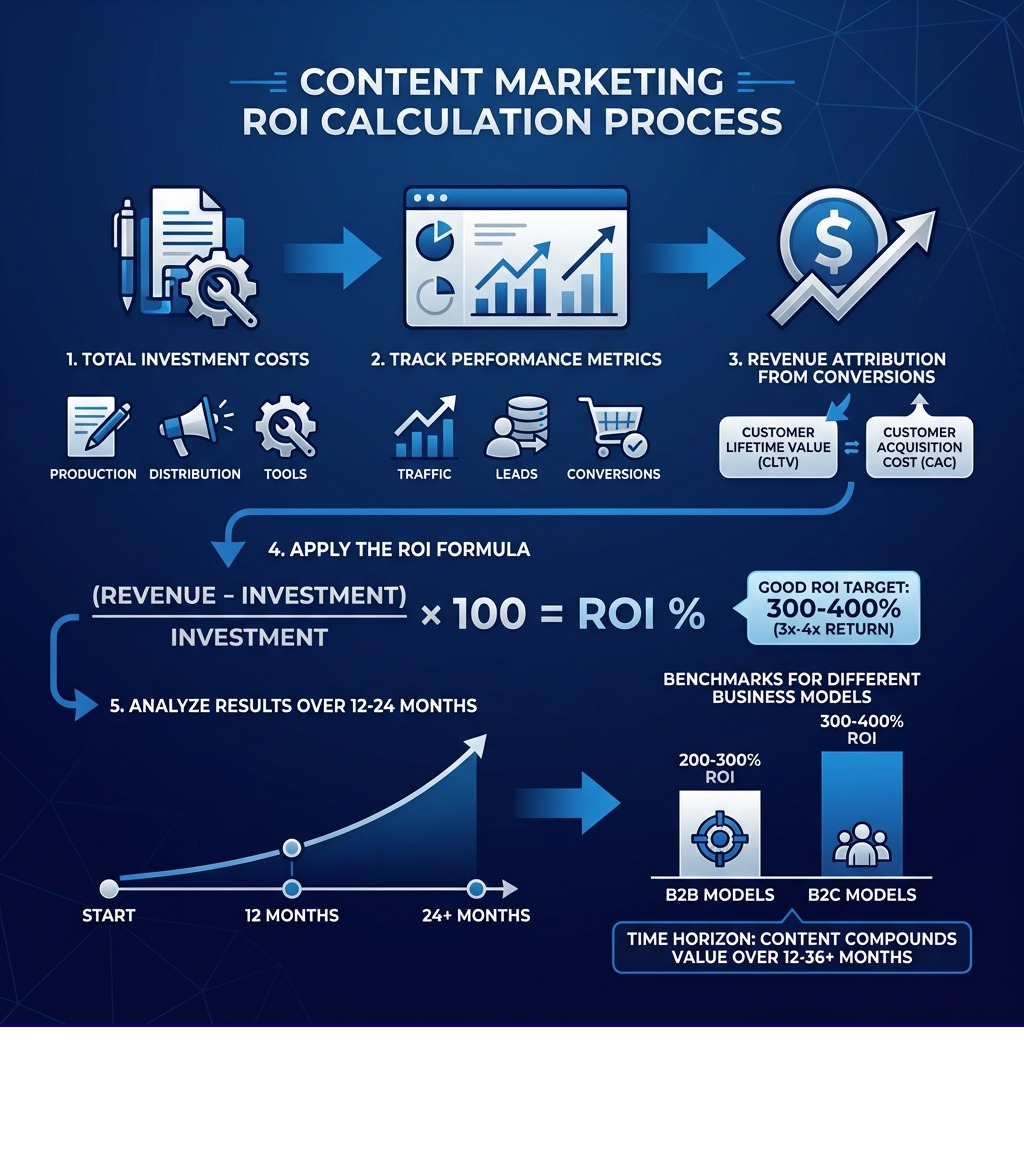
Key Components of Content Marketing ROI:
- Formula: (Revenue – Investment) / Investment × 100
- Good ROI Target: 300-400% (3x-4x return)
- Essential Metrics: Traffic, leads, conversions, Customer Lifetime Value (CLTV), Customer Acquisition Cost (CAC)
- Time Horizon: Content compounds value over 12-36+ months
Only around 41% of marketers are confident their content marketing efforts produce positive ROI. That’s a problem when 88.2% of teams are increasing or maintaining their content budgets, with some investing over $45,000 per month.
Here’s the reality: content marketing builds equity rather than just renting traffic like paid ads do. A well-optimized blog post can generate leads for years, not just days. But without measuring returns, you’re flying blind.
The content marketing industry is expected to grow by more than $417 billion between 2021 and 2025. Companies using content marketing generate 3X the leads per marketing dollar compared to traditional methods. Yet 21% of content marketers say measuring ROI is their biggest challenge, and 66.5% aren’t confident about where to allocate resources.
That’s where a content marketing ROI calculator becomes essential. It transforms vague metrics like “traffic” and “engagement” into concrete financial outcomes. You can finally answer questions like: Should we hire another writer? Is SEO worth the investment? Which content types drive actual revenue?
Unlike paid advertising with direct click-to-conversion tracking, content marketing creates a snowball effect. Multiple pieces of content often contribute to a single conversion. A prospect might discover your blog post through organic search, download a whitepaper, read several more articles, and then convert weeks later. Traditional attribution fails here.
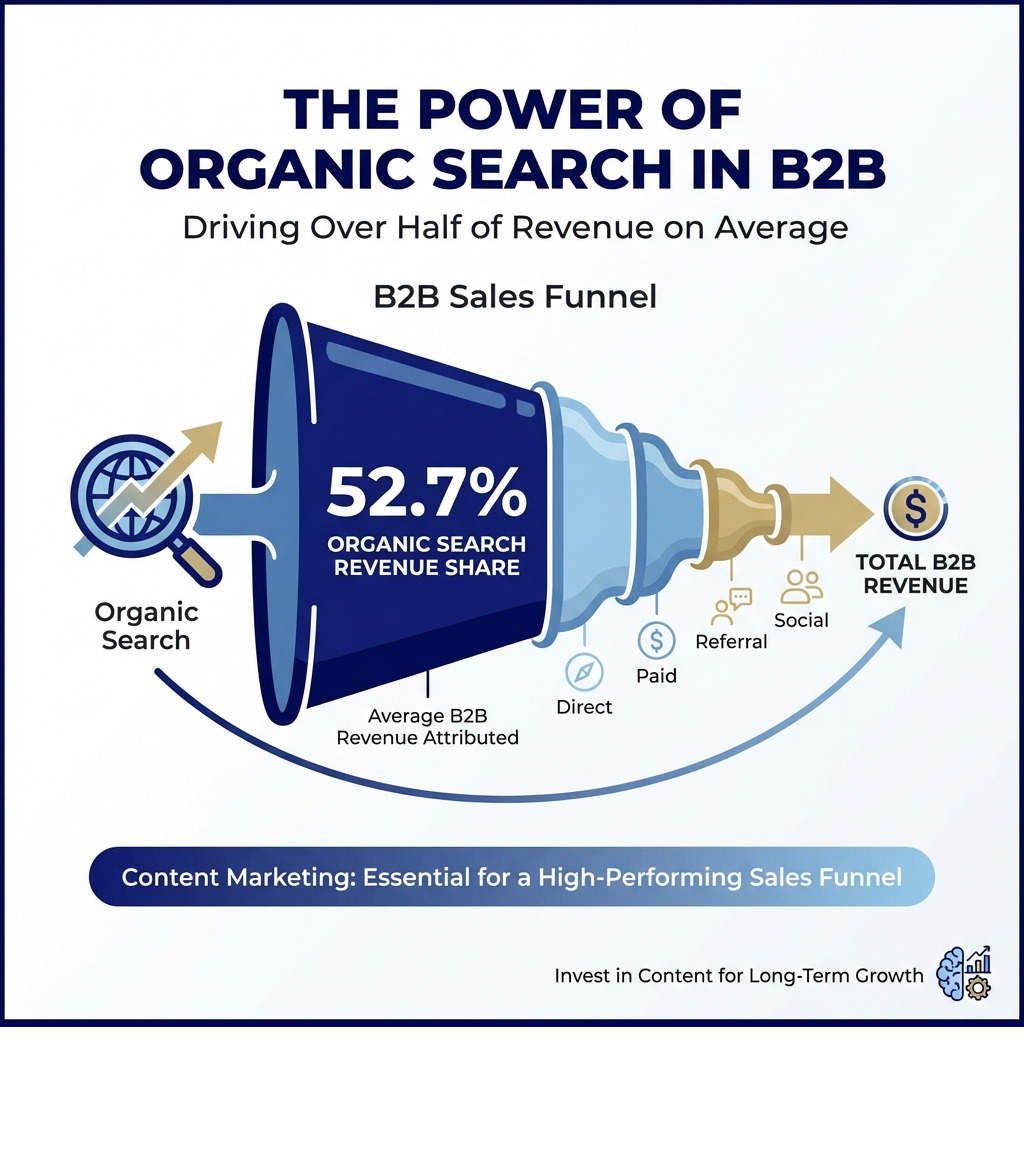
The good news? With the right approach, content marketing delivers some of the highest ROI of any marketing channel. Organic search alone accounts for about 52.7% of B2B revenue on average. Companies that measure and optimize their content ROI see compounding returns as their content library grows and matures.
Understanding the Content Marketing ROI Formula
To get the most out of a content marketing roi calculator, one must understand the math behind the curtain. At its simplest level, ROI is the net profit divided by the total investment.
The Formula:
((Total Revenue from Content - Total Content Cost) / Total Content Cost) x 100 = ROI %
For example, if a company spends $10,000 on a series of whitepapers and blog posts that directly result in $50,000 of new business, the calculation would be:
(($50,000 - $10,000) / $10,000) x 100 = 400% ROI
However, content marketing is rarely that linear. It involves both direct returns (sales you can track immediately) and indirect returns (long-term benefits that save money or build brand strength). Utilizing Data-Driven Marketing strategies allows businesses to look past surface-level “likes” and focus on these financial outcomes.
| Return Type | Description | Examples |
|---|---|---|
| Direct Returns | Revenue specifically attributed to a content piece. | E-commerce sales from a blog link, webinar sign-ups. |
| Indirect Returns | Value created that doesn’t show up as an immediate sale. | Brand awareness, reduced Customer Support costs, SEO equity. |
| Cost Savings | Content that replaces more expensive channels. | Organic traffic replacing expensive PPC keywords. |
| Lead Nurturing | Moving existing leads closer to a sale. | Email newsletters increasing the Close Rate of sales calls. |
Why You Need a Content Marketing ROI Calculator
Without a dedicated content marketing roi calculator, businesses often fall into the trap of “vanity metrics.” It’s easy to get excited about a post going viral, but if those 10,000 visitors don’t result in a single lead, the ROI is actually negative.
A calculator forces a team to be honest about resource management. It highlights where the budget is being wasted and where it should be doubled. For instance, if video content costs 10x more than written content but only produces 2x the leads, the calculator will show a lower ROI for video, prompting a shift in strategy. Professional SEO Copywriting Services often provide a higher ROI because they target high-intent keywords that convert at a better rate than general “viral” topics.
Benchmarking a Good ROI
What constitutes a “good” return? While any number above 0% means the business is breaking even, most experts suggest a target of 3:1 or 4:1 (300% to 400%).
According to the Cision Industry Growth Report, the industry is ballooning because content is consistently outperforming other channels when measured over a long enough time horizon. In B2B SaaS, for example, companies often spend $2.64 on marketing for every $1 of net new annual recurring revenue (ARR). While that sounds high, the high lifetime value of those customers makes the long-term ROI incredibly lucrative.
How to Use the Content Marketing ROI Calculator Step-by-Step

Using a content marketing roi calculator is straightforward once the data is organized. Most calculators require four or five key inputs to generate a projection. You can find a detailed Walkthrough of the ROI calculator to see this in action.
- Input Total Investment: Sum up all costs for the period (labor, tools, distribution).
- Input Traffic Data: How many visitors did the content attract?
- Input Conversion Rates: What percentage of those visitors became leads, and what percentage of leads became customers?
- Input Customer Value: What is the average sale price or the Customer Lifetime Value (CLTV)?
- Interpret Results: The calculator will output your ROI percentage, profit, and the “payback period” (how long it takes to recoup the initial spend).
Calculating Expenses for Your Content Marketing ROI Calculator
To get an accurate result, one must include all costs. A common mistake is only counting the invoice from a freelancer. To be precise, include:
- Production Costs: Fees for Website Content Contractors, internal staff salaries (pro-rated), and graphic design.
- Distribution Fees: Paid promotion, social media management tools, and email marketing software.
- Software Tools: Subscriptions for SEO tools, hosting, and analytics platforms.
- Overhead: A portion of the marketing manager’s time spent on strategy and editing.
Estimating Returns and Revenue
Determining the “Return” side of the equation is often the hardest part. Marketers should use a mix of CRM data and Google Analytics to track:
- Lead Value: If the average customer spends $1,000 and the sales team closes 10% of leads, every lead is worth $100.
- Sales Funnel Performance: Tracking the journey from a blog post to a demo request.
- Customer Lifetime Value (CLTV): Especially for subscription businesses, the value of a customer isn’t just the first check; it’s the total they pay over years.
By focusing on Results-Driven SEO, businesses can ensure that the traffic they are estimating is actually capable of converting into these high-value returns.
Key Metrics for Accurate ROI Measurement
To feed a content marketing roi calculator quality data, several Key Performance Indicators (KPIs) must be monitored.
1. Organic Traffic Growth
Between 2024 and 2025, 62.8% of marketers reported year-over-year traffic growth. Organic search is the foundation because it doesn’t require a “pay-to-play” fee for every click.
2. Customer Acquisition Cost (CAC)
This is the total cost of your content efforts divided by the number of new customers acquired. If a Performance Marketing Company helps you lower your CAC while maintaining volume, your ROI skyrockets.
3. Conversion Rate Optimization (CRO)
Even a small increase in conversion rate can double ROI without spending an extra penny on content creation. If a blog post has 1,000 visitors and a 1% conversion rate, it gets 10 leads. Bump that to 2%, and it gets 20 leads.
Tracking Long-Term Value and Evergreen Content
One of the most unique aspects of content is its “lifespan.” Unlike a TV ad that stops working the moment you stop paying, a “How-To” guide written three years ago can still be your #1 lead generator today.
When using a content marketing roi calculator, it is vital to set a “Time Horizon.” Many businesses use a 24-month or 36-month window to calculate the true value of evergreen content. Over time, the cost per lead (CPL) of evergreen content often drops to nearly zero as the initial production cost is spread over years of free traffic. This is why White Label Content Creation is such a popular choice for agencies; it allows for the rapid build-up of these long-term assets.
Business Model Variations
ROI looks different depending on how the business makes money:
- B2B SaaS: Focuses on monthly recurring revenue (MRR) and CAC payback periods.
- eCommerce: Focuses on Average Order Value (AOV) and immediate return on ad spend (ROAS).
- Ad-Based/Publishing: Focuses on traffic volume and “Value per 1,000 impressions” (RPM).
Effective Copywriting for Businesses must be tailored to these specific models to ensure the “returns” side of the calculator remains healthy.
Frequently Asked Questions about Content ROI
How can this tool help evaluate the effectiveness of content campaigns?
The content marketing roi calculator quantifies the financial impact, helping identify which topics or formats (like video vs. blogs) are actually driving profit rather than just “noise.”
Does the calculator account for both direct and indirect returns?
Yes. While direct sales are easier to track, a good calculator allows for the input of “lead value” to account for the indirect contribution of top-of-funnel content.
Can I compare organic vs. paid content?
Absolutely. By running the numbers separately, most marketers find that organic content has a higher long-term ROI because it builds equity, whereas paid ads stop the moment the budget runs out.
How do I track content conversions in Google Analytics?
Tracking conversions is the only way to prove content worth. In Google Analytics (GA4), one should set up “Key Events” for actions like form submissions or newsletter sign-ups.
A powerful trick is using the Reverse Goal Path report. This shows exactly which blog posts a user read right before they decided to buy. If a specific “zombie-themed” blog post (to use a creative example from our research) consistently appears in the path to a sale, that content is a high-ROI asset. Implementing Automated Content Marketing can help track these journeys more effectively by tagging users as they move through the funnel.
What are common mistakes in ROI calculation?
- Ignoring the “Snowball Effect”: Calculating ROI only 30 days after a post goes live. Content often takes 6-9 months to rank and reach its peak performance.
- Underestimating Internal Labor: Forgetting to count the hours the CEO spent editing or the social media manager spent promoting the piece.
- Focusing on Traffic Only: Traffic is a “vanity metric” if it doesn’t lead to a conversion. 100 qualified visitors are worth more than 10,000 random ones.
How does AI impact future traffic ROI?
The rise of AI Overviews and LLMs (Large Language Models) is changing the search landscape. Some reports suggest that clicks may decline as AI provides answers directly on the search results page.
However, this makes high-quality, human-led content more valuable. AI cannot provide original research, unique case studies, or deep expert opinions. While the Limitations of Automated SEO Content Optimization Tools are becoming clear, businesses that focus on “Helpful Content” will continue to see strong ROI, even if total traffic volumes fluctuate.
Conclusion
Measuring the success of a content strategy shouldn’t feel like guesswork. By using a content marketing roi calculator, businesses can move from “hoping it works” to “knowing it works.”
MDM Marketing, based in Canton, OH, specializes in this exact type of data-driven growth. With over 5 years of experience and an average 280% ROI increase for clients, the team understands that every blog post and social update must serve the bottom line. Whether it’s through Local SEO, high-end Content Marketing, or advanced Analytics, the goal is always sustainable, measurable growth.
Don’t let your content budget disappear into a black hole. Start tracking your costs, measuring your conversions, and refining your strategy based on hard numbers. If the math feels overwhelming, the experts at MDM Marketing are ready to help you transform your online presence into a high-performing revenue engine.
Ready to see what your content is truly worth? Contact MDM Marketing today to begin your journey toward data-backed profitability.
About Jay McCullough
This author hasn't written a bio yet.