
Is Your PPC Spend Actually Working? Here’s How to Find Out
A PPC campaign performance audit is a structured review of your paid advertising accounts — covering keywords, ad copy, bidding, targeting, and conversion tracking — to identify what’s wasting money and what’s driving real results.
Here’s what a PPC audit covers at a glance:
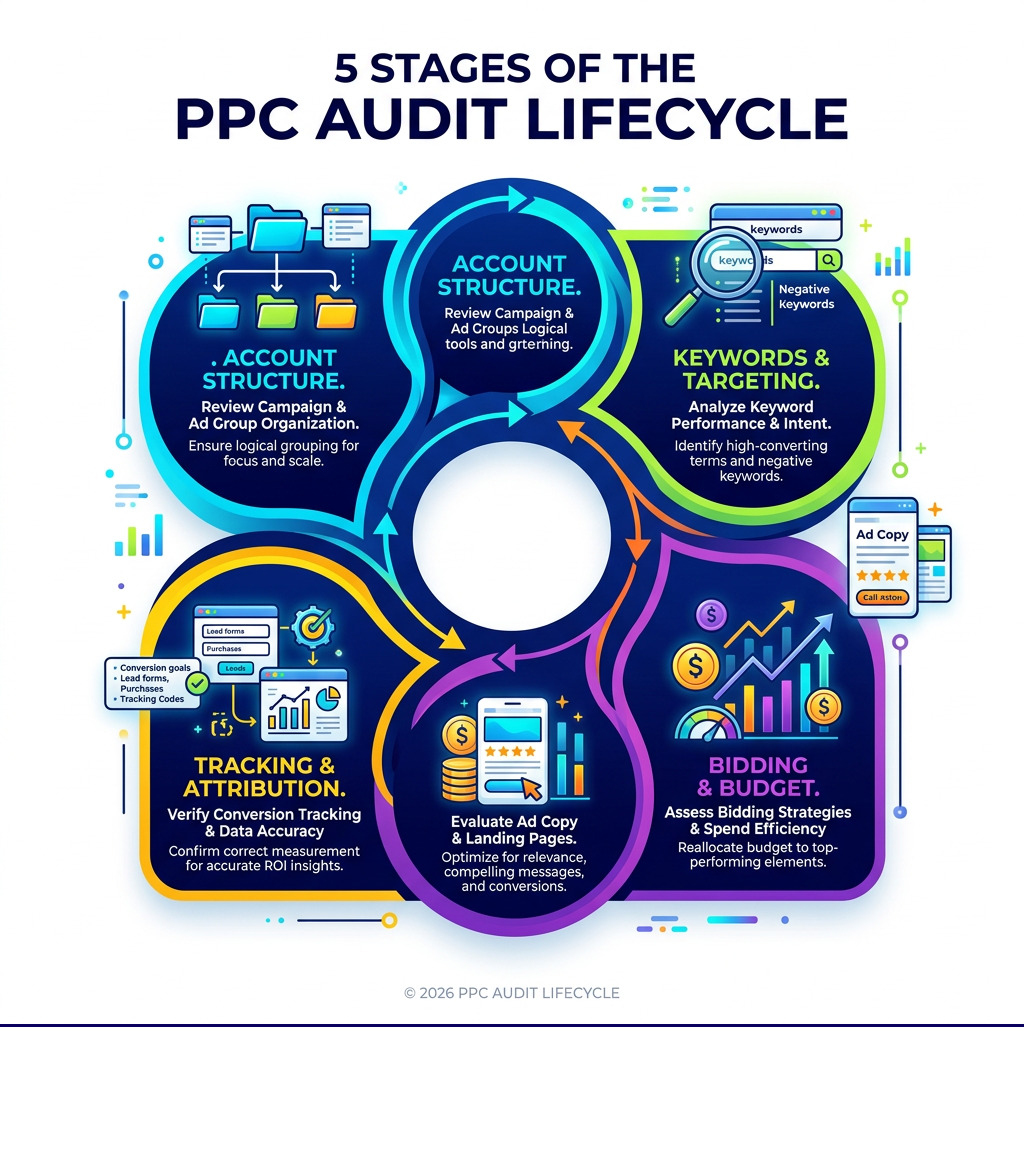
- Account structure — Are campaigns and ad groups organized logically?
- Keyword relevance — Are you bidding on terms that actually convert?
- Ad copy and landing pages — Does your message match what users expect?
- Bidding and budget — Is spend going to your best performers?
- Conversion tracking — Are you measuring the right things, accurately?
- Quality Score — Are relevance issues inflating your cost-per-click?
- Wasted spend — Are irrelevant queries silently burning your budget?
PPC performance doesn’t hinge on how much you spend. It hinges on how well that spend is analyzed, understood, and optimized over time.
Yet most businesses running paid search campaigns never do a formal audit. They set campaigns live, watch the dashboard, and assume the numbers tell the full story. They rarely do.
Research shows that 10–20% of total ad spend is commonly tied to irrelevant or low-intent search queries that slip past initial negative keyword filters. That’s a significant leak — and it’s just one of many that a proper audit can surface.
Whether you’re running Google Ads for a local service business, scaling e-commerce campaigns, or managing multi-channel spend as a B2B marketing leader, a systematic audit is the fastest way to stop guessing and start improving.
This guide walks you through exactly how to do it — without drowning in data.
Why a PPC Campaign Performance Audit is Essential for Growth
Pouring money into digital ads without a regular check-up is like navigating a maze blindfolded. You are definitely moving, but are you actually getting closer to the exit? For businesses in Canton, OH, and beyond, a PPC campaign performance audit is the only way to ensure your marketing dollars aren’t just disappearing into the digital void.
The primary goal of an audit is to stop losing a large amount of advertising budget on inefficiencies you might not even know exist. When you identify these leaks, you can perform a high-impact budget reallocation, moving funds from “zombie” keywords to the high-performers that actually ring the cash register.
Beyond just saving money, auditing is about improving the overall campaign ROI. By trimming the fat, you naturally increase the efficiency of every dollar spent. This leads to sustained success because your account becomes a finely tuned machine that adapts to market changes rather than being steamrolled by them. At MDM Marketing, we believe that mastering digital campaign planning starts with a clean foundation—you can’t build a skyscraper on quicksand.

Key Metrics to Track During Your PPC Campaign Performance Audit
To understand if your campaigns are healthy, you need to look at the right numbers. Looking at “Clicks” alone is a vanity exercise; you need to dig into the metrics that dictate profitability.
| Metric | Category | Why It Matters |
|---|---|---|
| CTR (Click-Through Rate) | Engagement | Tells you if your ad copy is actually relevant to the searcher. |
| CPC (Cost-Per-Click) | Efficiency | Determines how much you pay for every visitor. |
| Quality Score | Health | Google’s “grade” for your ad; higher scores mean lower costs. |
| Conversion Rate (CR) | Effectiveness | Measures how well your landing page turns visitors into leads. |
| ROAS | Profitability | The ultimate metric: how many dollars do you make for every $1 spent? |
CTRs and CRs can be checked to measure how effective your ads are at engaging users and converting them. If your CTR is high but your CR is low, you have a “broken promise” problem—your ad is great, but your landing page isn’t delivering what the user expected. This is why data-driven advertising for maximum ROI requires looking at the full funnel, not just the front end.
Understanding Quality Score and Ad Relevance
Quality Score is a diagnostic metric unique to Google Ads that impacts both your ad rank and your CPC. It is a combination of expected CTR, ad relevance, and landing page experience. Think of it as a discount code: if you have a Quality Score of 8, 9, or 10, Google rewards you with lower prices. If your score is 3 or 4, you’re paying a “tax” for being irrelevant.
Monitoring Google’s asset performance ratings is also crucial. It helps you catch declining CTR or conversion rates early by showing which specific headlines or images are resonating with your audience.
Analyzing Conversion Rate and ROAS
For service-based industries, such as PPC for plumbing companies, a lead isn’t just a number—it’s a potential customer with a specific lifetime value. Your audit must integrate platform data with backend CRM data. If Google says you got 50 leads but your CRM says only 5 were qualified, your campaign is targeting the wrong people. True ROAS analysis accounts for profit margins and the long-term value of a client, ensuring your spend is actually sustainable.
A Step-by-Step Framework for a PPC Campaign Performance Audit
Ready to roll up your sleeves? A successful PPC campaign performance audit follows a logical path from the “big picture” down to the tiny details. Before you change a single bid, you must check your tracking statuses in your Google Ads account. If your conversions aren’t being tracked correctly, your data is a lie, and your audit will be based on fiction.
For specialized fields like PPC marketing for contractors, tracking needs to be pinpoint accurate to account for phone calls, form fills, and even chat interactions. Once the tracking is verified, you can continuously optimize your PPC campaigns through a structured three-step process.
Step 1: Evaluating Account Structure and Settings
First, look at how your campaigns are organized. Are they grouped by product category, service type, or geography? A messy account structure makes it impossible to manage budgets effectively. Ensure your naming conventions are consistent and descriptive so anyone can look at the account and understand the strategy.
One pro tip: use observation mode (vs. targeting) to test new audience segments without limiting your reach. This allows you to see how different groups perform before you commit a specific budget to them. Finally, export your data into a spreadsheet to look for patterns that aren’t obvious in the standard dashboard view.
Step 2: Keyword Relevance and Negative Keyword Optimization
Keywords are the heart of your campaign, but they can also be the biggest source of waste. Use the search term report to see what people actually typed before clicking your ad. You will likely find “junk” searches—people looking for jobs, free tutorials, or unrelated products.
This is why you must keep your negative keyword list up-to-date to block those irrelevant queries. Use the Google Keyword Planner to find new, high-intent variations and ensure you aren’t over-relying on broad match keywords, which can be a primary cause of budget drain.
Step 3: Ad Copy and Landing Page Alignment
Your ad is a promise; your landing page is the fulfillment of that promise. If a homeowner is reading a roofing PPC guide and clicks an ad for “Emergency Roof Repair,” they should land on a page that immediately mentions emergency services—not a generic homepage.
Use tools like Microsoft Clarity to watch session recordings and see where users get stuck. Implementing A/B testing on PPC landing pages allows you to test different headlines and CTAs. With the help of Crazy Egg, you can use heatmaps to see exactly where people are clicking (or failing to click), allowing you to refine the user journey for maximum conversions.
Leveraging AI and Automation in PPC Analysis
The world of advertising is moving fast, and the future of AI-based advertising is already here. AI isn’t just about robots writing ads; it’s about processing massive amounts of data to find trends that a human would miss.
Automated bidding strategies like Target ROAS (tROAS) and Maximize Conversions are powerful, but they have a “learning phase.” Typically, these strategies require 30-50 conversions per month to work effectively. If your volume is lower than that, automation might actually hurt your performance. However, when used correctly, the best AI advertising campaigns can significantly outperform manual management by adjusting bids in real-time based on thousands of signals.
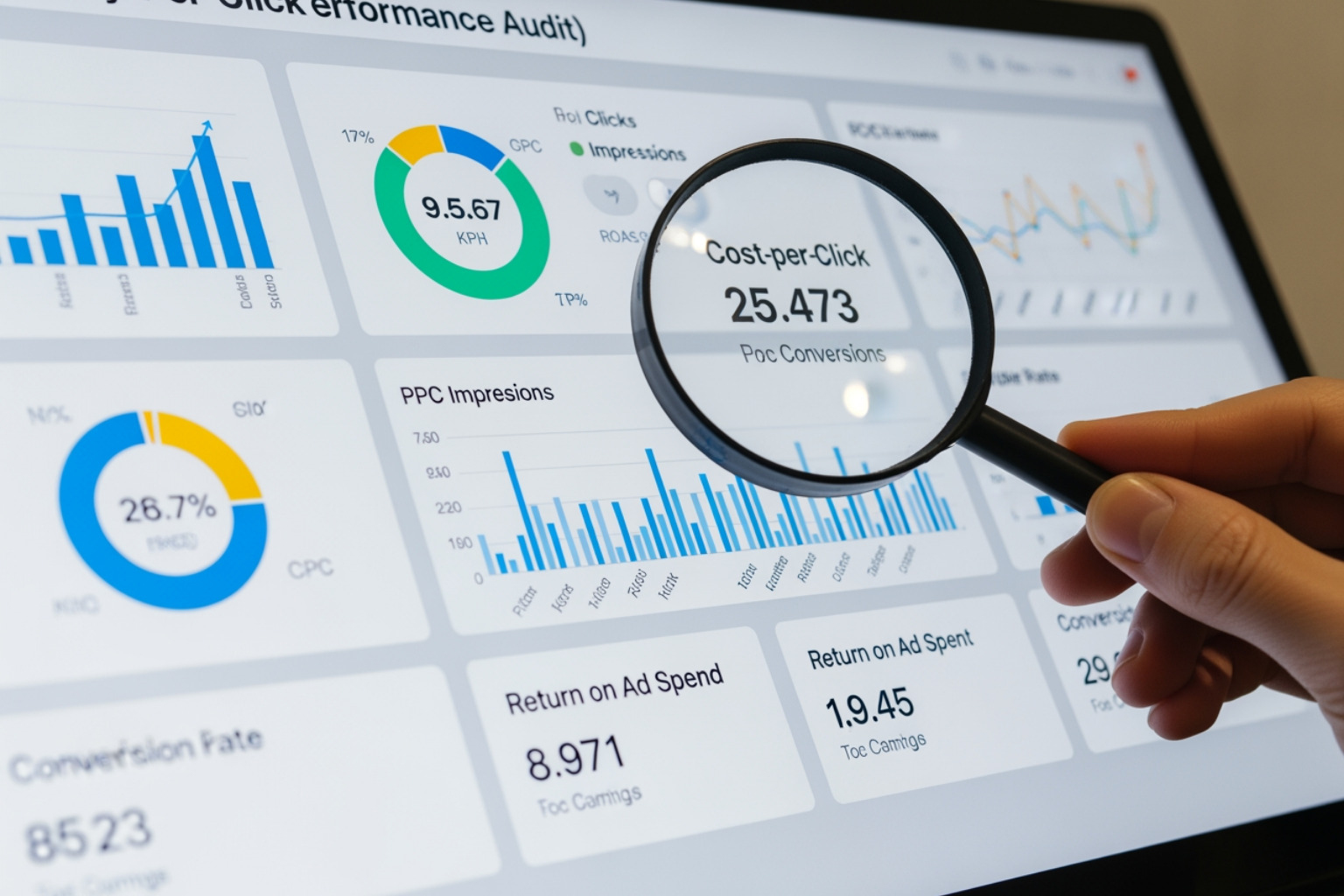
How to Use AI to Enhance Your PPC Campaign Performance Audit
AI-powered alerting systems can notify you the moment performance dips or spend spikes, allowing you to outsmart the competition by reacting faster. You can Sign Up for Free for tools that provide instant performance reports, highlighting exactly where your account is falling short. These tools often lead to a 30% increase in productivity for marketing teams by automating the boring stuff and letting humans focus on strategy.
Common Pitfalls and How to Avoid Them
Even the best marketers make mistakes. One of the most common is “creative fatigue”—when your ads have been running so long that the audience starts ignoring them. If you see your CTR dropping while your impressions stay the same, it’s time for fresh imagery and copy.
Another trap is over-relying on platform-reported conversions. Google often takes a lot of credit for sales that might have happened anyway. You also have to account for “conversion lag”—the time it takes for a user to click an ad and finally buy. Google can even adjust your costs for suspicious clicks up to 60 days after the fact, so your daily reports might shift over time.
If you are struggling to keep up, professional PPC services can provide the oversight needed to ensure automation doesn’t run unchecked.
Identifying Wasted Spend in Your PPC Campaign Performance Audit
Wasted spend often hides in “channel overlap,” where you are paying for the same user across multiple platforms, or “cannibalization,” where your paid ads are stealing clicks from your own organic search results. To stop the bleed, Get Instant Audit Report insights to see if your branded keywords are actually necessary or if you’re just paying for traffic you already owned.
Frequently Asked Questions about PPC Audits
How often should I conduct a PPC audit?
You should perform a deep-dive audit at least once every quarter. However, if you are in a highly competitive industry or have a large monthly spend, you will have to conduct more frequent audits—sometimes as often as once a month. Daily monitoring for major anomalies and weekly “quick win” checks should be part of your standard operating procedure.
What are the signs of an underperforming campaign?
The biggest red flags are a rising CPC combined with a falling Quality Score. If your ROAS is consistently declining while your bounce rates are climbing, it’s a clear signal that your targeting or landing page experience is broken. Budget pacing issues—where you run out of money by noon or fail to spend your daily limit—also indicate that your settings need a major overhaul.
What tools are best for PPC data analysis?
While Google Ads provides great native data, third-party tools can offer deeper insights. SEMrush is excellent for competitor benchmarking, while WordStream offers an easy-to-understand “performance grader.” For advanced automation and auditing, Optymzr and Adalysis are industry favorites that help you find hidden issues in seconds.
Conclusion
A PPC campaign performance audit isn’t just a “one and done” task; it’s a commitment to data-driven growth. By systematically reviewing your account structure, keywords, and creative assets, you can transform a struggling campaign into a high-ROI engine for your business.
At MDM Marketing, we specialize in helping businesses in Canton, OH, and beyond achieve measurable outcomes through transparent reporting and iterative improvement. Whether you need help scaling your paid acquisition or strengthening your organic presence through our SEO services, our team is here to help you navigate the complexities of digital marketing.
Don’t let your budget go to waste. Contact us for a strategy session today and let’s turn your PPC data into a blueprint for success.
About Jay McCullough
This author hasn't written a bio yet.