
Why Data-Driven Content Strategy Is Essential for Modern Marketing
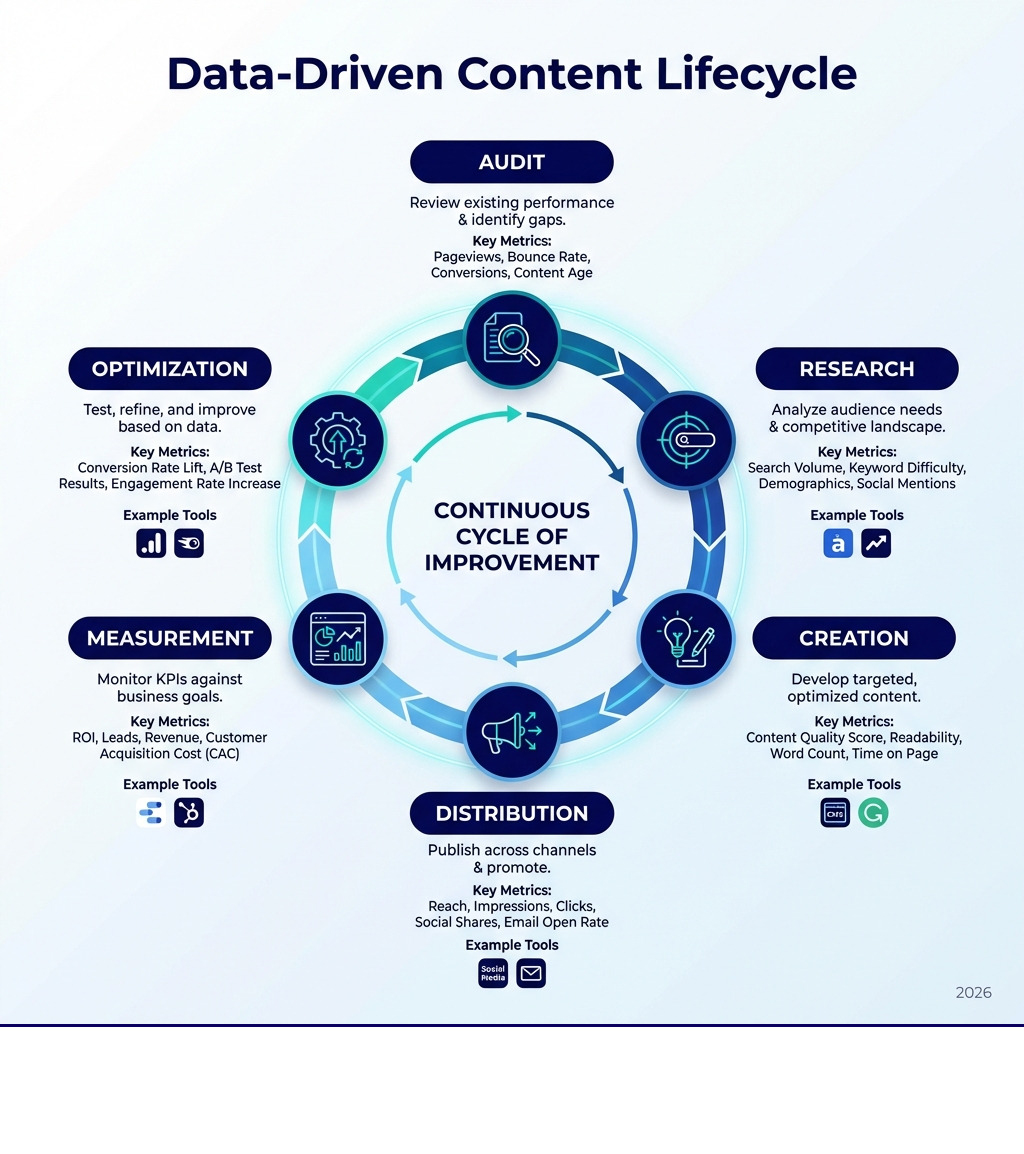
A data-driven content strategy uses audience behavior and analytics to guide every decision, from topic selection to distribution. Instead of guesswork, you use search trends and conversion data to inform what you create and how you optimize it.
Key components include:
- Content audits – Reviewing performance metrics like pageviews and conversions
- Audience research – Analyzing demographics and search intent
- Competitive analysis – Identifying market gaps
- Topic clustering – Building authority through pillar pages
- Performance tracking – Monitoring KPIs tied to business goals
- Continuous optimization – Refining content based on data
Internet users spend nearly six hours and 40 minutes online daily, yet 65 percent of marketers struggle to prove their impact. With content volume growing by 3,000% annually, you have only 10 seconds to persuade visitors to stay.
A data-driven approach helps you identify high-ROI topics and formats. For small and mid-sized businesses, this levels the playing field against enterprise brands. This guide provides 10 essential tips to turn analytics into measurable growth.
Why Your Business Needs a Data Driven Content Strategy

In a digital landscape where content grows by 3,000% annually, intuition isn’t enough. Businesses in Canton, OH, need precision to capture attention. A data-driven content strategy ensures your assets speak directly to audience needs.
With 65 percent of marketers unable to demonstrate ROI, data provides the clarity needed to secure budgets. Given that users spend six hours and 40 minutes online daily, data helps you identify where to be present. Benefits include:
- Higher ROI: Aligning content with intent improves Data-Driven Marketing results.
- Resource Efficiency: Data reveals what works, preventing wasted effort.
- Competitive Edge: Identifying gaps helps you differentiate your brand, essential for Mastering Effective Web Marketing Strategies for Modern Needs.
- Agility: Real-time performance data allows for continuous optimization.
10 Essential Tips for Implementation

Implementation requires blending analytical rigor with creative execution. Focus on business-impact KPIs rather than vanity metrics.
| Vanity Metrics (Avoid) | Business-Impact KPIs (Focus On) |
|---|---|
| Page Views | Conversion Rate (leads, sales) |
| Social Likes | Customer Lifetime Value (CLV) |
| Bounce Rate | Revenue Influenced |
| Keyword Rankings | Organic Traffic (intent-driven) |
| Email Open Rates | ROI of content efforts |
Essential Tools:
- Analytics: Web analytics and data tracking platforms
- SEO: Keyword research and search performance tools
- CRM: Customer relationship management software
- Social: Social media monitoring and engagement tools
- Collaboration: Team communication and project management platforms
1. Building Your Data Driven Content Strategy Through Audits
A content audit is your foundation. Export indexed pages from search console tools and combine them with analytics data (conversions, bounce rates) to perform a RAG analysis:
- Green: High-performing content. Double down on these.
- Amber: Underperforming content with potential. Optimize these for better rankings.
- Red: Outdated or redundant content. Delete or consolidate these.
Audits help you identify missing “connective tissue” and jargon that confuses visitors. You have only 10 seconds to persuade users; redundant content drives them away. MDM Marketing provides SEO Copywriting Services and Website Content Contractors to ensure your assets are engaging and effective.
2. Optimizing for Visibility in a Data Driven Content Strategy
Search is evolving. With Google’s AI Overviews, users often get answers without clicking. Your data-driven content strategy must pivot to “AI visibility.”
- Topic Authority: AI evaluates semantic relevance and entity relationships. Demonstrate deep expertise across topic clusters.
- AIO Ownership: Aim to be the source for AI summaries by providing structured, original insights.
- Human-AI Collaboration: Use AI for research, but ensure human experts infuse the content with brand voice.
- AI-driven personalization: Anticipate user needs to deliver proactive value.
MDM Marketing offers Automated Content Marketing and Results-Driven SEO to optimize for both traditional search and the AI landscape.
3. Deep Audience Segmentation and Intent Mapping
Effective strategies go beyond basic demographics. Use deep segmentation to understand motivations:
- Firmographics: Industry and company size (e.g., targeting developers in Canton, OH).
- Psychographics: Values, interests, and pain points.
- Behavioral Data: Website interactions and download history.
- Search Intent: Distinguishing between informational, commercial, and transactional queries.
Gather this data via web analytics, CRM systems, and social listening on platforms like Reddit. Tailoring content to specific segments leads to higher engagement. MDM Marketing’s Local SEO Marketing Services and Conversion Rate Optimization SEO help you connect with and convert your local audience.
4. Prioritizing Core Content and Pillar Pages
Pillar pages are comprehensive guides that establish authority and serve as hubs for related topics. They are essential for:
- Topical Authority: Signaling expertise to search engines through deep coverage.
- User Experience: Providing all necessary information in one place to reduce bounce rates.
- Internal Linking: Strengthening site structure by linking to cluster content.
For example, a firm using an SEO for Construction Guide might create a pillar page on “Construction SEO” with cluster articles on local tactics. MDM Marketing’s White Label Content Creation ensures your pillar pages are expertly crafted to meet user and search engine needs.
5. Aligning with Sales and Customer Success
Your sales and customer success teams provide real-world data that dashboards miss. Leverage their insights on:
- Common Objections: Create content that addresses hesitations before the sales call.
- Customer Pain Points: Develop tutorials that solve post-purchase challenges to improve retention.
- Usage Patterns: Highlight features that customers love or find confusing.
Establishing feedback loops ensures your content generates qualified leads. As a Performance Marketing Company, MDM Marketing integrates insights across departments to deliver Business Scaling Solutions that drive growth.
6. Leveraging AI and Automation for Insights
AI and automation amplify your ability to extract insights from massive datasets:
- Predictive Analytics: Forecast trends to address emerging topics early.
- Content Intelligence: Identify gaps and suggest optimal distribution channels.
- Automated Keyword Research: Uncover high-value long-tail opportunities quickly.
- Efficiency: Use AI for drafting and research, allowing humans to focus on creativity.
AI should be a co-pilot, not an autopilot. MDM Marketing provides Automated SEO Solutions that integrate AI to streamline processes while maintaining human quality.
7. Diversifying Content Formats Across the Journey
Audiences consume information differently. Use diverse formats to engage them at every stage:
- Long-form Articles: Best for awareness, such as SEO for Homebuilders.
- Video: Ideal for tutorials and social media storytelling.
- Podcasts: Great for on-the-go consumption and thought leadership.
- Interactive Tools: Quizzes and calculators generate valuable first-party data.
- Case Studies: Provide critical social proof during the decision stage.
Use social media management tools to distribute these formats efficiently based on where your audience is most active.
8. Implementing Multi-Touch Attribution
Customers often interact with multiple pieces of content before converting. Multi-touch attribution assigns value to every touchpoints in the journey. Models include:
- Linear: Equal credit to all interactions.
- Time Decay: More credit to interactions closer to conversion.
- U-Shaped: Focuses on the first and last touchpoints.
Implementation requires CRM integration and consistent UTM tagging. This provides a clear picture of revenue influence. MDM Marketing’s White Label SEO Reports incorporate these models to show the true ROI of your content.
9. Conducting Regular A/B Testing
A/B testing removes guesswork by comparing two versions of content to see which performs better. Key elements to test include:
- Headlines: Impact on click-through rates.
- CTAs: Wording and placement (e.g., “Learn More” vs. “Get Started”).
- Layout: Readability and image placement.
- Formats: Comparing video vs. text engagement.
Continuous optimization is vital for effectiveness. Beyond content, ensure your site is technically sound. MDM Marketing helps Improve Page Speed and maintain a Mobile-Friendly Website to support your testing efforts.
10. Maintaining a Consistent Publishing Cadence
Consistency builds authority and signals to search engines that your site is active. Industry benchmarks suggest publishing 5-10 articles per month for optimal ROI.
Consistency supports:
- SEO: Regular updates keep your site relevant for target keywords.
- Engagement: Keeps your audience returning and builds loyalty.
- Authority: Establishes your brand as a thought leader.
For local brands, this strengthens your Local SEO for Small Businesses. MDM Marketing acts as an Online Presence Manager to ensure your cadence remains steady.
Overcoming Common Challenges in Data-Driven Marketing

- Data Silos: Disconnected systems hinder a unified view. Solution: Integrate your tech stack with a CRM or CDP.
- Skill Gaps: Teams may struggle to interpret data. Solution: Use intuitive dashboards and provide data literacy training.
- Proving ROI: Vanity metrics mask true impact. Solution: Align KPIs with business goals and use multi-touch attribution.
- Data privacy concerns: Regulations like GDPR require transparency. Solution: Use privacy-first tools and clear data policies.
- Buy-in: Executives may resist new methods. Solution: Start with small pilot projects that show tangible ROI.
Addressing these ensures your Strategic Marketing Services Visibility remains high.
Measuring Success and Proving ROI

Shift from vanity metrics to business-impact KPIs:
- Conversion Percentages: Tracking lead form completions and purchases.
- Customer Retention: Measuring how content influences repeat business and CLV.
- Revenue Influenced: Attributing sales pipeline to specific content touchpoints.
- Qualified Leads: Counting MQLs and SQLs generated.
- AI Visibility: Tracking brand references in AI Overviews.
Use a White Label SEO Dashboard to visualize these metrics. This transparency justifies your efforts and secures investment for a continued Online Visibility Boost.
Frequently Asked Questions about Data-Driven Content
What is the difference between data-driven and traditional content marketing?
Traditional marketing relies on intuition and best practices. A data-driven content strategy uses measurable data—analytics, search trends, and user behavior—to inform every decision, ensuring content is relevant and tied to business goals.
How do I identify my target audience using data?
Combine demographics (age, location), firmographics (industry), and psychographics (interests). Analyze behavioral data from Google Analytics and search intent from keyword tools to create detailed buyer personas.
What are the most important metrics for a data-driven strategy?
Focus on conversion rates, Customer Lifetime Value (CLV), revenue influenced, and qualified lead generation. These metrics prove the tangible impact of content on the bottom line.
Conclusion
A data-driven content strategy is the compass for modern digital success. By embracing analytics, businesses in Canton, OH, and beyond can move from guesswork to precision, building a content ecosystem that drives growth.
MDM Marketing specializes in turning complex data into actionable strategies. With a 93% client retention rate and an average 280% ROI increase, we help our partners achieve measurable outcomes through SEO, content, and social media marketing.
Ready to grow? Contact us for a custom strategy custom to your needs. View our SEO services to see how we can boost your authority and visibility.
About Jay McCullough
This author hasn't written a bio yet.